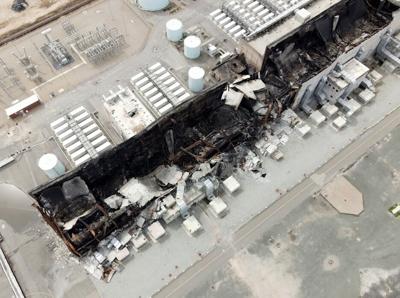

Every week, an average of five to six truckloads of de-energized battery modules leave Vistra’s battery energy storage site in Moss Landing for recycling. Each truckload carries about 192 modules on 24 pallets, according to Monterey County Department of Emergency Management Director Kelsey Scanlon.
At the Monterey County Board of Supervisors meeting on Tuesday, Jan. 6, Scanlon delivered the first update of the new year on the battery plant cleanup, nearly a year after the plant went ablaze and sent the community into a frenzy. The battery removal process officially began on Sept. 29, 2025, according to the U.S Environmental Protection Agency’s webpage dedicated to cleanup updates.
Many residents still have questions, particularly concerns about the range of the fallout of the heavy metal contamination, testing methodology, and whether or not local farms and farmers have been affected.
Scanlon did not answer those questions at Tuesday’s meeting, but provided a high-level overview of what is happening now.
Approximately 34 percent of the batteries—about 12,000 of a total of 35,772—have been de-energized and transported off site for recycling. About 55 percent of the batteries were damaged by the fire. Scanlon said operations have been running for 24 hours a day, excluding Sundays, despite the rain, and that there have been no flare-ups during the battery removal work.
Because of the rain, water-management protocols have been established. Water collected on-site is tested for contamination before disposal, in accordance with California State Water Resources Control Board requirements. Tents have been installed to prevent re-ignition under wet conditions.
“The U.S. EPA has protocols in place for Vistra to test the water captured on site near the Moss 300 building and check for any elevated levels for contamination before the water is properly disposed of,” Scanlon said.
After battery removal is complete, Phase 2 is expected to begin in mid-2026. That phase includes demolition of the Moss Landing building, removal of severely burned sections down to the concrete foundation, and off-site disposal of burned and damaged materials. The structure will also be sampled for waste characterization before disposal.
Agencies involved in the cleanup include the U.S. Environmental Protection Agency, which oversees the work at the site; the U.S. Coast Guard Pacific Strike Team, which assists with federal oversight; Vistra, the site owner; and the California Department of Toxic Substances Control, which oversees sampling related to human and ecological risk.
Separately, Vistra’s consultant, Terraphase Engineering Inc., has shared results from Phase 2 of sediment, surface water and pore water (the water naturally present in the soil) sampling.
Sampling was conducted Sept. 10-12, 2025, at five locations near the Moss Landing power plant. Samples were analyzed for metals associated with the battery modules used by Vistra, as well as lead, pH, polycyclic aromatic hydrocarbons (PAHs), dioxins and furans.
The consultants, working with several state agency partners to assist with data interpretation, concluded that samples from all areas were protective of human health and ecological receptors. In areas where metals exceeded ecological screening levels, they found concentrations consistent with natural background conditions in the marsh rather than fire-related contamination.
“Based on the reported data, DTSC concluded that chronic human health risks at the sampled locations are not expected,” Scanlon said. The Environmental Health Bureau posted the results from Phase 2 sampling on Jan. 7.
A preliminary environmental assessment report prepared by Vistra’s consultant evaluating Phase 1 and Phase 2 data is expected to be delivered in March.
On March 17, a panel of state agency partners is scheduled to participate in a Board of Supervisors meeting to respond to questions related to the sampling. The panel will include toxicologists from DTSC’s Human and Ecological Risk Office, DTSC’s Ecological Risk Assessment unit, and the California Office of Environmental Health Hazard Assessment.


(0) comments
Welcome to the discussion.
Log In
Keep it Clean. Please avoid obscene, vulgar, lewd, racist or sexually-oriented language.
PLEASE TURN OFF YOUR CAPS LOCK.
Don't Threaten. Threats of harming another person will not be tolerated.
Be Truthful. Don't knowingly lie about anyone or anything.
Be Nice. No racism, sexism or any sort of -ism that is degrading to another person.
Be Proactive. Use the 'Report' link on each comment to let us know of abusive posts.
Share with Us. We'd love to hear eyewitness accounts, the history behind an article.