


Just before 5pm on April 19, 2019, an alarm was triggered by smoke at a small battery energy storage facility in Surprise, Arizona. Firefighters responded to the scene after a call came over dispatch at 5:42pm reporting smoke near a major highway.
The firefighters were expecting a brushfire, but once it became clear they were dealing with a lithium-ion battery storage facility, the captain called in a team of firefighters trained and equipped to respond to hazardous materials.
After arriving on the scene and gathering information, the four-member hazmat team donned their turnout gear at about 6:37pm. Low-lying smoke was emanating from the facility, and the team’s equipment registered toxic gases in the vapor. After waiting it out for about 80 minutes, the gases decreased to a safe enough threshold, and the team approached the building. At around 8:01pm, they opened a door, unaware the facility lacked adequate ventilation.
The inrush of oxygen created a backdraft, and as the team stood outside the door measuring gases and sizing things up, the gases ignited just before 8:04pm, causing an explosion that shot out the door about 75 feet horizontally and 20 feet vertically. All four firefighters were blown back and knocked unconscious – the team’s captain, who was standing in the doorway, was launched 73 feet, landing under a bush. The four were quickly transported to a hospital, two by helicopter.
ABOUT THREE WEEKS LATER AND 700 MILES AWAY, the Monterey County Planning Commission, on May 8, considered approving a project unlike anything ever seen in the county, or anywhere: The project would amend the Moss Landing Power Plant Master Plan to include the use of renewable energy storage, and Vistra, a Texas-based energy company that acquired the property in 2018 when it merged with Dynegy, would reuse an old turbine building to establish a 300-megawatt Battery Energy Storage System, aka BESS.
Though it wasn’t highlighted at the time, it would be the biggest BESS in the world, all under one roof.
By the time the project came before the commissioners around 11:30am, they had just spent over 90 minutes discussing a second cannabis dispensary in unincorporated Carmel. The commissioners had already been acquainted with Vistra’s project when it was first presented to them in March, but they had decided to delay voting on it until concerns from the California Department of Fish and Wildlife could be addressed.
Rehashing the project took just a few minutes – energy comes off the grid and is stored in racks of batteries inside the 96,411-square-foot building, and when needed, is sent back out to the grid to supply energy.
There was no comment from the public outside of previous letters from CDFW and Caltrans, nor was there discussion among commissioners. If anyone in the room was aware of the explosion in Surprise, Arizona, they didn’t mention it.
This despite that, the environmental documents the commissioners were being asked to approve included a section reading, in part: “With any battery storage system, there is a risk of fire resulting from overheating or electrically faulty conditions in the battery energy storage… A range of active fire protection features would be installed in the battery storage building in the unlikely event that the passive source features were to fail.”
Seemingly surprised at the lack of discussion, Chair Paul Getzelman turned to Commissioner Martha Diehl, who had been vocal in the March meeting in support of the project’s renewable energy goals.
“Commissioner Diehl, do you have thoughts?” Getzelman said. “You always have thoughts… no?”
“Look at me not having any thoughts,” Diehl said.
“Can we get that on the record?” Getzelman said, as he turned to county staff. “I guess we just did.”
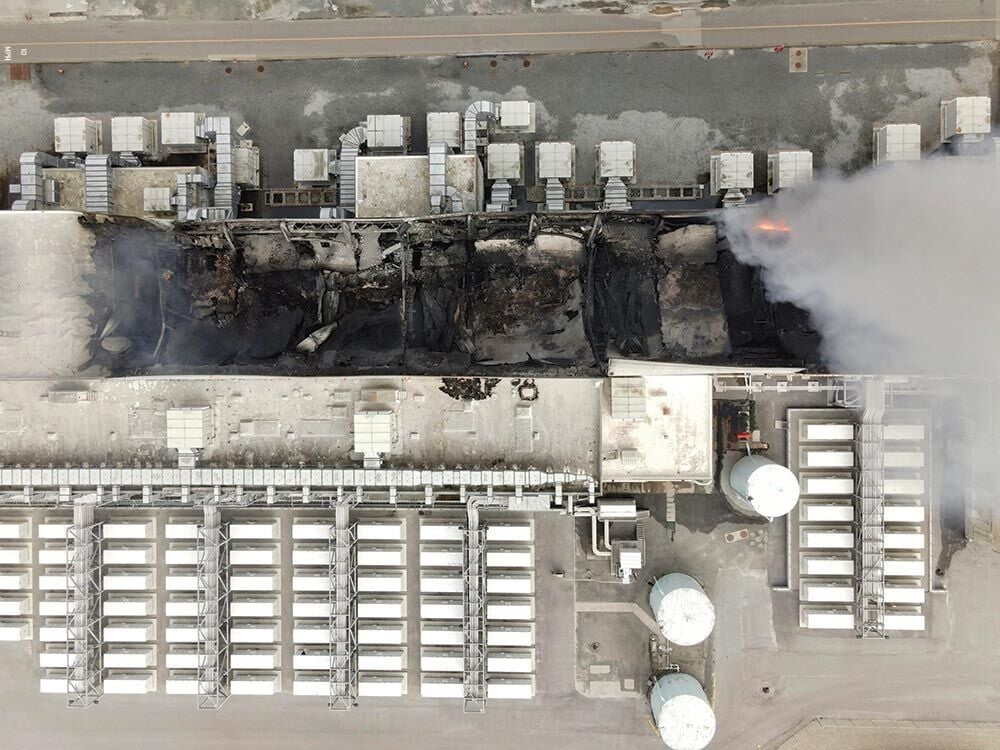
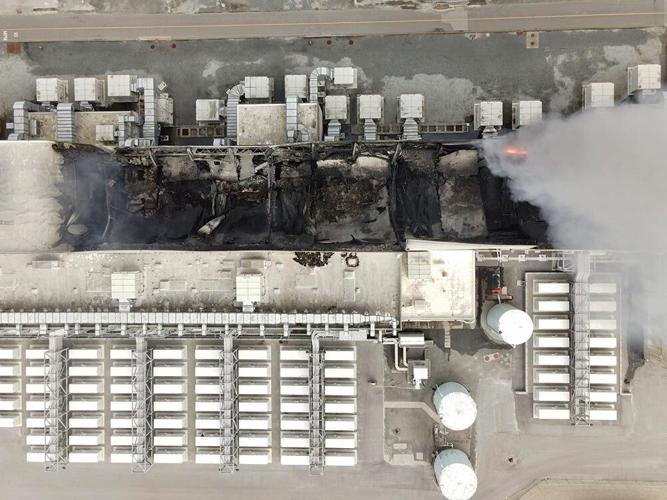
In Vistra’s 2018 application to the county for the Moss 300 project, it stated that the structure that would house the batteries – a disused, former turbine building – was “robust concrete with steel columns, girders and beams and will be considered non-combustible.”
MORE THAN FIVE YEARS LATER, AROUND 3PM ON THURSDAY, JAN. 16, 2025, Joel Mendoza, chief of the North County Fire Protection District, was at his department’s station in Castroville when a call came in about a structure fire along Highway 1 in Moss Landing. Mendoza and his colleagues immediately recognized the address – Vistra’s Moss Landing Power Plant. On the way there, reports over dispatch made clear it was at Moss 300, a battery energy storage facility the firefighters were intimately familiar with. They had toured it, inspected it, and in 2021, responded to an incident at the building when some batteries started to smoke.
As Mendoza and other firefighters arrived on the scene about 10 minutes later, he could see smoke rising from the roof as they approached. “We had a good sense something was escalating,” he says. “We knew there was probably a fire inside the building.”
After ensuring everyone onsite was safely accounted for, Mendoza and his team gathered as much information as they could from the plant manager and others. “Once we confirmed through their CCTV that [battery] racks were actively burning and spreading from rack to rack, we knew this was going to be a large-scale incident,” he says.
So they notified county officials – the Department of Emergency Management, the Sheriff’s Office and Environmental Health – around 3:30pm, and by 5pm, the County advised nearby residents to close their windows, doors and shut off their air systems until further notice.
At around the same time, as North County firefighters were laying hoses to douse a wall of the building, that wall and the roof started to collapse. That was when the decision was made to relocate the incident’s command post from an adjacent building to off the property, at the Power Plant Cafe’s parking lot across Highway 1.
As responders gathered there, Mendoza says one of his engines reported seeing flames shoot from the roof around 5:30pm. It was then, he says, that discussions began about evacuation orders.
At that point, it was clear to any onlooker with a basic understanding of battery fires that the impacted batteries had entered “thermal runaway,” a rapidly escalating chain reaction in lithium-ion batteries that can potentially lead to a fire or explosion. When it reaches this stage, there is so much heat it’s impossible to extinguish using water, as was the case at Moss 300. Additionally, applying water could put undamaged batteries at risk by causing them to short out; Mendoza and his colleagues could not fight the fire, only monitor it.
The county issued evacuation orders for the Moss Landing area at 6:30pm. The fire burned, then smoldered, into the night and the next morning. County officials held an online emergency meeting at 8:30am the next day, then another at 2pm after the fire flared up again that afternoon. The county lifted its evacuation order at 6pm on Friday, Jan. 17, after officials from the U.S. Environmental Protection Agency deemed that the air did not pose a threat to human health.
Some locals remained unconvinced.
SOCIAL MEDIA WAS ABUZZ with residents reporting symptoms they attributed to exposure to the Vistra fire’s smoke plume – headaches, sore throats, metallic taste, etc. There were questions, but no answers.
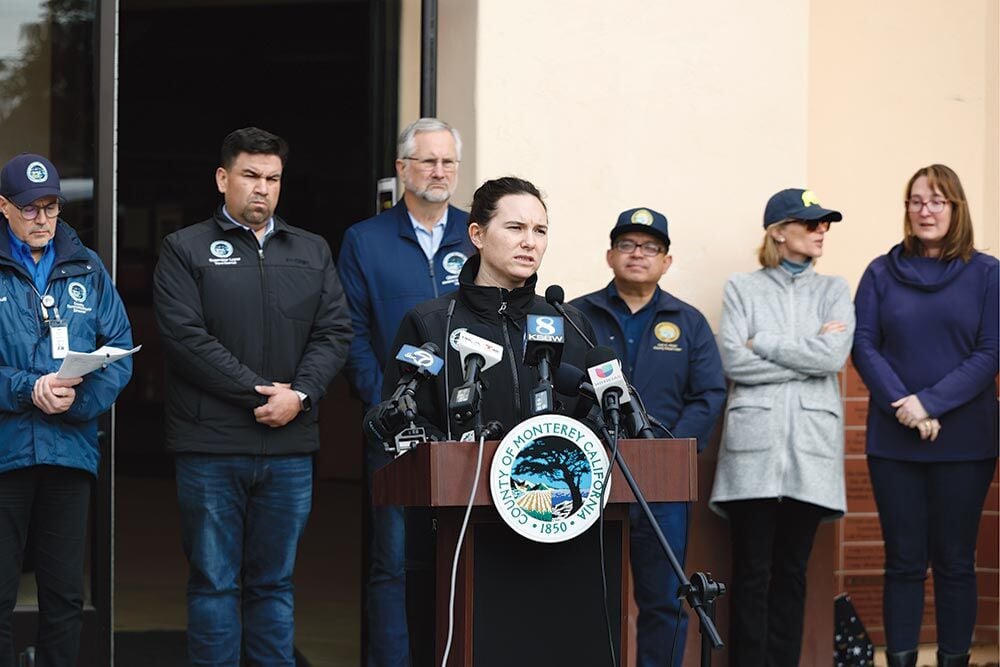
The Monterey County Board of Supervisors held an emergency meeting at 8:30am on Friday, Jan. 17, the day after the Vistra fire ignited. All five supervisors (in background) attended a press conference in Castroville immediately afterward, where Kelsey Scanlon, the county’s director of Emergency Management, provided updates.
Then, on Jan. 27, San Jose State University issued a report that landed like a bombshell. Ivano Aiello, a geoscientist at SJSU’s Moss Landing Marine Labs who’d been studying soil sediments in the Elkhorn Slough for a decade, found that samples he and his team had taken around the slough in the days after the fire showed a “hundreds to thousand-fold” increase in nickel, manganese and cobalt, heavy metals found in the types of batteries used at Moss 300.
That raised even more questions, because EPA officials had only been testing the air for gases, not the constituent particulates within the plume. And while officials from the state Department of Toxic Substances Control had run scans and collected soil and water samples Jan. 24, they hadn’t yet been analyzed. It wasn’t until Feb. 12 that Toxic Substances officials announced they had found “there are not elevated metals associated with the fire in soil.”
But that announcement came with no data. On Feb. 24, the department came out with the data, but no analysis. A Feb. 14 letter the state Office of Environmental Health Hazard Assessment sent to Monterey County Environmental Health did provide analysis: Out of the eight sites the Department of Toxic Substances Control sampled, only two registered as out of the ordinary. One site had elevated levels of cobalt – 60-percent higher than normal for the region – and another had hydrocarbons believed to be carcinogenic, and more soil testing of that site was recommended.
The fire wasn’t done just yet: On Feb. 18 at around 6:30pm, nearly a month after the original incident, Moss 300 flared up in a previously burnt part of the facility, creating smoke and flames. Nearby residents were told to keep their windows and doors shut for the night as a precaution, and the fire didn’t peter out until around 2am.
Vistra, meanwhile, had been working to neutralize the site’s inherent volatility, and on Feb. 22, a Vistra-trained team, under the supervision of U.S. EPA, started a process to “de-link” any accessible, undamaged batteries so that they were no longer connected to each other, a process that was expected to take a few weeks.
On Feb. 27, six weeks after the fire broke out, Vistra hosted its fourth quarter 2024 earnings call. At about 10 minutes in, CEO Jim Burke mentioned the fire, expressing thanks there were no injuries and appreciation to the community for handling the event safely. He noted Vistra’s other two battery facilities on the site – Moss 100 and Moss 350 – were undamaged, as was Vistra’s nearby 1,060-megawatt natural gas plant, and said the battery systems would remain offline until the company learned what had happened.
There was no further discussion of the fire until the very end of the hour-long call, when an analyst asked about Vistra’s insurance policy for the Moss 300 facility. A Vistra representative said it was insured up to $500 million, and the company expected to collect the full amount.
IN 1949, AS THE COUNTRY AND THE WORLD BEGAN ITS POST-WWII TRANSFORMATION, PG&E constructed the Moss Landing Power Plant, which became operational in May 1950. The plant was expanded in the decades following, and in 1998, PG&E sold it to Duke Energy, while PG&E retained ownership of the electric transmission facilities just north of the plant.
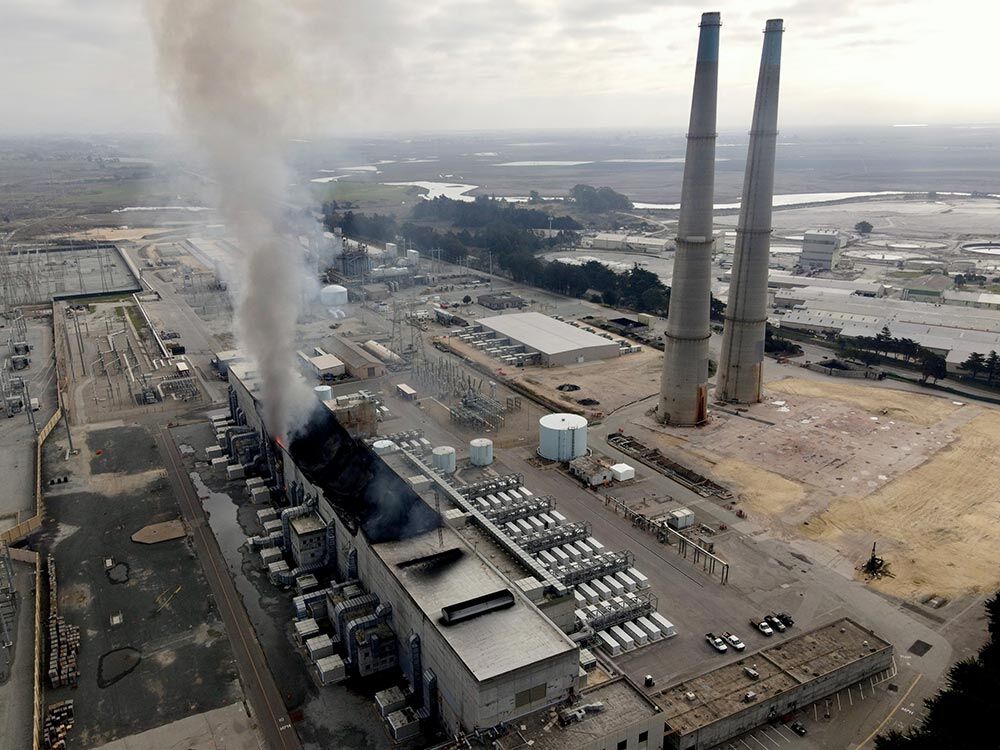
Much of the burnt Moss 300 building is unstable and unsafe for crews to enter. Its demolition will be a lengthy, complicated process in order to be done safely.
Duke made some modernization improvements until 2005, and in 2006, sold the plant to LS Power Equity Partners, which a year later sold it to Dynegy, which became a subsidiary of Vistra when they merged in April 2018.
That’s when things started heating up: In October 2018, PG&E got approval from the California Public Utilities Commission to purchase the energy capacity of a 300-megawatt BESS that Vistra was planning to build on its Moss Landing property. (At the same time, the CPUC approved an agreement between PG&E and Tesla that allowed them to move forward with a 182.5-megawatt BESS on PG&E’s adjacent property to the north.)
Just under a year after the Planning Commission approved Vistra’s Moss 300 project in 2019, it unanimously approved PG&E and Tesla’s 182.5-megawatt Elkhorn BESS in February 2020. Then in June 2020, the Board of Supervisors approved a BESS with 85 Tesla Megapacks – a 60-megawatt project – for Apple at the California Flats solar project, near Parkfield in South Monterey County.
In July 2020, the Planning Commission approved another application from Vistra to build more battery storage on its Moss Landing property, this one for four different facilities totaling 1,200 megawatts. Vistra started the first phase of that project, what would become Moss 100, in September.
Vistra’s Moss 300 came online in December 2020, making it the world’s largest BESS at the time and capable of powering about 225,000 homes. “A battery system of this size and scale has never been built before,” said Vistra’s then-CEO Curt Morgan in a January 2021 statement. “As our country transitions to a clean energy future, batteries will play a pivotal role and the Vistra Moss Landing project will serve as the model for utility-scale battery storage for years to come.”
Moss 100 came online amid fanfare on Aug. 19, 2021 with a ribbon-cutting celebration.
Just two weeks later, Sept. 4, 2021, a smoke incident at Moss 300 led to the temporary shutdown, while Moss 100 remained online. In January 2022, Vistra announced its findings from an investigation into the incident: The water-based suppression system became armed in response to low levels of smoke, and “because of failures of a small number of couplings on flexible hoses and pipes, improperly sprayed water on battery racks… The water damaged the batteries and caused some to overheat, thus creating more smoke which, in turn, resulted in the release of more water and caused damage to additional batteries. In total, roughly 7 percent of the facility’s battery modules were damaged.”
On Feb. 13, 2022, a similar incident occurred at Vistra’s Moss 100 facility, and this time, both Vistra facilities were taken offline.
Meanwhile, PG&E’s 182.5-megawatt Elkhorn facility came online in April 2022. Unlike both Vistra facilities, the Elkhorn’s batteries were not in buildings – they were in an array of 256 Tesla Megapacks on 33 concrete slabs.
In the early morning of Sept. 20 of that year, just over five months later, a fire broke out in one of the Tesla Megapacks at the facility, prompting the closure of Highway 1 and a shelter-in-place order for nearby residents. Though the fire only burned for six hours, the orders remained in effect until just before 7pm due to the risk of toxic smoke inhalation.
In the infancy of battery energy storage in Monterey County, three incidents, each at a separate facility, occurred in just over a year.
IN 2023, NEWLY ELECTED DISTRICT 2 COUNTY SUPERVISOR GLENN CHURCH, whose district includes Moss Landing, organized a meeting at the North County Recreation Center in Castroville on Sept. 20, the one-year anniversary of the Elkhorn battery fire. About seven weeks earlier, on Aug. 1, Vistra’s 350-megawatt facility in Moss Landing went online, but unlike the first two Vistra facilities, this one was outdoors, with 122 separate containers housing more than 110,000 battery modules, bringing Vistra’s Moss Landing battery storage complex to 750 megawatts total.
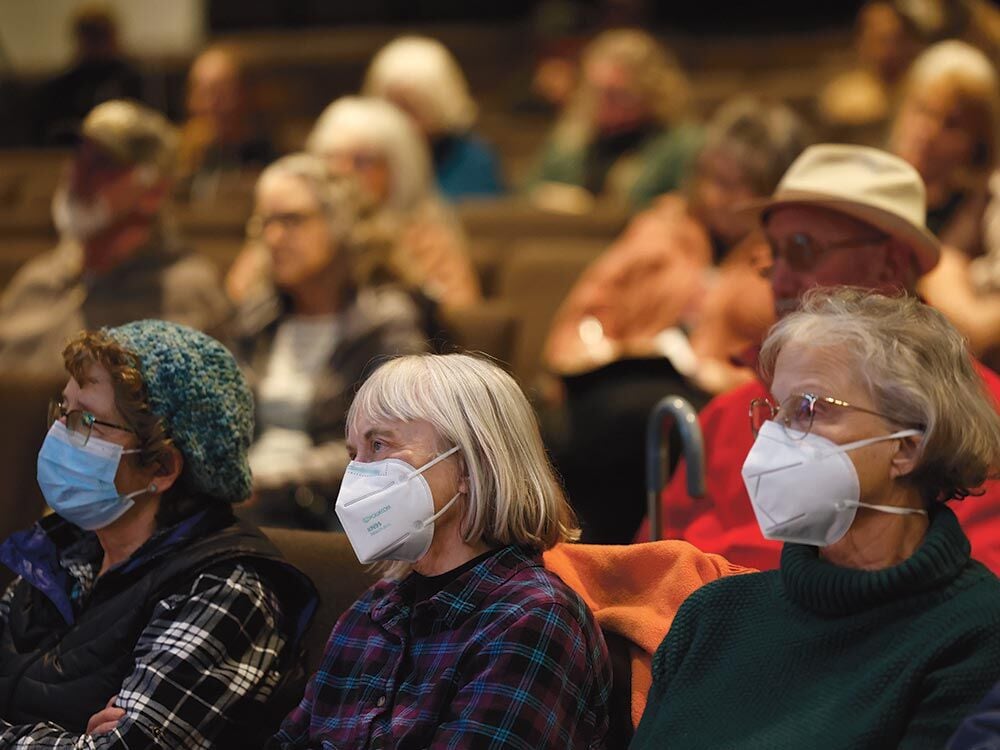
At a March 3 meeting in Salinas organized by Never Again Moss Landing, concerned residents looked for answers about how to move forward from here.
The meeting began at 6pm, and about 100 people showed up to attend. Various county officials sat behind tables on the stage, along with multiple representatives from Vistra and PG&E.
Kelsey Scanlon, the county’s director of Emergency Management, moderated the meeting, and after Church gave an overview of Moss Landing’s industrial history, the discussion turned to the recent incidents and what had been learned from them.
Vistra’s Brad Masek explained the cause of the smoke incidents at Vistra’s Moss Landing facilities, and that failed couplings attached to hoses were partly to blame – they had caused water to leak on the batteries. Vistra had since replaced all the couplings, he said, making sure they were all double-threaded, and reengineered its water suppression system so that it would not just be triggered by smoke, but also by a loss of air pressure in the lines.
PG&E’s Dave Gabbard said that in the one Megapack that had burned a year before, PG&E subsequently discovered that a ventilation shield on the unit had been improperly installed, dislodging valves that allowed water into the unit, causing batteries to overheat. He said PG&E identified 88 other Megapacks with a similar flaw, and quickly repaired all of them.
The meeting lasted two hours. When the public was invited to ask questions, Scanlon read some aloud: “What types of hazardous chemicals may be in the air that could impact the community beyond the fence?”
A representative from Vistra said based on the company’s modeling, only hydrogen fluoride could be of concern. There was no mention of heavy metals.
As the meeting was wrapping up near 8pm, Scanlon announced that she was reading the last question, a “doozy”: “Based on the expansive lists presented here tonight regarding emergency backup plans, acute exposure guidelines, and customer communication guidelines, I get the feeling this battery storage system has enormous potential for grand-scale catastrophic failure with far-reaching, long-lasting impact. Is this the case?”
Masek responded first, saying Vistra’s forecasts didn’t show that to be the case. Gabbard echoed that, adding that PG&E is always trying to improve its safety procedures at the Elkhorn facility.
Vistra spokesperson Brad Watson chimed in last. “I have one more thing, to give you a high-level perspective,” he said, noting that a year earlier, there were 4,000 megawatts of battery storage in California, and that now there were 6,800 megawatts, enough power for 5.1 million homes. “How many incidents do you hear of the tens of thousands of megawatt hours that are being released to your grid of clean energy? It’s just important to look at a high level at how well they are operating overall. Are they perfect? No, but no system created by humanity is perfect.”
ON FEB. 26, ABOUT SIX WEEKS AFTER THE FIRE, Bay Nature Institute, a Berkeley-based nonprofit nature magazine and website, hosted an online forum about the potential impacts the Vistra fire’s fallout might have on nearby ecosystems. Moss Landing Marine Labs’ Aiello, who’d been studying marsh sediments in Elkhorn Slough for a decade, fielded questions.
Aiello said that when he first went out to the slough a few days after the fire, he could see black pieces of debris scattered on the ground. Since his bombshell Jan. 27 announcement, he said rain had dissipated the metals on the surface, adding that they weren’t going away, they were just going somewhere else – in this case, the slough.
A colleague described their work on a new project, authorized by an expedited permit in the wake of the fire, to collect mussels from Montaña de Oro State Park in San Luis Obispo County, acclimate them in the lab to Elkhorn Slough waters, then deploy them in nylon bags hanging off the Highway 1 bridge at Elkhorn Slough and at Moro Cojo Slough. The plan is to cycle them out every two months to see how much nickel and cobalt they accumulate.
They’re trying to get a picture – and have the unique opportunity to do so – of how the metals travel and transform through the aquatic ecosystem.
Aiello emphasized that the area he’d been studying was a tiny fraction of the fire’s fallout zone, and speculated the plume could have contained more than a million pounds of heavy metals.
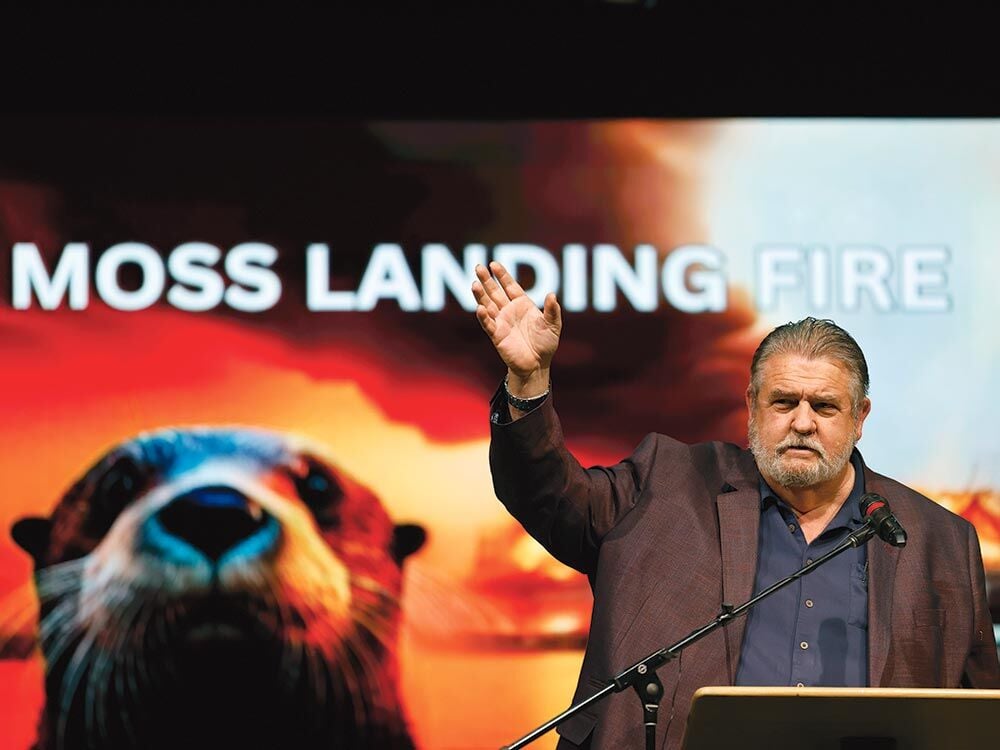
In the days after the fire, Brian Roeder founded Never Again Moss Landing, a community group for residents to share information and resources.
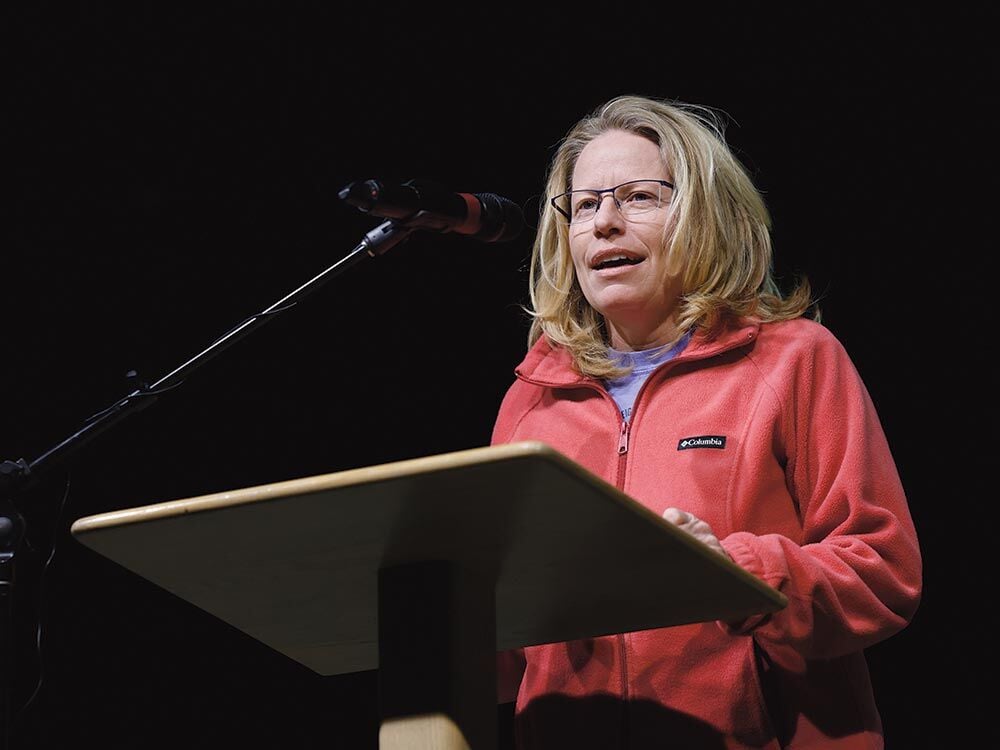
Angie Roeder, who lived in Prunedale at the time of the fire, experienced symptoms from exposure to its smoke and fallout. Her family has since moved.
FALLOUT FROM THE FIRE WAS THE CENTRAL THEME of an event on Monday night, March 3 at the Salinas Valley Community Church. It was organized by Never Again Moss Landing, a citizen group formed in response to the fire to share information and resources. About 60 people were in attendance, and the stage was tabled with the night’s speakers.
Prunedale resident Angie Roeder, whose husband Brian started NAML, spoke first. Angie said that, perhaps because of time she spent deployed in the Air Force, she had heightened sensitivity to toxins. The Roeders packed up the night of the fire to get out for the weekend, and figured when they got back everything would be fine. But Angie started experiencing symptoms the following day, and did every time she returned to their five-acre Prunedale property. Seeing others on social media reporting their symptoms, she started the Moss Landing Power Plant/Vistra Fire Symptoms page on Facebook. It gained traction so quickly, she said, that she soon made it private.
“I could feel things coming on, and I’ve had lots of frustration over the years with having symptoms and reactions to chemicals and having doctors not listen to me,” she said.
She said her family had been staying at two different AirBnB’s in Carmel since the fire, and that many could not be so lucky.
Prunedale resident Shiree Goins was likewise laid out by the fire. On Jan. 21, her birthday, she woke up feeling dizzy and lightheaded, and had a splitting headache. She told her husband they had to leave the house the next day – they did, she said, staying at an AirBnB for two weeks before finding a new home.
Goins said she’d been to numerous doctors, and that tests showed all her organs were functioning normally. To find out what was causing the symptoms, she was told, she’d need to see a toxicologist.
“We are the canaries in the coal mine,” Goins said of herself and others with heightened sensitivity. “We are here with our symptoms, screaming out, but unfortunately, we’ve felt time and time again that nobody is listening, no one is hearing our cries.”
On March 10, the Roeders and 50 other plaintiffs, including Goins, filed a lawsuit in Alameda County Superior Court against a number of defendants including Vistra, PG&E and LG Energy Solution, the manufacturer of the batteries at Moss 300.
That followed a Feb. 4 lawsuit filed by four local residents against an identical group of defendants.
On Feb. 27, Moss Landing residents Kim and Luis Solano, owners and proprietors of the Haute Enchilada restaurant in Moss Landing, which has shuttered in the wake of the fire, filed a federal lawsuit against a similar group of defendants, excluding PG&E. Moss Landing residents Sofia and Jonathan Vitale – Sofia is the Solanos’ daughter – filed a federal suit against the same defendants March 12.
Vistra has declined to comment on the litigation.
IN THE DAYS AFTER THE FIRE, Church often referred to it as a “Three-Mile Island” type of event for the battery energy storage industry, one that would wake people up to its potential dangers. Given the reach the fire had in the media – it made news internationally – that may prove to be true, but the Moss 300 facility was hardly a reflection of the industry as a whole.
Nick Warner, a battery safety expert, says less than 1 percent of battery storage facilities worldwide are in dedicated-use buildings – an indoor structure designed to house large-scale utility battery systems – and that Moss 300 was “globally unique in every way.” He bristles at the “Three-Mile Island” comparison, and believes a more apt one is the Hindenburg, as airships were already on their way out to make way for better, safer technology – airplanes.
Indoor battery storage facilities are going the same way, he says, adding that Moss 300 was the only one that reused an existing building. Worldwide, “it had far and away the most capacity under one roof. It was an antiquated design and concept already being replaced by a newer and better way of doing things.”
All the battery storage facilities in Moss Landing have been offline since the fire broke out, and there’s no clear timeline for when any of them will go back online. The focus now is to safely clean up the mess.
De-linking the accessible batteries in Moss 300 was completed March 13; the remaining batteries in the structure are unsafe to access, so the risk for a re-ignition remains.
On March 18, Scanlon, the county’s director of Emergency Services, presented an update to the Board of Supervisors about the progress on the site, and said the county was transitioning from the response phase into the recovery phase.
“Debris removal of this quantity and complexity has never been done before,” she said. Cleanup of the site could take years.
Already, the regulatory environment surrounding battery storage facilities in the state is starting to shift. On March 13, the five commissioners on the CPUC unanimously passed a resolution requiring all battery energy storage facilities to work with local authorities to create emergency response plans, or else face financial penalties.
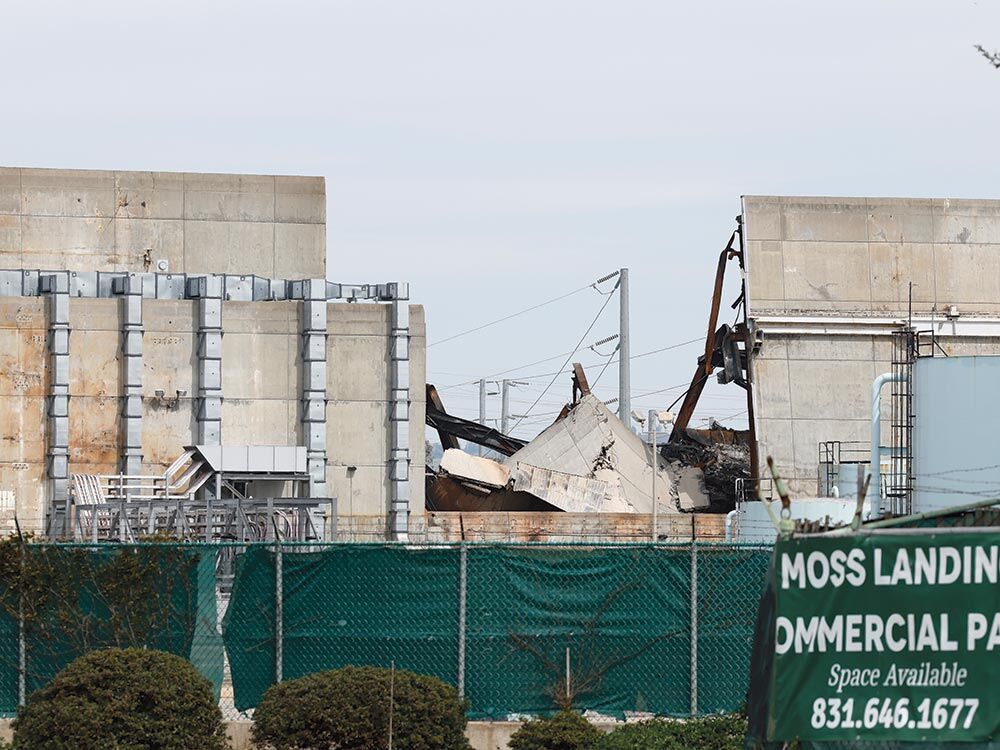
Much of the burnt Moss 300 building is unstable and unsafe for crews to enter. Its demolition will be a lengthy, complicated process in order to be done safely.
Assemblymember Dawn Addis, D-Morro Bay, introduced AB 303, which would bolster safety standards by creating environmental setbacks from sensitive sites like schools, as well as to restore local control in approving battery storage facilities – since AB 205 passed in 2022, those proposing new battery storage can opt to have the California Energy Commission take jurisdiction over the approval process.
Vistra currently has a 600-megawatt BESS proposed in Morro Bay, and Vistra notified the city last October that it would be opting to have the Energy Commission consider approval of the project’s draft environmental impact report, not the city. (Also in Addis’ district is a potential 200-megawatt battery storage facility near Watsonville.)
State Sen. John Laird, D-Santa Cruz, whose SB 38 was signed into law a year after the Elkhorn fire, had similar requirements to those the CPUC commissioners passed a few weeks ago, but it lacked the enforcement teeth.
He put out a statement Feb. 4, noting that the CPUC was leading the investigation into the causes of the fire, while also emphasizing the critical importance battery energy storage has for the state’s transition toward renewable energy. “California battery storage produced 500 megawatts in 2019, growing to 13,300 megawatts now, with the goal of 52,000 megawatts by 2045,” he wrote. “In September 2022, when the electrical grid was on the verge of a blackout, battery storage put more energy online than Diablo Canyon’s nuclear power during a few key hours – and the power stayed on.”
On March 20, Laird introduced SB 283, which would prevent the development of battery energy storage facilities in combustible buildings.
Looking back at how Vistra’s Moss Landing projects were approved, it’s easy to poke holes at what was missed or not contemplated during the process. But the projects, in a rapidly evolving industry, had no precedent locally, and the planning commissioners were given nothing but assurances.
At a Jan. 29, 2025 Planning Commission meeting, about two weeks after the fire, Diehl spoke about her vote back in 2019. “I just want to say one thing about the recent fire in Moss Landing, which is that as a person who voted for that facility, I was wrong,” she said.
At the time, she had felt the safety discussions were extensive and the facility was safe. “I just want to put that on the record, because sometimes you’re wrong,” she said.
When Goins, at the Never Again Moss Landing meeting, referred to people like herself as “canaries in the coal mine,” that was, in another sense, true for the entire Central Coast – it seems doubtful another indoor battery project like Moss 300 will ever again get approved, locally or anywhere else. And for an energy company, safer designs are also a safer investment.
But whether the public likes it or not, battery energy storage is likely not going away – our demand for energy is only growing. And the alternatives to renewable – nuclear or fossil fuels – are untenable.
Not to mention, Vistra got approval from the county in 2020 to build 1,200 more megawatts of storage in Moss Landing. And after Moss 100 and Moss 350, it still has approval to build 750 more megawatts. Since the fire, however, the company is waiting to see what the investigation finds.
Whether Vistra follows through with its plan or not, battery energy storage facilities are likely the future – they store renewable energy, then feed it to the grid when the sun’s not shining or the wind’s not blowing. They are the missing link, and as the transition toward renewable energy continues to gain traction – in California and elsewhere – batteries will be leading the charge.
(2) comments
Thank you for this important, timely information, much appreciated.
[thumbup] .. this is a great article. Give the best summary I've read so far.
Welcome to the discussion.
Log In
Keep it Clean. Please avoid obscene, vulgar, lewd, racist or sexually-oriented language.
PLEASE TURN OFF YOUR CAPS LOCK.
Don't Threaten. Threats of harming another person will not be tolerated.
Be Truthful. Don't knowingly lie about anyone or anything.
Be Nice. No racism, sexism or any sort of -ism that is degrading to another person.
Be Proactive. Use the 'Report' link on each comment to let us know of abusive posts.
Share with Us. We'd love to hear eyewitness accounts, the history behind an article.