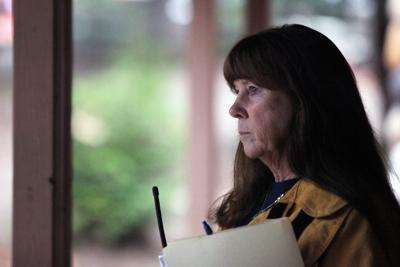

For at least a few days after the winter storms of 2017 turned Big Sur into an island, things looked dark to long-time Big Sur Fire Chief Martha Karstens.
“There’s no light [at the end of the tunnel] right now,” she told the Weekly soon after about 350 residents lost access to the outside world. “You don’t know what to plan for.”
Karstens found the light not long afterward. Today she says that period was one of the most rewarding times of her 28 years as a volunteer with Big Sur Fire, the last decade of which she spent as chief, a part-time paid position.
She and the rest of the community figured out how to get people, food, medicine and other supplies in and out of the region, despite losing Pfeiffer Canyon Bridge, which shut down Highway 1 to the north, and a slide that shut down Highway 1 to the south.
“I love challenges like that,” she says.
Karstens now has a new challenge to tackle: retirement.
On Nov. 19, she announced to the community through a letter that she was retiring, to be replaced by Big Sur Deputy Chief Matt Harris on Jan. 1.
“I have so appreciated all of your help, friendship and support over the years, in particular after the devastating Pfeiffer Fire (in 2013),” she writes.
Karstens lost her own home in that fire, which has since been rebuilt. More than 30 other homes were lost.
“I know you all will be equally supportive of Matt going forward and he will make an excellent chief,” her letter continues.
Karstens has been a volunteer paramedic since 1976, when she served on a volunteer ambulance in Big Sur through the Red Cross. After 14 years a new law phased out volunteer ambulances in rural areas and the all-volunteer Big Sur Fire Brigade, which had only answered fire calls up to that point, decided to take on volunteer paramedics. Karstens signed on, and after 18 years she became chief, a partially paid position to handle all the administrative tasks that come with the job.
“When the pager goes off, I’m a volunteer,” she says. The pager has been with her 24/7 for 42 years, but no more, and as she told the community, “I will now see how ‘normal’ people live.”
She acknowledges it will be a big change, one she will take slowly in the coming months as she adjusts to retirement. She has no immediate plans for what it will look like, and no plans to leave the region that’s been her home since 1971.


(0) comments
Welcome to the discussion.
Log In
Keep it Clean. Please avoid obscene, vulgar, lewd, racist or sexually-oriented language.
PLEASE TURN OFF YOUR CAPS LOCK.
Don't Threaten. Threats of harming another person will not be tolerated.
Be Truthful. Don't knowingly lie about anyone or anything.
Be Nice. No racism, sexism or any sort of -ism that is degrading to another person.
Be Proactive. Use the 'Report' link on each comment to let us know of abusive posts.
Share with Us. We'd love to hear eyewitness accounts, the history behind an article.