Seafood Watch hosts educational discussions with chefs all over the world—from New Zealand to Thailand—according to its website, which is teeming with helpful information.
Their smartphone app has been downloaded more than a million times.
They provide consumer guides catered to the unique seafood options of all 50 states.
But despite all that, the Monterey Bay continues to be their main focus, according to Sheila Bowman, Seafood Watch manager of culinary and strategic initiatives.
“In our minds, Monterey should be one of the most sustainable seafood cities in the country, maybe even the world,” she says. “That’s our goal.”
As part of that local effort Seafood Watch works with 41 partners in the Monterey/Santa Cruz area such as Passionfish and Old Fisherman's Grotto, educating staff and promoting the use of sustainable seafood options.
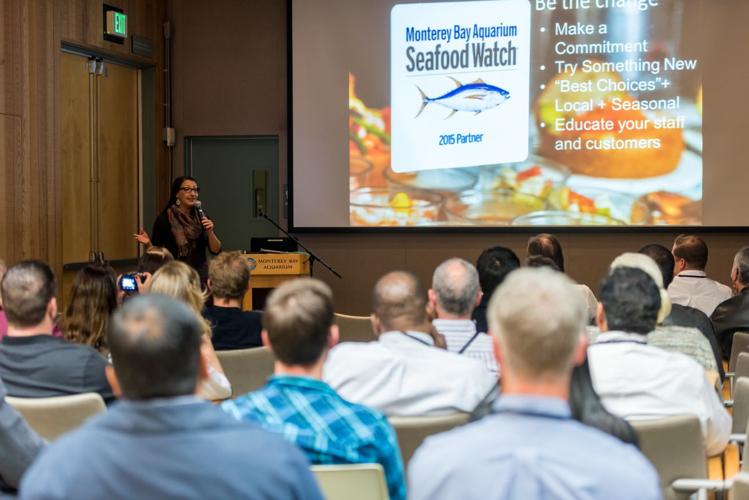
For a recent American Culinary Federation Monterey Bay Chapter event, some 30 chefs met with Aquarium officials for a dynamic presentation/tour/tasting.
After they all settled in MBA’s auditorium, Bowman spoke first. She encouraged local chefs to modify their menus with more sustainable choices, whether that means serving salmon when it’s in season, or turning to alternatives like ling cod and dogfish.
She introduced Seafood Watch colleagues like Simone Jones, business engagement manager, who works with international chefs and educates them on how to prepare sustainable alternatives.
Brian Albaum, another business engagement manager, works with large producers and suppliers of seafood. Although these experts had little talk-time, they sent a message with their depth of expertise: When restaurants or purveyors request training, Seafood Watch has the resources to respond.
“We are more than willing to come to your restaurant and train the staff,” Bowman says.
Bowman went on to push for the use of locally caught groundfish like rockfish, longspine thornyhead and sand dabs, saying they're quickly becoming a good source for sustainable, local, seafood.
That wasn’t always the case. In 2000, ground fisheries were declared a federal disaster due to overfishing. But after years of careful conservation efforts, including the National Oceanic and Atmospheric Association Catch Share program and Seafood Watch’s influence on fishery management, 39 species of groundfish were added to Seafood Watch’s “Best Choice” and “Good Alternative” categories in 2014.
The Monterey Bay Fisheries Trust buys from and leases to local fisherman, insuring the catch stays local and isn’t sent off to other areas, like Oregon. The successful catch share program transformed local ground fisheries from coastal catastrophe to a model for sustainable fishing.
Bowman added something for those reluctant to buy and serve farmed fish. Because dramatically improved practices have slashed rampant disease and escapes, sustainably farmed fish, particularly certain species like rainbow trout, striped bass and barramundi (also known as Asian seabass) rank as excellent choices.
“Farmed seafood is becoming a great option,” Bowman says.
To wrap up the first segment, Bowman hit on the ultimate goal she holds for Seafood Watch and its partners: To inspire chefs to make a commitment to educate staff and customers, experiment with less known species on their menus, and focus on serving local and seasonal ingredients.
From there Simone led a tour of the aquarium to see species of fish that could potentially be featured on menus, pausing to give examples of how to cook each fish.
At the Kelp Forest exhibit, Simone pointed out the spiny dogfish, a type of shark that she says, “comes out white and flaky like cod,” which is a big reason a lot of the fish and chips served in the U.K. today consist of dogfish fillets.
After the tour, the chefs headed for Cindy’s Waterfront where chefs and staff members gathered around white tables drinking wine and seltzer water.
The cooks were passing out plates as soon as we arrived. While they served the first dish, they continued to cook and prepare the coming courses.
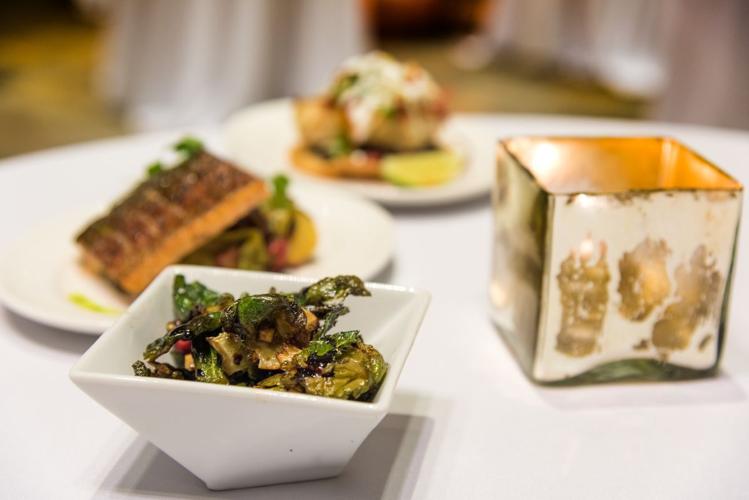
First up was fried brussel sprout leaves with pomegranate, crushed pistachios, and balsamic vinaigrette. The pomegranate’s sweetness complemented the slightly bitter sprouts well, and the pistachio added a crunchy texture.
The next dish: pan seared trout and marble potatoes with maple cider gastrique, bell peppers, and bits of bacon. The trout was topped with sprouts and a green sauce on the side that resembled slime and tasted sweet. The fish was cooked perfectly, with sear marks on both sides while still being moist and tender.
The next—and final—dish of the night, the ling cod tostadas, were also the most impressive looking. A thick piece of white fish, avocado, black beans, and cabbage seasoned with lime and cumin stacked on the tostada topped with mexican crema and a mild chipotle salsa.
As I struggled to eat my tostada without destroying it, I talked a bit with Soerke Peters, chef and owner of Basil Seasonal Dining in Carmel. Peters is committed to the cause of sustainable food and takes pride when noting that Basil was the first Certified Green Restaurant in Carmel, which helped him earn his chapter's chef of the year nod.
Although he is satisfied with his achievement, Peters doesn't believe what Basil does should be anything extraordinary.
“Restaurants consume more electricity than any other retail business.” Peters says.
He flags more overconsumption where that comes from.
“Restaurants could be almost zero waste,” he says.
To that end, he attends to everything from the small detail (biodegradable trash bags) to the biggest fundamentals (purchasing nearly all of the ingredients served within an 100 mile radius).
“I love farmers markets, especially the one at the MPC parking lot. You need to know where your food comes from,” he says.
One of the cooks came to the table with a plate put together just for Peters—a pile of green, wispy plant matter. Peters picked up a piece and commented on how special it is to eat seaweed this fresh.
He offers me some of the fried seaweed. It is satisfyingly salty, the type of salty sensation you get when you take a deep breath by the ocean—the same ocean I can see through the floor-to-celling windows of Cindy's Waterfront, and the same ocean Seafood Watch and local chefs are trying to save one plate of sustainably raised trout at a time.






(0) comments
Welcome to the discussion.
Log In
Keep it Clean. Please avoid obscene, vulgar, lewd, racist or sexually-oriented language.
PLEASE TURN OFF YOUR CAPS LOCK.
Don't Threaten. Threats of harming another person will not be tolerated.
Be Truthful. Don't knowingly lie about anyone or anything.
Be Nice. No racism, sexism or any sort of -ism that is degrading to another person.
Be Proactive. Use the 'Report' link on each comment to let us know of abusive posts.
Share with Us. We'd love to hear eyewitness accounts, the history behind an article.