
You might wonder why chefs and bartenders tend to ignore all the folk wisdom traded over the millennia—especially on Valentine’s Day.
As far as we can tell, no local restaurants are dishing up a mash of eels, lotus root and fire-roasted newt. A scan of menus finds a noticeable lack of toad secretions, and good luck finding a shared plate of live beetles to munch on.
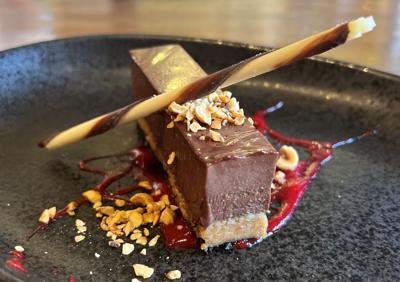
Instead, chef Christian Ojeda at Lucia Restaurant & Bar in Carmel Valley offers the likes of spiced butternut squash risotto, diver scallops and a luscious dark chocolate mousse. At Estéban Restaurant in Monterey, chef Mario Garcia is plating saffron arancini, roasted mushrooms, a surf and turf option and other appealing dishes.
Maybe Pacific’s Edge in Carmel? It sits on the road to Big Sur and all the foraged goods with special powers. But no—chef Joshua Kinzer nixes sparrow tongues in favor of scallop and prawn carpaccio, roasted rack of lamb, sorbet with fresh berries and more.
So that’s it. No aphrodisiacs. Valentine’s Day canceled.
But hang on for just a moment. What the restaurants are preparing sounds so much more appetizing than sea cucumbers or manroot or any of the other often vile concoctions passed down from myth, legend or observation. Besides, as Manuel Vázquez Montalbán asserted in Immoral Recipes, “no one has ever succeeded at seduction by means of food alone.”
In other words, alcohol must be involved, right?
“It’s a creative outlet, to be honest,” says Colleen Kelly, bartender at Lucia in the Bernardus Lodge, who created a list of cocktails with suggestive names like “Between the Sheets” and “Ménage a Trois” to go along with Ojeda’s menu (both of which run through the end of the month, so no need to rush). “It gives you the chance to play with spirits.”
While Ojeda includes ingredients purported to possess aphrodisiacal qualities, such as oysters, pomegranate and truffles, he is not ready to endorse their potency. Aphrodisiacs, he explains, result from the lore of food and the human desire for…well, desire.
“Look at chocolate,” he says—and you should do more than just look at his dark chocolate mousse—”there are many different forms of what chocolate should be.” It’s fattening. It’s healthy. It’s calming and titillating. “It’s food and the way you want to think about it.”
Scientists have long dismissed most of the folk remedies. Writing in Pharmacognsy Review, the team of Sabna Kotta, Shahid H. Ansari and Javed Ali noted that the approval of Viagra in the 1990s renewed attention in treatment that has dated back to ancient times. But, they cautioned, although common foods like strawberries, coffee, honey and chocolate are often praised for their potential in the bedroom—or car, let’s be real—“there is no or little scientific confirmation supporting those assertions.” They go on to point out that some of the available herbs or somewhat edible items handed down by tradition “have limited efficacy, unpleasant side effects and contraindications in certain disease conditions.”
To further the point, Paola Sandroni of the Mayo Clinic, noted in a paper for Clinical Autonomic Research, that the chemical derived from beetles that goes into Spanish fly, acts “by inhibition of phosphodiesterase and protein phosphatase activity and stimulation of beta-receptors, inducing vascular…” Um...In other words…Yeah.
Here’s the important bit: “Morbidity from its abuse is significant.”
What we believe they are trying to explain is that some properties, such as ambra grisea, can have an effect. But without clinical trials, the extent, the side effects and the potential for death remain uncertain.
There are explanations that don’t include “cyclic nucleotides,” “efflux of K+” or other such phrases.
Mythology and legend play a role in defining aphrodisiacs. For instance, the Greek god of all things between the sheets, Aphrodite, was born from the sea. And so the power of love was bestowed upon oysters and other sea creatures. Writing in Vogue, Alexandra Malmed noted the “law of similarities” that governed Medieval thought. Logically, sea cucumbers and other objects with suggestive shapes and textures would charge desire.
The best recipe Vogue could come up with, unfortunately, was tuna and avocado tartare with caviar. How does that compare with ginseng, which according to Sandroni carries ginsenosides that “enhance acetylcholine-induced and transmural nerve stimulation-activated relaxation associated with increased tissue cyclic guanosine monophos…” Forget it.
Back on track: There are other forces at play beyond mythology.
The instruments of love—secretions from the glands of toads on one end of the spectrum, caviar of truffles on the other—tend to be exotic. They are wrapped in luxury or hard to come by. As Alison M. Downham Moore and Rashmi Pithavadian explain in their best seller “Aphrodisiacs in the Global History of Medical Thought” (soon to be a major motion picture) from the Journal of Global History, the potency attributed to aphrodisiacs “has often relied on them coming from far and foreign places.”
Because moral guardians over the ages tended to discourage anything that would put us over the hump, so to speak, the supposed elixirs of encouragement were given a “forbidden fruit” appeal.
Furthermore, Downham Moore and Pithavadian explain, the very trade in items thought to be aphrodisiacs, as well as the pharmacology that developed around them, “helped to shape the very concept that sexual physiology is amenable to chemical manipulation.”
And that notion continues today, with Viagra being the most noted success story—although it derives not from ginseng, but from a lab.
So Burning Question answered? Eh. Somewhat. Most of it is fanciful. Some ingredients have a pharmacological component. And the ways they entered the aphrodisiac lexicon are many.
But we like what Ojeda has to say on this one.
It’s Valentine’s Day. There is dark chocolate mousse. There is hope. Spring, he adds, is in the air.


(0) comments
Welcome to the discussion.
Log In
Keep it Clean. Please avoid obscene, vulgar, lewd, racist or sexually-oriented language.
PLEASE TURN OFF YOUR CAPS LOCK.
Don't Threaten. Threats of harming another person will not be tolerated.
Be Truthful. Don't knowingly lie about anyone or anything.
Be Nice. No racism, sexism or any sort of -ism that is degrading to another person.
Be Proactive. Use the 'Report' link on each comment to let us know of abusive posts.
Share with Us. We'd love to hear eyewitness accounts, the history behind an article.