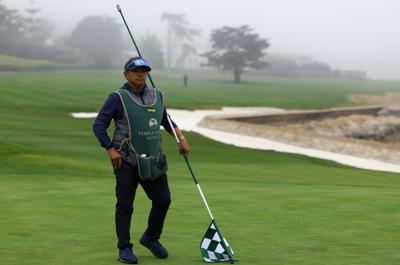

On May 1, Pebble Beach caddies became employees of the caddie company that has been operating the program since 2002. Their response is unusual in the world of golf—the caddies filed to form a union.
“This was a radical change,” says Tony Malokas, who has toted bags at Pebble Beach courses for 26 years. “There was only one thing we could do.”
For as far back as anyone can remember, caddies at the regulation courses owned by Pebble Beach Company—Spyglass Hill, The Links at Spanish Bay, Del Monte Golf Course and the iconic Pebble Beach Golf Links—have acted as independent contractors. They are now hourly employees of Caddiemaster, a Florida-based caddie management company.
According to Malokas, 211 caddies signed a petition asking Caddiemaster to recognize them as a union. With no positive response, they approached Unite Here, an international union representing hospitality workers, including those at The Lodge at Pebble Beach, and filed for an election with the National Labor Relations Board.
A vote is scheduled for June 18. Should 51 percent of caddies approve, they would become part of Unite Here Local 19. The union could then negotiate a new contract with Caddiemaster.
“I want to emphasize that we’re not complaining about the job,” Malokas says. “It’s always been a fantastic job. We want to have a say in it.”
Although many caddies expressed concerns about the hourly wage structure—said to range from $16.90 to $24.98—leading to a possible reduction in pay, it was the way the transition was announced that sparked outrage.
According to Malokas and others who spoke on background, caddies received a text from Caddiemaster in February informing them of the decision.
In a statement posted to caddiemastercares.com, Caddiemaster CEO Dan Costello acknowledged the response. “We know this transition to employees has created uncertainty and strong opinions. We respect that,” he wrote. “But I want you to understand something clearly. Every decision we make is based on the same goal: strengthening the future of caddying and creating the best environment for all caddies to succeed.”
The company promises employee benefits. Caddiemaster will now pay social security and Medicare, once the responsibility of the private contractors—a savings of around $3,300 a year to each caddie, according to the company’s statement. It is also offering 401(k) contributions, workers' compensation and other benefits. In addition, the company indicates that take-home pay will be “virtually identical” to the contractor model.
But the caddies say that with loops lasting up to five-and-a-half hours, and the new policy limiting them to five work days a week, few would be able to average the 35 hours a week necessary for federal benefits. And in the weeks leading up to their first paychecks as employees, caddies feared reductions of up to 30 percent.
The checks were delivered on Friday, May 22. “It’s OK,” Malokas says. “I haven’t sat down to do the math,” adding that colleagues reported checks to be slightly lower.
Pebble Beach Company turned to Caddiemaster in 2002 because the caddie program was growing rapidly and scheduling 200-300 independent contractors became a complex process. It was something routine for the company.
The employee model allows Caddiemaster to provide training and set quality standards. It’s not a new model to the golf world. Other courses across the country employ loopers, often through outside companies. But unionization—should it happen—might be a first.
Although not directly part of the dispute between the caddies and the management company, Pebble Beach CEO David Stivers has been monitoring the situation closely.
“We recognize the rollout of the new program was difficult, and there were several significant issues raised,” he said in a statement. “[Caddiemaster] knows it, takes it seriously and is working to get this right. The goal is to create a caddie program that is better for caddies and better for guests.”
One veteran caddie, who did not wish to be identified, explains that as professionals, they are in line with those goals. “Pebble Beach wanted the program to improve,” he says. “Most caddies agreed the program had to get better.”
It was the manner in which the transition was made, as well as the sudden change in lifestyle and work habits that rankled.
“We felt like they dropped it on us,” Malokas points out. “We’ve all built our lives around flexibility.”
For now, employees are holding meetings and attending those hosted by the company regarding unionization and the upcoming vote.
“I think we caught them off guard,” Malokas says. “I feel confident, but you never know.”


(1) comment
Only a CEO who was afraid to lose millions in profits and possibly his job would make up a website with fake testimonials the day before an interview praising this new process. Most of those dollars would not go back into the Monterey Peninsula, its residents, and businesses, but to the venture capital firm that bought the company, that bought his company. They're certainly not sharing the wealth by giving raises to the floor managers! They're spending 10's of thousands on union-busting "labor consultants" to prevent this all from happening. If the caddie mgmt co thought so highly of their caddies, and operated in good faith, maybe this wouldn't be happening. It only takes a few poor decisions by the few decision makers, to cause a big mess for everyone.
Welcome to the discussion.
Log In
Keep it Clean. Please avoid obscene, vulgar, lewd, racist or sexually-oriented language.
PLEASE TURN OFF YOUR CAPS LOCK.
Don't Threaten. Threats of harming another person will not be tolerated.
Be Truthful. Don't knowingly lie about anyone or anything.
Be Nice. No racism, sexism or any sort of -ism that is degrading to another person.
Be Proactive. Use the 'Report' link on each comment to let us know of abusive posts.
Share with Us. We'd love to hear eyewitness accounts, the history behind an article.