
Standing on a peak of Little Moab Road in Fort Ord National Monument offers a near-360-degree view of the Salinas Valley and the Monterey Peninsula.
With the Gabilan Mountains as the backdrop, the green and brown of agricultural fields stretch across the flat valley floor, with tiny dots – representing vehicles – traveling to-and-fro along Highway 101. Small structures are scattered throughout, becoming more clustered further north and toward Salinas’ city center.
This is the so-called Salad Bowl of the World, the centerpiece of an $11.7 billion agriculture industry that helps feed the globe. To characterize it as the southern edge of Silicon Valley, which Salinas Mayor Dennis Donohue proclaimed during his State of the City Address on April 30, may be confusing to most.

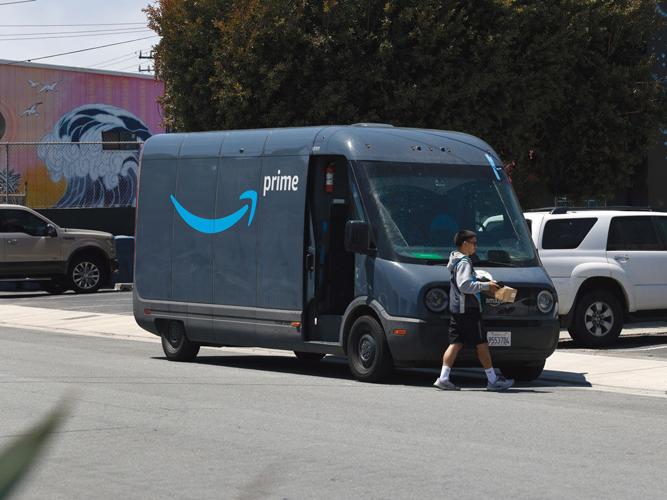
Electric Amazon delivery vehicles manufactured by Rivian are a common sight in Monterey County.
When one thinks of Silicon Valley, images of high-rises in downtown San Jose, spaceship-like architecture of the Apple campus in Cupertino and sprawling warehouses come to mind. The agricultural remnants of what was once known as the Valley of Heart’s Delight are few and far between.
But thinking of the invisible lines that divide the state, referring to Salinas as part of Silicon Valley is appropriate. U.S. Rep. Zoe Lofgren, who for years represented San Jose and surrounding Santa Clara County communities, saw her district shift to include Salinas and the Salinas Valley after redistricting in 2022. It connected the two hubs together, at least on a map: agriculture and tech.
Recently, the Salinas Valley and its surroundings have taken a major step toward becoming part of Silicon Valley by more than just a map. Earlier this year, Reservoir Farms opened near the intersection of Highway 68 and Hitchcock Road, where ag tech companies and startups are developing prototypes that they hope will one day be used in the fields.
San Jose-based electric air taxi manufacturer Archer Aviation is testing its aircraft at the Salinas Municipal Airport. Its competitor Joby Aviation broke ground on an expanded manufacturing facility in 2024, just outside Lofgren’s Congressional District 18. When it was completed in 2025, it essentially doubled the company’s footprint at the airport, now at 435,500 square feet.
From the perch on Little Moab Road, that massive new structure in Marina can be seen off to the west. To the east, an even larger structure, which also broke ground in 2024, dominates the landscape, making it hard to miss as it stands surrounded by agricultural fields.
At five stories tall, and a little more than 3 million square feet, its physical mass is representative of its owner’s global impact.
It’s near the top of the list of the e-commerce behemoth’s largest facilities in the world, and as construction nears its end, the Silicon Valley era of Salinas is officially underway, as Donohue noted: “Amazon is coming.”
IN 2008, Uni-Kool Partners pitched the idea of the Salinas Ag-Industrial Center to city officials.
The concept was simple: Its 257 acres of land at the intersection of Abbott Street and Harris Road, where leafy greens were being farmed, could be transformed into an industrial center, where existing ag companies could expand their operations – such as cooling, processing, warehousing and distribution facilities – while new businesses could set up and take advantage of the proximity to the adjacent major transportation corridor in Highway 101. The Salinas City Council approved the plan in 2010.
Over the next decade, the only dirt being moved was from the tractors setting up rows of plantings. The vision of the industrial center was just that. It proved to be simple in concept, expensive in execution.
Under the plan, all backbone infrastructure – including roads and utilities – needed to be constructed by whoever built first on the land. A 2022 estimate by the city pegged that cost at nearly $70 million, a dollar amount that proved too steep for most ag companies operating on razor-thin margins, leading to the industrial center concept gathering dust.
That was until late 2021 when Scannell Properties, which has worked with Amazon on various projects, filed an application to the City of Salinas for a warehouse and distribution facility, standing five stories tall – up to 110 feet – and 3.2 million square feet, making it one of Amazon’s largest facilities in the world.
Around the same time, the City of Salinas received a request from an attorney representing Scannell to eliminate the restriction that “wholesale distribution” uses on the property must be “agriculturally-related or serve the agriculture industry.” Then-City Manager Steve Carrigan agreed and struck the requirement, as is allowed under the specific plan.
“Since the specific plan was adopted in 2010, ‘Wholesale Distribution’ has significantly changed with the rise of e-commerce, globalization, and more recently challenges in the supply chain and labor shortages created by the pandemic,” Carrigan wrote in a 2021 letter. “The agriculture industry has also significantly changed since 2010, such that the original basis upon which the specific plan was originally adopted may no longer be relevant.”
In 2022, Carrigan said the project was tabled indefinitely, citing rising construction costs as the developer’s reasoning.
However, in November 2023, the project was revived when Scannell purchased the property from Uni-Kool Partners for $14.7 million, County Assessor records show.
Internally, the project was referred to as Project GOAT, and the fact the Amazon project was back on the table was never publicly acknowledged by the city until bulldozers showed up on the property and construction fencing was installed in mid-2024. The city issued a notice in August 2024, informing the public that Amazon was indeed back in Salinas, and with that would come various road work and other infrastructure projects.
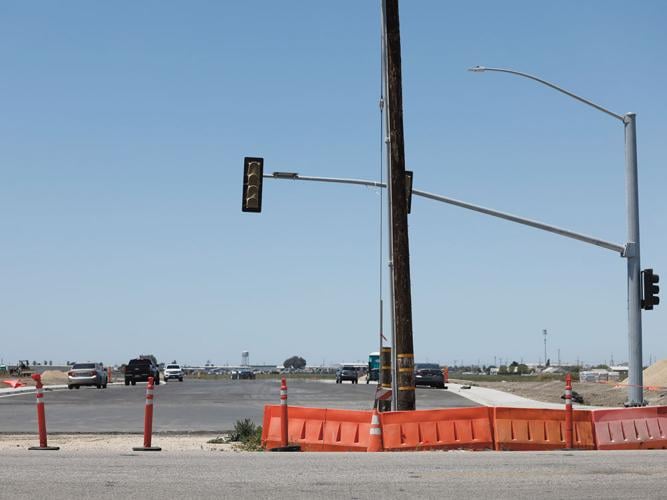
That includes widening Abbott Street and Harris Road, installing a ramp metering signal on southbound Highway 101 at the Abbott onramp, and converting the Highway 68 westbound ramps and Spreckels Boulevard intersection to an all-way stop.
The city floated the idea of an enhanced infrastructure financing district (EIFD) for the project, which allocates the revenue from a development’s future property tax increases for up to 45 years toward funding infrastructure improvements.
The city council approved a $129,000 contract with a consultant to explore the idea in late 2023. The proposal also required the County of Monterey’s participation. However, by February 2024, the contract was terminated.
“After thorough consideration, we have concluded that we will not be pursuing the formation of the EIFD at this time,” then-interim City Manager Jim Pia wrote in a letter to consultant Larry J. Kosmont.
County of Monterey spokesperson Maia Carroll confirms that the county has not received a request from the city.
Still, money continues to flow in a city that is in desperate need of new revenue sources.

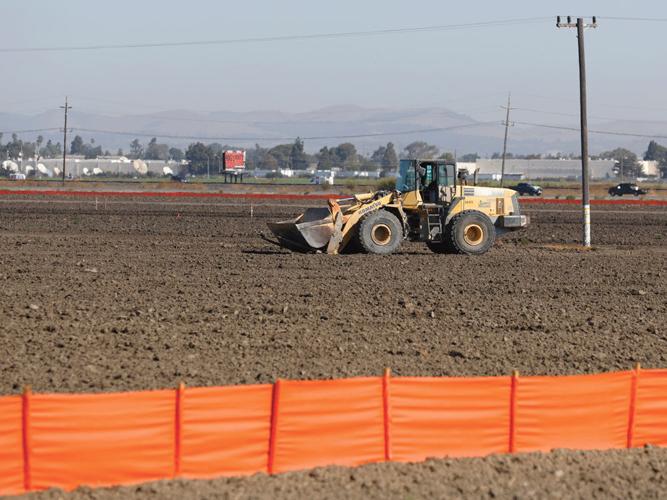
The site where the Amazon fulfillment center will be built in Salinas is shown in September 2024.

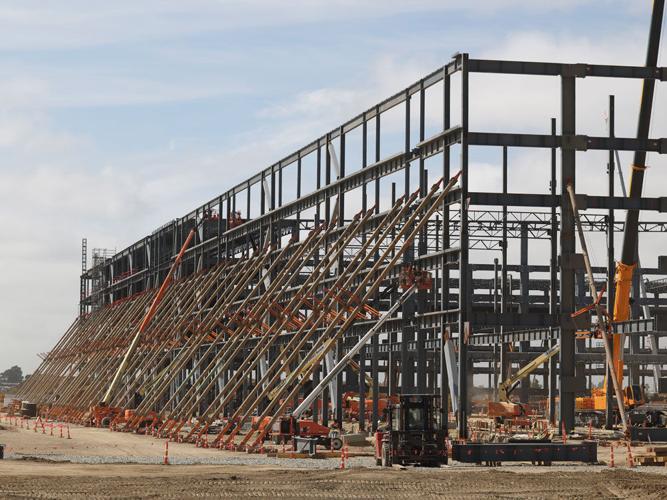
The new Amazon warehouse is shown under construction in April 2025.

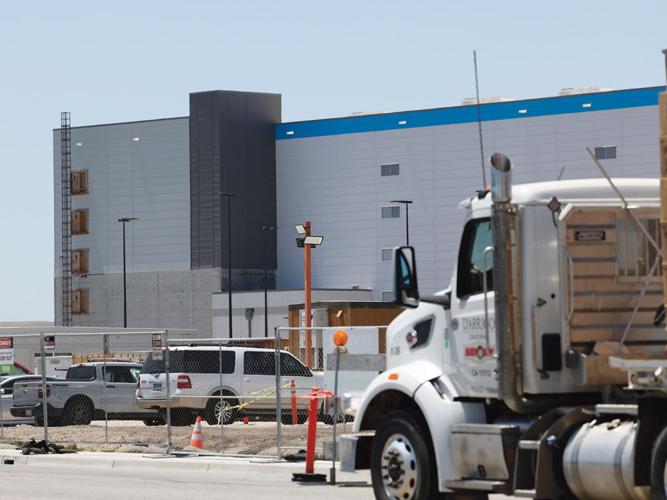
The former agriculture field at the corner of Abbott Street and Harris Road has undergone a transformation in under two years. Shown from top, the first bulldozers arrived on site in September 2024. By April 2025, the structure of Amazon’s facility began to take shape. Currently, the exterior of the structure is nearly complete as work continues inside.
ON MAY 26, the Salinas City Council got its first look at the city’s budget for the next two years.
A report to the council noted deficits were likely over the next three years due to economic uncertainty fueled by rising inflation and worldwide conflicts.
Councilmember Andrew Sandoval took note of a plan in the budget documents to reallocate nearly $2.6 million in funding for various road improvements to repaving Abbott Street.
That road, he said, is heavily trafficked by agricultural trucks, and once Amazon goes operational, it will only get busier. He suggested the city instead tax the ag industry and Amazon for road improvements.
“We shouldn’t be in a position where we’re picking and choosing between certain improvements in our community,” Sandoval said. “If we reallocate those funds to specifically Abbott Street, I’m concerned the promises that we made to residents to fix those [other] streets are not going to be able to be honored.”
Amazon paid $10 million in traffic impact fees to the city, Sandoval said, but both he and Councilmember Margaret D’Arrigo questioned why those funds were not showing up in the budget report.
City Manager René Mendez confirmed the city did receive the money, which was placed in an impact fund that cannot be used for general purposes. That fund has a list of projects that are under development, which will be presented to the council in about a year, according to Mendez, adding that a more detailed budget report with those numbers will be available soon.
New development pays impact fees, which are used to fund various projects in the city, but such fees have been lacking recently, Mendez noted.
“There just has not been a lot of development and growth in Salinas over the last several years,” Mendez told the council. “When development occurs, they pay their share.”
That share can be seen in documents obtained by the Weekly through a California Public Records Act request. Scannell Properties has been dishing out impact fees to various entities, including $420,831.71 to Spreckels Union School District and $597,656 to Monterey One Water.
The arrival of Amazon could be the catalyst for future development in Salinas, Donohue noted in his State of the City speech.
“This is more than a company,” he said. “It is a signal that Salinas is on the map for major investment. It means jobs, economic activity and new possibilities for our residents.”
IN THE 2020S, Amazon has been making headway into the region.
In 2021, it opened a nearly 130,000-square-foot delivery hub near the Hollister Municipal Airport in San Benito County. Four years later, a more than 1-million-square-foot facility was completed a few miles north.
Amazon recently broke ground on a 438,000-square-foot data center and energy storage facility in Gilroy, at the southern edge of Santa Clara County.
Similar to the Salinas project, all of these facilities have taken over former agricultural land.
Despite their massive size, these facilities are on the relatively smaller side in Amazon’s portfolio. The company’s largest in the world is located in Ontario, California, a 4.5-million-square-foot warehouse that extends up to six stories.
Six other facilities range from 3.6 million square feet to 3.8 million square feet, in states such as Oregon, Rhode Island, Virginia and others, according to Damotech, a company that focuses on warehouse safety.
So at 3.2 million square feet, Salinas’ Amazon facility puts it in the company’s top 10 largest in the world.

As the first to build in the Salinas Ag-Industrial Center, Amazon is required to construct new roads and other infrastructure in the area.
According to a development application filed with the city, plans call for 60 loading docks, 318 trailer parking stalls and 1,103 parking spaces, with 258 delivery trucks expected to go in and out daily.
An environmental review of the Salinas Ag-Industrial Center was conducted in 2009. It examined the impacts of a fully built-out center, and under the California Environmental Quality Act, individual projects in the center, such as Amazon, do not require a separate review, so no analysis of the specific figures above was conducted.
Roughly 1,600 employees are expected to be hired.
Amazon spokesperson Natalie Banke says the facility is considered a “robotics fulfillment center,” where employees pick, pack and ship customer orders.
“Employees often work alongside robots, helping keep employees safe by doing the heavy lifting and enabling them to learn new, more technical skills,” she says.
In a 2025 radio interview, Luis Alvarez of Salinas-based Alvarez Technology Group described Amazon’s new Vulcan robot that will be operational in the facility. The robot is able to “feel” items, determining how much pressure it needs to exert in order to grab them without crushing them.
“They’ve got a new robot that may actually replace humans,” Alvarez said. “Amazon does say this is not going to eliminate any jobs.”
He added that with each new facility it builds, Amazon learns how to incorporate technology to make its processes more efficient.
“This [Salinas facility] is going to be the most high-tech one in the entire Amazon ecosystem when it’s built,” Alvarez said.
When the facility will go live is still in the works, according to Banke. Internal documents within the city show Amazon is projecting it will open later in 2026.
ROBOTS may not need vehicles to get to their job – they’ll be living where they work – but the humans working with them do.
Abbott Street is a four-lane road that runs parallel to Highway 101. It’s a busy stretch of road, with farmworkers tending the fields and workers commuting into the Firestone Business Park.
Follow Abbott Street south, and it merges onto the fast lane of southbound Highway 101 toward South Monterey County. Heading onto northbound Highway 101 from Abbott Street is a different story.
It’s a maze of intersections, narrow roads and crumbling pavement through various industrial areas before hitting Airport Boulevard, crossing over an interchange that frequently clogs with traffic. From there, it’s another right on what looks like a side street in Roy Diaz Street, which eventually curves into an onramp for northbound Highway 101.
What percentage of employees commute to work in a personal vehicle versus public transportation remains to be seen – documents filed with the city show plans for 1,103 employee parking spaces. Carl Sedoryk, general manager/CEO of Monterey-Salinas Transit, says the agency has been in contact with Amazon to come up with ways to reduce traffic congestion around the facility.
Options include Amazon funding the extension of existing bus routes, adding new routes or the company providing subsidies to employees to participate in MST vanpools. Amazon is waiting for the results of a traffic study before it proceeds, according to Sedoryk.
Ask commuters in the area about the new Amazon facility, and they’ll likely question how the inevitable added traffic will further congest the streets. The expected added time to get to home may be an inconvenience for many, but for some businesses, it could hurt their bottom line.
Norm Groot is the executive director of the Monterey County Farm Bureau, whose office is located on Abbott Street near its intersection with Harkins Road, where northbound traffic from Amazon is expected to travel.
The area is home to various agricultural shipping and cooling facilities, including Taylor Farms, Tanimura & Antle and D’Arrigo Brothers.
The major concern, Groot says, is how traffic delays will impact freshly harvested product that is on its way to a cooling facility, when minutes can determine whether it ends up in a store or landfill.
“It’s the critical crunch time,” he says. “Every delay impacts the product itself and whether or not it will have a shelf life.”
Work has been in the planning stages for years to mitigate the increasing amount of traffic in the area, long before Amazon came to town. But those projects will come to be long after Amazon is operational.
The US 101 South of Salinas Project, developed by the Transportation Agency for Monterey County and Caltrans, plans to add a network of new frontage roads along Highway 101, as well as reconstruct the interchange at Abbott for northbound and southbound traffic, and upgrade the Chualar interchange, among other things – likely by 2031.
In the meantime, an auxiliary lane was added on Highway 101 for vehicles entering from Spence Road in 2023.
Later this year, temporary barriers will be placed at 11 uncontrolled intersections between Salinas and Chualar to prohibit traffic from making left- or U-turns onto side streets. Permanent barriers are expected to be completed by the end of 2027.
The overall project, which includes new interchanges, is currently in the environmental review phase, according to TAMC, with Caltrans seeking grant funding for the first phase of construction at the end of 2026.
That gap between Amazon going live and when the South of Salinas Project is completed is what concerns Farm Bureau members the most, Groot says.
Representatives of the business community came up with some plans to help mitigate traffic, Groot says, such as retiming traffic lights and restriping lanes, that they submitted to the city, which has retained a consultant to look into the traffic.
“There’s a lot of concerns about how traffic is going to be handled,” he says. “I’m hoping we can get some sort of relief in the meantime.”
SUCH CONCERNS over traffic, and the city’s internal approval of the project, were the subject of a lawsuit filed in 2024 against the City of Salinas by two Salinas residents and the International Brotherhood of Teamsters Joint Council 7.
The suit challenged Carrigan’s 2021 decision to loosen a use restriction on the property, and the Community Development Department’s approval of the facility’s site plan on Sept. 17, 2024. In both cases, the suit alleges the city did not provide the required public notice or conduct an environmental study on the amendment.

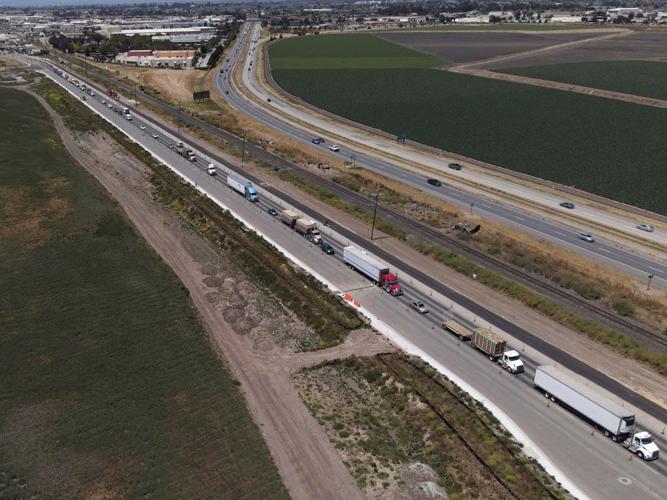
Abbott Street, which runs parallel to Highway 101, frequently backs up with trucks and other traffic from nearby industrial and agricultural operations. A project is years away to improve access to the highway.
“The project… will generate a substantial quantity of truck and other vehicle traffic on local roads, will cause significant impacts on the environment, not to mention public health and safety, that were never disclosed, evaluated or mitigated,” according to a petition written by attorney Mark R. Wolfe.
The city denied the allegations.
Monterey County Superior Court Judge Carrie M. Panetta sided with the city in a December 2025 ruling.
“The specific plan contemplates future changes and was intended to be interpreted broadly and with flexibility to encompass new and unforeseen facilities,” she wrote. “Therefore, the actions by the City do not appear to constitute an abuse of discretion.”
The city sought to have the plaintiffs pay its attorney fees of $42,000, but that request was dropped on March 16.
The Salinas Ag-Industrial Center was envisioned as benefiting the agriculture industry. But with city officials striking a few words in the plan, which paved the way for Amazon and the concerns over traffic, will the area now hurt the industry in an ironic twist?
Groot says that remains to be seen.
“Everyone is looking at how this is going to play out in the next five to 10 years,” he says. “We will really see how it plays out with this traffic mitigation and whether we can continue to move product to those facilities.”
Those 1,600 workers will have to come from somewhere, and those who may have been thinking about working in Monterey County’s largest industries – agriculture and hospitality – may be enticed by what Amazon has to offer.
Banke says Amazon will offer health care coverage for employees and their families, 401(k) matching, up to 20 weeks of paid parental leave and pre-paid college tuition.
“I’m sure both agriculture and hospitality are concerned about where these workers are going to come from,” Groot says. “There’s probably some who will make that change and leap into something where they can work inside and in a closed environment. Let’s just say they have comparable wages in both of those sectors.”
(0) comments
Welcome to the discussion.
Log In
Keep it Clean. Please avoid obscene, vulgar, lewd, racist or sexually-oriented language.
PLEASE TURN OFF YOUR CAPS LOCK.
Don't Threaten. Threats of harming another person will not be tolerated.
Be Truthful. Don't knowingly lie about anyone or anything.
Be Nice. No racism, sexism or any sort of -ism that is degrading to another person.
Be Proactive. Use the 'Report' link on each comment to let us know of abusive posts.
Share with Us. We'd love to hear eyewitness accounts, the history behind an article.