
Sara Rubin here, taking a look at the numbers. Yesterday, the California State Senate and State Assembly both passed Assembly Bill 109, the Budget Act of 2026, more simply referred to as the state budget. By 11pm, it was handed over to Gov. Gavin Newsom seeking his final blessing and signature.
The $253 billion budget is massive by nature, with plenty of 10-figure line items. The budget allocates funds for the state’s education system (including state universities), the courts and the justice system, Medi-Cal, elections administration and beyond—it spells out the dollar figures that will go where to provide services and run the government for the next two years.
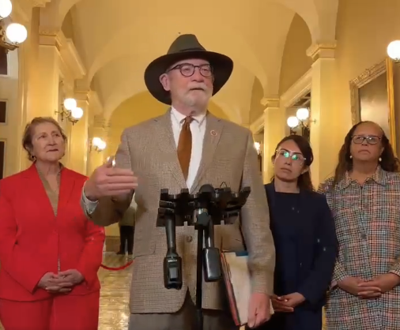
State Sen. John Laird, D-Santa Cruz, chairs the Senate Budget Committee. Immediately after the chamber voted yesterday, he and Senate Pro Tem Monique Limón, D-Santa Barbara, held a press conference in the Capitol.
In his remarks, Laird emphasized two things. One was the sheer amount of work that went into the process. “We did more work on this budget than is usually done in a year,” he said. He noted a day-and-a-half-long retreat among Senate Democrats, followed by 54 hearings in budget subcommittees, then another six for the full committee.
The other was the intent to mitigate the federal cuts coming from HR 1, known as the “One Big Beautiful Bill.” Laird said, “We cannot backfill each one of those cuts but we can triage against them.”
It is a reminder that California lawmakers and the federal administration are mapping out two entirely different versions of reality, with opposing ideas about the role of government and how it should operate.
“Trump’s agenda is failing, prices are rising, and his cuts are gutting the programs working families rely on most,” Assembly Speaker Robert Rivas, D-Hollister, said in a statement. “This budget fights back…We’re not waiting for Washington to get its act together.”
Some of that fight back shows up in a budget that acknowledges the reality of poverty and diminished federal support for social services. The Legislature approved $100 million for CalFood to support stocking food banks; it includes $16.5 million for diaper banks. It allocates $100 million in new funding (for a total of $175 million) for legal aid for immigration services.
Of course, even with these efforts, not every request got approved. Last week, on Thursday, June 11, a group of immigrant workers and advocates gathered outside of Rivas’ district office in Salinas pushing for a $500 million one-time allocation to establish the Immigration Enforcement Emergency Relief Fund that would offset lost wages for families caught up in ICE actions.
“People are being kidnapped and deported, and families are being left without breadwinners,” says Melissa Ojeda of the Warehouse Worker Resource Center. The requested funds, however, are not included in the budget bill.
There are other line items that soften the blow to immigrant community members, primarily by delaying health care and dental insurance policy changes that would have immediately dropped undocumented immigrants.
It doesn’t solve every problem because it can’t, but it should minimize harm. As Limón said yesterday, “The priority is to solve the problems we have in front of us now.”


(1) comment
First of all, the article blames the "Big Beautiful Bill" for California being in a poor financial position. Must you be reminded this state was in deep financial trouble before Trump took office and long before the "Big Beautiful Bill" was signed into law? Governor Newsome had a surplus when he took office and even bragged about the surplus later in his tern, then managed to squander it away. The legislature can also shoulder some responsibility for that.
Second, do you also need to be reminded that illegal immigrates are actually illegal? They were all given the opportunity to return to their home country with a thousand dollars in their pockets, an offer which many claimed. We all make choices in our lives and none of us make 100% good choices, but we have to live with the bad choices we make. Illegal immigrants are also humans like the rest of us who must make choices, who also must be prepared to live with them good or bad. I certainly can be sympathetic to the extreme cases, but those are in the great minority.
Welcome to the discussion.
Log In
Keep it Clean. Please avoid obscene, vulgar, lewd, racist or sexually-oriented language.
PLEASE TURN OFF YOUR CAPS LOCK.
Don't Threaten. Threats of harming another person will not be tolerated.
Be Truthful. Don't knowingly lie about anyone or anything.
Be Nice. No racism, sexism or any sort of -ism that is degrading to another person.
Be Proactive. Use the 'Report' link on each comment to let us know of abusive posts.
Share with Us. We'd love to hear eyewitness accounts, the history behind an article.