

The bloody tragedy of Macbeth, first performed in 1606, was reportedly riddled with real-life tragedy. An actor died unexpectedly, so playwright William Shakespeare himself was tapped to fill in on stage. A prop mishap, in which a real dagger was used onstage rather than a fake, led to another actor’s death during the play.
So it was that the story of an aspiring king, cursed by a prophecy delivered from three witches, came to be known itself as a cursed play. According to theater lore, real witches were angry at Shakespeare for using text from a real-life spell so they put a curse on the play. This has led to theater people to avoid naming the play, instead referring to it as “the Scottish play.”
Given all of that context, it’s a bold undertaking for any theater company, especially one that’s brand new. After producing an abridged Henry V at a bar, New Canon Theatre Co. is currently debuting its first full-length play on a traditional stage, with Macbeth running through Sunday, Aug. 6 at the Carmel High School performing arts center.
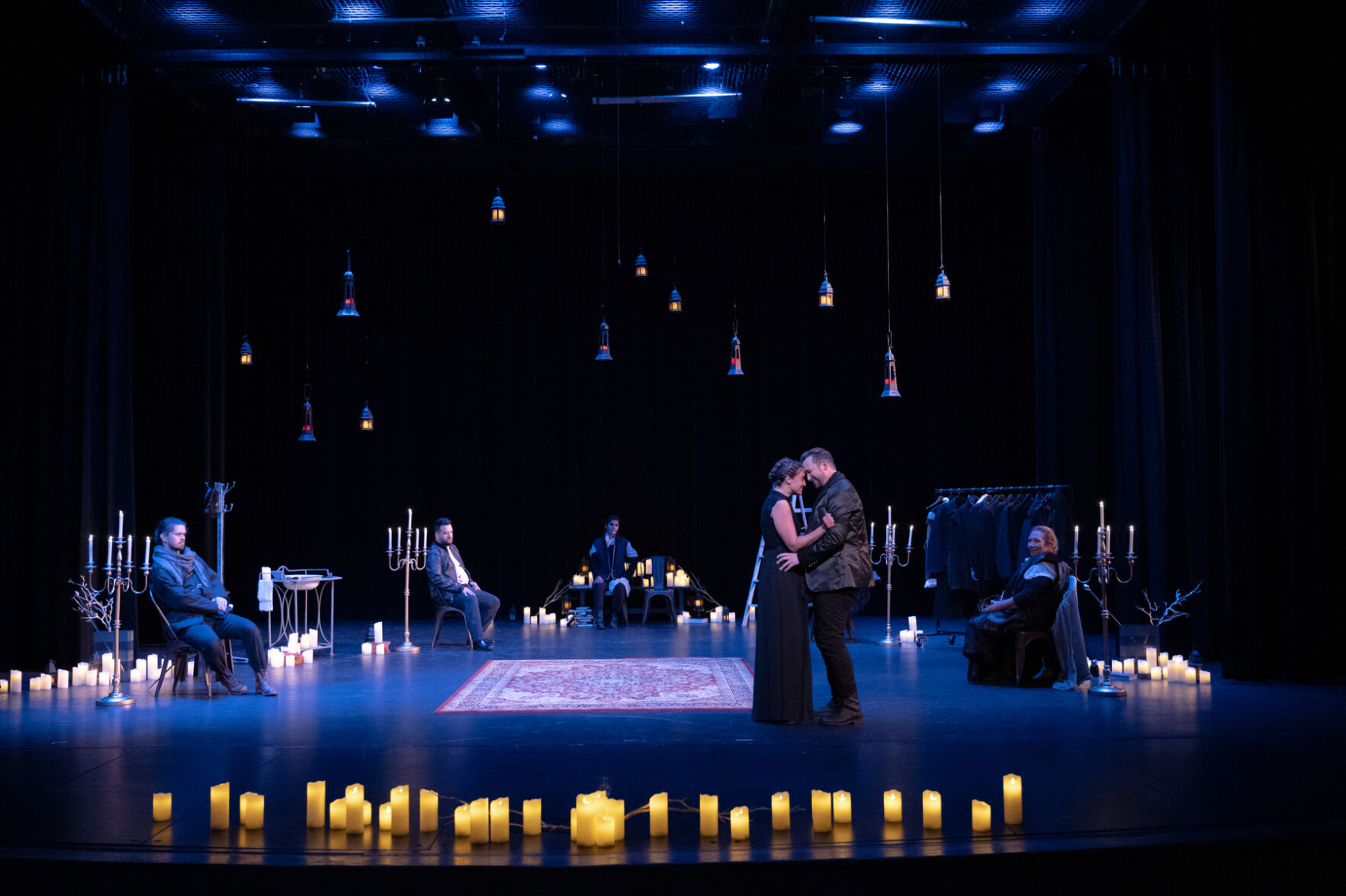
It’s a high-energy production, especially the shorter, bloodier second act. Just eight actors share all the roles thanks to quick costume changes, many of which happen on stage in sight of the audience—the three witches don white headscarves when they transform into the Weird Sisters. Lady Macbeth changes out of her black attire into a blue dress to become Lady Macduff for a brief scene.
There is a lot of movement in the script, with characters on the run from power-hungry, bloodthirsty Macbeth, then mounting a military battle to take him down. This pared-down production achieves all of that movement and storytelling with just one unchanging set, a chamber flanked by dozens of candles, and with just a few essential props.
Instead of appearing only at the beginning of Act 1 and Act 2 with incantations (“double, double toil and trouble/ Fire burn and cauldron bubble”) and their prophecies about Macbeth becoming king, and how he will die, in New Canon’s Macbeth, the witches don’t just disappear—they reappear throughout the entire play, lurking and laughing around the periphery, seeming to guide Lady Macbeth’s and Macbeth’s murderous decisions every step of the way. It might give the impression that these witches are ultimately responsible for the power-hungry couple’s choices.
But Shakespeare has always served humanity as Freud before Freud, psychologizing not only family lives, but giving us a still-universal, still-relevant take on politics and societies. While the witches might be mad at Shakespeare, they really shouldn’t be—he had used them as embodiments of dark urges and desires hidden in every human psyche. They are ugly and they screech because our dark sides are ugly, screechy and in conflict with our other traits. The witches are not controlling Macbeth as much as they seem here to represent a giving in to those darker urges.
Speaking of shrieks, New Canon is not afraid to be loud and have some fun with it. There are a few shrieks, sometimes from offstage, that help tell the story of violence. Lady Macbeth, played with an unwavering intensity by Volcano Jones, makes some noise, as convincing in her plotting, joyful greed for social advancement as she is later, in a white gown, unhappy and tormented, a haunted ghost of herself rubbing her hands with the famous line: “Out damned spot.”
While fulfilling all the requirements of traditional Shakespearean theater—because it can be said that Macbeth by New Canon Theatre Company is a success—the performance is firmly set in a modern agreement with the audience, which itself becomes an invisible river into which pebbles are being thrown (literally, by one of the noblemen of Scotland, who skips invisible stones in our direction).
A special recognition is owed to Nicola Reilly, a one-woman orchestra, who not only provides a haunting violin theme to each character—Leonard Cohen’s “Avalanche” for Macbeth and Nancy Sinatra’s “Bang Bang” for Lady Macbeth—but also bells in a few places, and an epic cackle. The musical themes are drawn not from Shakespeare’s day but from modern songs, some of them recognizable to audience members. The music creates an eerie undertone to the story, with violin music going simultaneously with the dialogue. When it abruptly stops, it’s a cinematic cue: A dramatic conversational or action moment is about to take place.
In a production like this, with just a few actors playing multiple characters, good acting is a requirement to help the audience follow along and keep pace with the who’s who. In a Shakespearian story of betrayal, modern audience members need clear facial cues to know who is good, who is bad and who to trust. This cast delivers, especially in Act 1, which includes a lot of decision-making—will or won’t Macbeth betray his countrymen and friends in a murderous pursuit of power?
The second act involves less contemplation and more battling, including a classic sword-fight scene that feels a little bit too staid, lacking the high energy and movement that otherwise happens all across the stage throughout.
With its first production, New Canon shows an eagerness to deliver on its goal, entering an already-crowded local theater scene with a fresh and relevant take on a classic play.


(0) comments
Welcome to the discussion.
Log In
Keep it Clean. Please avoid obscene, vulgar, lewd, racist or sexually-oriented language.
PLEASE TURN OFF YOUR CAPS LOCK.
Don't Threaten. Threats of harming another person will not be tolerated.
Be Truthful. Don't knowingly lie about anyone or anything.
Be Nice. No racism, sexism or any sort of -ism that is degrading to another person.
Be Proactive. Use the 'Report' link on each comment to let us know of abusive posts.
Share with Us. We'd love to hear eyewitness accounts, the history behind an article.