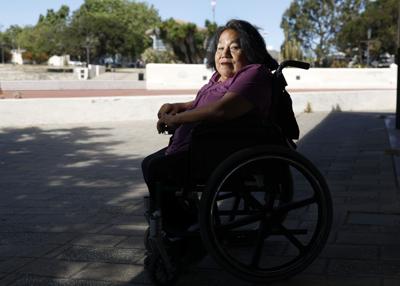

Music lover Tonia Eaton has adapted to life in a wheelchair, continuing to show up for live shows.
Growing up in small-town Alaska, Tonia Eaton played alto saxophone and sang in a choir. As a child, she thought she might become a musician. Her interests developed in a different direction and she found her way into a career in tech, but she never lost her affection for live performance. “I really respect anyone who’s on the stage, even if I don’t like the music,” Eaton says.
She moved to Salinas during the dot-com boom years, commuting to a job as a web designer in San Jose. She was always on the go, out for shows all the time. Then the dot-com bust left Silicon Valley looking like a ghost town, and osteoporosis left Eaton with diminishing mobility.
She started to focus on her own community of Monterey County, where she discovered a surprising amount of music venues. “You can’t possibly do as many things as you would want to do—there’s something going on almost every day,” she says. “The audience can draw out the best in a performer, and I think Monterey County has an engaged audience.”
Advancing osteoporosis led to an increasingly severe disability, eventually landing Eaton in a wheelchair, her bones too weak for walking safely. But she views her wheelchair as an enabling tool, rather than a constraint: “Otherwise I’d be in a nursing home,” she says. “I would be stuck.”
This way, she can live independently and, with the help of Monterey-Salinas Transit Rides, get around to venues for live music—and bookstore events, theatrical plays and restaurants—all over Monterey County. She started writing about musicians and landed a job as a freelance music writer for Monterey County Weekly, the sister publication of Salinas Valley Now. She still works as a web designer (from home).
Eaton has become attuned to accessibility, noting that some venues are not accessible in practice, even if they claim to be so in theory. She has gotten comfortable notifying venue management of obstacles they might overlook, like curbs or even a single step. “I need to be an advocate sometimes,” she says. “Some people don’t speak up, and I am willing to.”
She says it’s important that the general public understands no two disabilities are alike, and to avoid making assumptions. “There is a spectrum of mobility,” she says.
Travel logistics are more complicated and Eaton’s schedule revolves around MST’s, but she still makes a point of getting where she wants to go as a fan of live entertainment. And she feels grateful. “I super appreciate when I get to go out and sit at a coffee shop and look at the ocean,” she says. “People don’t realize you can just do that any day of the week. It’s quite a trek to get out there, and just say: wow.”


(0) comments
Welcome to the discussion.
Log In
Keep it Clean. Please avoid obscene, vulgar, lewd, racist or sexually-oriented language.
PLEASE TURN OFF YOUR CAPS LOCK.
Don't Threaten. Threats of harming another person will not be tolerated.
Be Truthful. Don't knowingly lie about anyone or anything.
Be Nice. No racism, sexism or any sort of -ism that is degrading to another person.
Be Proactive. Use the 'Report' link on each comment to let us know of abusive posts.
Share with Us. We'd love to hear eyewitness accounts, the history behind an article.