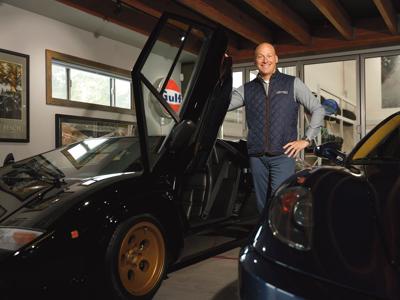

When Vince Finaldi first came to see a 12,000-square-foot former cannabis extraction facility in Del Rey Oaks, he says the building was desolate. “It looked like it was out of the movie Saw,” he says.
But he had a vision for a boutique European auto shop, and Finaldi Inc. started in 2020, peaking at nine employees (there are currently five on staff). Today they occupy a pristine space where collector cars are on the floor – some getting ready for auction at Car Week, others actively being worked on.
He grew up with cars – his Italian immigrant father worked for General Motors and at a shop back in Italy, and then continued out of the family’s home in Southern California. Finaldi learned the trade, but took a different career path. He joined the military out of high school (“I picked the Marine Corps, because if you’re going to do it you might as well do something hard.”) and then went to college, curious about science or medicine. But he soon learned he had an aptitude for law and went on to become a partner in a law firm that handled sexual abuse cases, seeking justice for children haunted by experiences in schools, athletics or religious communities. (A case involving the Diocese of Monterey brought Finaldi to Monterey County in the 2010s, when he fell in love with Carmel Highlands, and later relocated from Southern California.)
In January, he became president of the Concours d’Elegance and will take over as chairperson this fall, taking the baton from Sandra Button, who held the leadership role for decades.
Weekly: Tell me how you got tapped to become the new chairperson of Concours.
Finaldi: They said, it’s easy to find a car person who knows a lot about cars, but they don’t know anything about running a business – and it’s easy to find a business person who knows nothing about cars. I said, “I’m not just a Concours person, that’s not me.” I buy cars, sell cars, fix them, do mechanical work, paint work, that’s my niche.
Then I learned that a lot of their ideas about Concours and where it’s going align perfectly with mine.
What direction is it going?
There are certain headwinds with automotive collecting and events, as some of the older collectors are aging out and passing away. It’s not the same for kids as it was when we were young.
My group of friends, on their 16th birthday, 90 percent of them were at the DMV taking their driving test. Today, 20-year-olds don’t even have a license yet. In many respects, the car meant a big step up in personal freedom, you get to make your own rules. Now, when they get their phone is when they get that freedom.
Ideas about how to bring in more youth and keep the event vibrant – allowing in newer cars that resonate with a young crowd – are very important to me.
How do you achieve that?
Young adults don’t have the funds to afford a ticket to a world-class concours. A concession can and should be made for the age range 12-21, so they can attend.
Car Week has grown to be many dozens of public and private events well beyond the Concours. How is that going?
I think all the events are great, and I’ve gone to almost every single one. We all get along, there’s room for all the events here. One thing is if people don’t have the money to go to Concours, they stand on the street. One big problem is takeovers and crowding. How do you fix the influencer problem? In part by giving young people a place to go – I think you can kill two birds with one stone [by lowering youth ticket prices].
Tell me about your relationship to cars. Do you keep them forever?
I grew up in the car world where it was a business. I learned early on that you don’t get attached. My dad imported and exported cars. I’d fall in love with these cars. I’d come home from school and they’d be gone. By the time I was 15, I saw cars as a commodity.
But you have cars you love – do you see them as art, or as a way to get around, or a combination?
If a car won’t drive, if it can’t make it to Big Sur and back, then you’re really stretching it calling it an automobile.
The first thing an automobile has to do is to function. If it can’t, what it looks like doesn't really matter to me. You can make the most beautiful sculpture in the world but if it doesn’t function, it’s not a car.
What’s your day-to-day ride?
It’s just a Mercedes SUV. But I use these cars as well. I’ll drop my kids off at school; they get embarrassed showing up in a fluorescent green Porsche.
Do you speak Italian?
Enough, conversationally. We had metal workers here from Italy, but with the administration’s changes to the visa program, they went back. Between that and tariffs, it really wreaked havoc on the restoration business because most parts come from overseas. Now, it’s become more predictable.
In your law practice, you've represented victims of abuse by adults they trusted. Do you get depressed about all those stories?
You can’t do that type of practice for 22 years unless you are able to set boundaries and compartmentalize things, but everyone who does that type of work has a threshold.
You do it long enough and you hear almost every story there is. You care about your clients and have empathy for them but no one can take all their pain in. You get to a critical mass—it’s not that you can’t care anymore, but it becomes just like a job. I felt like I wasn’t being intellectually stimulated [anymore] and I didn’t think that was a service to my clients, partners or family. I need to be stimulated; I get up early and I hit the ground running every day.


(0) comments
Welcome to the discussion.
Log In
Keep it Clean. Please avoid obscene, vulgar, lewd, racist or sexually-oriented language.
PLEASE TURN OFF YOUR CAPS LOCK.
Don't Threaten. Threats of harming another person will not be tolerated.
Be Truthful. Don't knowingly lie about anyone or anything.
Be Nice. No racism, sexism or any sort of -ism that is degrading to another person.
Be Proactive. Use the 'Report' link on each comment to let us know of abusive posts.
Share with Us. We'd love to hear eyewitness accounts, the history behind an article.