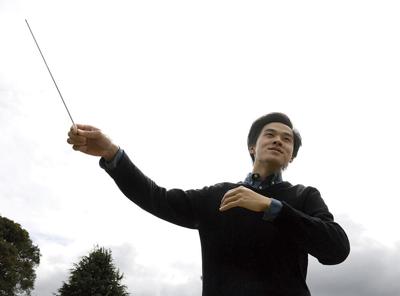

Music has long played an important role in the young life of Alan Truong, a Salinas native. He joined Youth Orchestra Salinas when he was 11 years old, learning instruments such as viola, clarinet and bassoon, which became his main focus.
Truong comes from a family of immigrants and refugees that moved from China to Vietnam and lastly to America. He earned his bachelor’s degree at Oberlin Conservatory of Music in Ohio. Truong, now 22, has been serving as assistant conductor at the nonprofit YOSAL (Youth Orchestra Salinas) before heading to the famed Juilliard School in New York this fall, where he will study the art of conducting an orchestra.
Truong says conductors have influenced his musical career the most, and that has motivated him to take on the role. In the future, he hopes to inspire other musicians in the same way.
Aside from music, Truong likes to cook and he sees it as a way to preserve his culture.
Weekly: When you face an orchestra for the first time, what is a conductor’s goal?
Truong: Can you make your personality known to this orchestra in 15 minutes, and convince them to be on your side and support what you want them to do? Support not just your vision for the music, but it’s also everybody’s collective vision – because how they play affects what you think, and what you think affects how they play.
What is the most important task of a conductor?
I think a conductor should do whatever they can to make the experience of the musicians and of the audience very worthwhile. Today you can go on the internet, you can find the most amazing recorded performances of pieces that have been performed millions of times since they’ve been written. If you can make a new experience – a new and interesting, exciting experience – for the musicians that you’re conducting, and for the audience that’s listening, I think that is probably the most important thing.
How important was YOSAL in getting you started?
The reason why YOSAL is so important to me is that it is the very first step in a very long musical journey. Without YOSAL, I don’t think I would be a musician. What they do is they provide an opportunity, regardless of whatever circumstances you are in, so that every child can have this special opportunity to learn music.
Why do you think without YOSAL you wouldn’t have pursued a career in music?
I, like many other children here in Salinas, do not have the financial opportunity to pursue music. A lot of our parents do not have the means to support a traditional musical education path, which is, you know – you have to buy an instrument, which can cost thousands of dollars. And then pay weekly for lessons, which can add up to a lot of money in a very short amount of time.
You mentioned that conductors inspired you. Does one stand out?
Farkhad Khudyev [former music director at Youth Music Monterey County]. Out of every musician that I’ve met in my life, he is the person who is most like himself, who is just so dedicated to music in the sense that he is free, and that’s something that I hope to attain someday.
You auditioned at different schools. How do you prepare when you don’t have an orchestra in front of you?
Basically, you just have to learn the music very, very, very well and then you have to be able to move your hands through the music. And then you have to think about all the things that you might want to say. Everybody has different opinions on how to do this part of the process. But when it comes down to it, you just have to know the music extremely well to be able to connect with the musicians.
Let’s turn to cooking. Is there a dish that you like to prepare the most?
The dish that feels like home is fried rice. You know, it’s so simple, but it can be so complex. The technique, the execution – just like in music, there are a lot of pieces that are very simple, but when it comes down to playing it really well, can you play every note in tune? Can you play it with the correct inflections? Can you play it with all these nuances? It’s the same thing when I’m making fried rice.


(0) comments
Welcome to the discussion.
Log In
Keep it Clean. Please avoid obscene, vulgar, lewd, racist or sexually-oriented language.
PLEASE TURN OFF YOUR CAPS LOCK.
Don't Threaten. Threats of harming another person will not be tolerated.
Be Truthful. Don't knowingly lie about anyone or anything.
Be Nice. No racism, sexism or any sort of -ism that is degrading to another person.
Be Proactive. Use the 'Report' link on each comment to let us know of abusive posts.
Share with Us. We'd love to hear eyewitness accounts, the history behind an article.