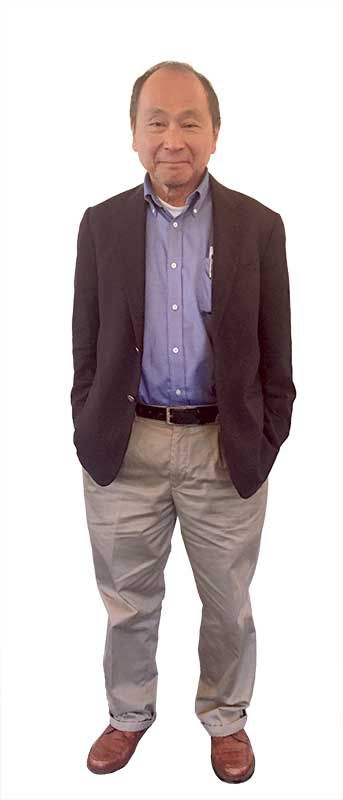

When Francis Fukuyama is listening to a question, his eyes are laser-focused, his face still. He is a portrait of deep reflection, and has been so influential in the field of political science that in 2009, Foreign Policy ranked him number 65 in a list of the world’s top 100 thinkers. (He’s dismissive of accolades: “It’s ridiculous.”)
Fukuyama – a part-time resident of Carmel and a senior fellow at Stanford – started his path as a philosophy major at Cornell University, and was a student of the famed late philosopher Allan Bloom. As a graduate student, he studied political science, and went on to work for the RAND corporation, followed by stints in the Ronald Reagan and George H.W. Bush administrations. In 1989, he published an article in The National Interest titled “The End of History?” that brought him acclaim, and led to a 1992 book titled The End of History and the Last Man, which launched his international reputation.
His 1989 article’s hypothesis, as he says, is the “idea of history as a progressive ideology that terminated in liberal democracy.” (It’s complicated – more later.)
The Weekly caught up with Fukuyama in July just before he was set to speak at a luncheon put on by the World Affairs Council of Monterey Bay, a nonprofit that hosts discussions about heady topics of the day. Much has happened globally and nationally since the interview – remember Obamacare? – but that ever-shifting landscape is at the top of his mind.
“I’ve looked a lot at political institutions in developing countries over the last 10-15 years,” he says, stifling a chuckle, “although I must say that given what’s happened in the United States, I’ve increasingly turned my attention to American politics.”
He is not alone.
Weekly: What do you mean when you say history terminates in a liberal democracy?
Fukuyama: The idea that there’s a progression of types of institutions as you go from a very poor agrarian society up to a modern capitalist democracy. Karl Marx said the end of history would be communism, that we’re all evolving our political and economic systems, and the final one was going to be a communist utopia. My observation was that we were indeed modernizing and developing, but that we were never going to reach the communist stage. We would end up at the one before that, which was some form of democracy and market economy.
How do you reconcile that with the subject of your talk today, the rise of global populism?
When I wrote the article there was a question mark at the end. The big question right now is that you’re seeing a backlash, not against democracy so much, but the liberal part. Certain people don’t like globalization, they don’t like open borders and free trade, and a lot of the things that have been associated with the liberal world order that’s been created over the past couple of generations.
Trump, Brexit, Putin and a lot of forces in the world are trying to push back against that. I have an open mind – this was a hypothesis, that liberal democracy would be that kind of final form of government – but now we seem to be going backward, and that’s perfectly possible.
Many workers in this country are increasingly feeling left out. With globalization and mechanization, how can we serve all the people?
It’s not clear that we can. The problem is technology, and it’s not clear that you can put controls on things like self-driving cars or automated factories. Americans have been steadily trying to dismantle the welfare state, and I think that pushes in exactly the wrong direction.
Why do you think Obamacare was so vehemently opposed by the right?
I think a lot of it was driven by a deeper problem in this country, which is polarization and partisanship. The Obamacare provision that you can’t be denied insurance for pre-existing conditions, those all came out of the Heritage Foundation. These were conservative ideas in the prior health care debate.
Do you look to the future with optimism or pessimism?
I’m very worried about many things that have happened in the last few years because democracy has been under threat after a long period of growth, but people have overdone that sense of pessimism. It’s not as if we’re facing this inevitable wave of Trumps all over the world.


(0) comments
Welcome to the discussion.
Log In
Keep it Clean. Please avoid obscene, vulgar, lewd, racist or sexually-oriented language.
PLEASE TURN OFF YOUR CAPS LOCK.
Don't Threaten. Threats of harming another person will not be tolerated.
Be Truthful. Don't knowingly lie about anyone or anything.
Be Nice. No racism, sexism or any sort of -ism that is degrading to another person.
Be Proactive. Use the 'Report' link on each comment to let us know of abusive posts.
Share with Us. We'd love to hear eyewitness accounts, the history behind an article.