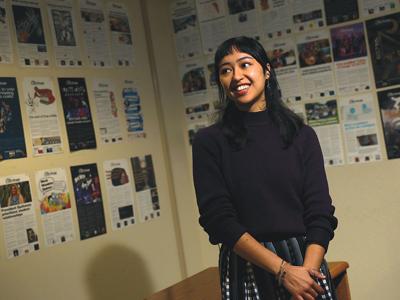

Just six years ago, dance was a passion for Layna Hughes. Journalism was merely an interest.
At the time, she was completing studies at Christopher High School in Gilroy, heading for Gavilan College. And she had been involved in ballet from the age of 2.
“When Covid hit, dance became harder to do,” Hughes recalls. “But I needed that busy feeling. I needed to find what’s me, outside of dance.”
That turned out to be journalism. Now 22, Hughes serves as editor-in-chief of The Lutrinae, CSU Monterey Bay’s student newspaper. After transferring to CSUMB, Hughes began writing as a contributor to The Lutrinae, quickly becoming a staff writer. Now a senior, she was named editor for the 2025-2026 school year.
Weekly: Talk about developing as a young journalist.
Hughes: The first article I ever did, I wrote out an embarrassingly long list of questions – they were complicated. I remember having my notebook out, I barely looked up at her the whole interview. I was glued to my notebook. Even during the interview, I could tell this wasn’t working out.
You get a knack for it. I’m going to let them lead me. I’ve done my research, but they are the experts.
You learn the importance of trust. I have to figure out how to maintain journalistic ethics while building trust. The quicker you build that trust, the more that person will be honest with you.
When I started, I went into being a reporter under the guise of wanting to get my voice out there. But journalism is being a blank canvas for telling other people’s stories. It’s less your voice than amplifying the voices of others.
Is it different being an editor?
It’s way different than I anticipated. I almost didn’t take the role because I love writing. Part of me misses the story side.
But being an editor, it really tests you. Yet it’s been valuable for me. I have an appreciation for people who know different things. I’m not an expert on the website or photography. There’s a synergy in the newsroom. It’s incredible getting to be captain of all that.
What’s your perspective on the state of journalism?
I don’t think it has to be gloomy. Journalists have always had to wear different hats. Now we wear more, with video and photography and social media. But to see young reporters, it gives me so much hope. I don’t think it’s a dying field – that’s a misguided perception. That’s not what’s happening.
A lot of journalists are scared that storytelling is more accessible – anyone with a phone. But with that accessibility, the quality goes down. That’s where we come in. With social media, media fatigue is real. With media fatigue more prevalent, people are learning to appreciate quality.
One of the things I learned early on was that some people will love your story, some will hate it and most won’t care either way.
You can’t always guarantee that a story will be received well. It’s interesting to see new reporters. They get negative feedback – welcome to The Lutrinae, welcome to the job. You have to know that you did the work. You can’t control how it will be received. We’re telling the truth. We’re reporting on what’s there, no matter how it sounds.
That’s why a newsroom is so tight knit. No one understands what we do. It can be isolating at times, honestly. But outside of the newsroom, we have each others’ backs.
What types of stories do you like to write?
I really like stories that are something we know students are talking about, but it’s speculative. There was a bomb threat at the library. Everyone had their own idea of what was going on. We have a unique opportunity to confirm or deny, which is huge. Being a reporter, I like that we can ask the questions all the students want to ask.
It’s a big deal. Journalism allows me into rooms that I otherwise wouldn’t be allowed into. That’s a responsibility.
Do you have free time?
Between being a student and an editor, that time is few and far between. With my background in dance, it’s important to move – dancing, or I really like swimming. It’s a full-body activity, which reminds me of dance.
You’re a senior. That means looking for a career.
I have this relentless optimism that I’ll find something or something will find me. It’s being open to the possibilities. My career path – I’m OK with it being unpredictable. I’m excited to keep learning.


(0) comments
Welcome to the discussion.
Log In
Keep it Clean. Please avoid obscene, vulgar, lewd, racist or sexually-oriented language.
PLEASE TURN OFF YOUR CAPS LOCK.
Don't Threaten. Threats of harming another person will not be tolerated.
Be Truthful. Don't knowingly lie about anyone or anything.
Be Nice. No racism, sexism or any sort of -ism that is degrading to another person.
Be Proactive. Use the 'Report' link on each comment to let us know of abusive posts.
Share with Us. We'd love to hear eyewitness accounts, the history behind an article.