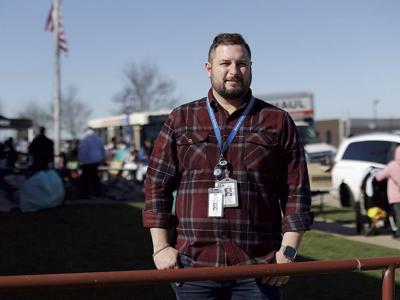

One of the steady voices during the surge of winter storms that soaked Monterey County was that of Daniel González from the Monterey County Department of Emergency Management. He was one of the people charged with providing interpretation in Spanish, as the county sought to reach thousands of residents with information in their own language about the latest conditions and changing evacuation warnings and orders. As such, González became an important source for many people.
González grew up between two countries, Mexico and the U.S. His parents were migrant workers who traveled back and forth as work demanded. So as a child he became fluent in English.
González went on to earn a bachelor’s degree in law in 2003 in Mexico, then moved to Salinas. (He later also attended Monterey College of Law.) He had heard much about the city from his grandfather Agripin Vazquez, a bracero who worked in Salinas Valley farms in the 1940s and ’50s.
He has since worn different hats – Spanish interpreter for Salinas Union High School District, legal coordinator, staff member and executive director at YMCA Monterey County and the executive director for Center for Community Advocacy (CCA), a nonprofit that empowers farmworkers to organize and engage civically.
González doesn’t discount the possibility of practicing law again, but sees working with the Department of Emergency Management as another way to help others.
Weekly: What brought you to county government?
González: When I was at CCA it really caught my attention, the level of need that our community had for information – especially when it came to access to resources and information that had to do with emergencies and services overall. They were really looking for somebody that could bring that connection to the community, establish connections with South County and some of the areas that have historically been impacted by a lack of information or lack of resources.
Your grandfather clearly had an influence on you growing up.
My maternal grandfather was a deep influence on me. He always encouraged me. If I had the benefit or the opportunity to receive an education or have access to information, I should utilize that gift to help the community, use that gift to support people, help them improve and help them live better. The fact that we were able to send notifications in [Indigenous Mexican languages] Triqui, Mixteco and Spanish was a great milestone for our area that you don’t necessarily see in other places.
Has your career path changed your views?
I stopped seeing myself as [being] in this box where I’m just the attorney. I got involved with a lot of the issues that our community was facing, and it really took me in a completely different direction. When the opportunity came to me, it opened up a completely different area. It showed me that I could do other things [beyond opening a law firm].
For example, improving revenue in the nonprofit so that we can continue doing more work, becoming successful at grantwriting or fundraising. I wasn’t really looking at that before, and it really changed my perspective. I didn’t think of myself as somebody that could do those things.
Your grandpa was a Cesar Chavez supporter, but you weren’t always as vocal about farm labor. Why is that?
My formal education was in Mexico. Over there, the farmworker movement wasn’t something that people shared a lot or talked about. For me, it was anecdotal. It was something – “Oh, yeah, my grandpa did that.” When I got here I realized the importance of that and what it meant for people who live here.
It seems there is some level of disconnect between people who live in Mexico and the people who live here in the States in terms of the struggles that people go through here. Sometimes, people in Mexico don’t realize the hardships that our migrant workers go through. There is this idea that “Oh, you came to the States and you’re just making a lot of money, or you’re well off. You forgot about your heritage.”
I started realizing what our community goes through when I first came in 2006. The second time I came – when I ended up staying – the hardships that our people face and what they go through to make sure their families have a better life became clear. Essentially that’s what we’re doing when we come here, right?


(0) comments
Welcome to the discussion.
Log In
Keep it Clean. Please avoid obscene, vulgar, lewd, racist or sexually-oriented language.
PLEASE TURN OFF YOUR CAPS LOCK.
Don't Threaten. Threats of harming another person will not be tolerated.
Be Truthful. Don't knowingly lie about anyone or anything.
Be Nice. No racism, sexism or any sort of -ism that is degrading to another person.
Be Proactive. Use the 'Report' link on each comment to let us know of abusive posts.
Share with Us. We'd love to hear eyewitness accounts, the history behind an article.