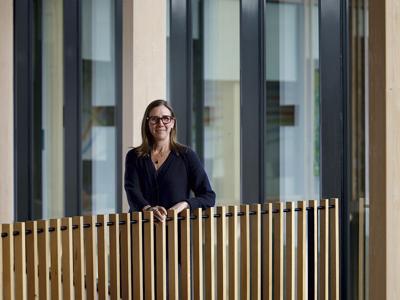

Early in her psychiatry career, Susan Swick tried a few different directions. There was forensic psychiatry, with tasks such as assessing a defendant to determine whether they acted with full mental capacity. There was work with inmates on Rikers Island. “It was really interesting work from an intellectual perspective, and it was heartbreaking,” Swick says. The repeat dilemma was that by the time she would see a patient, so much damage was already done – if only, she thought, we’d been able to work with this patient early on in their life. “Kids are fascinating and fun and playful – and they get better, so it’s a delight,” Swick says.
She had some experience working with children and their parents from 2003-2009 at an oncology center at Massachusetts General Hospital in Boston, where her focus was helping parents communicate a diagnosis to a child. She learned that parents, overwhelmingly, wanted to protect their children and not share details – but that strategy backfired, leaving kids aware there was a secret, and worrying alone. “Kids are so tuned in,” she says. The task was to help parents make it “talk-aboutable,” a term Swick uses freely.
“I got to thinking about, how do we support families even when there isn’t cancer in the house?” she says. Her work became focused on youth.
Swick moved to Carmel in 2018 to become the Ohana Center for Child and Adolescent Behavioral Health’s first executive director, where clinicians work with children, teens and young adults – and also with their parents. Part of Swick’s vision is to change our culture around seeking mental health support. “We all see a dentist at some point,” she says. “We want to make it just as normal.”
Weekly: Early in your career, in your work with oncology patients, you started focusing on resilience.
Swick: Even when a family lost a parent, I was able to bear witness to how resilient kids and families were when love was expressed.
What is the opposite of love being expressed – anger? Disengagement?
I humbly put forth that I have learned more about this as a parent than as a clinician.
It is never bad to express love. Unconditional love is a safe harbor. Unconditional trust is what really matters in the life of a child.
Now you are the parent of four children, now ages 15 to 22. But you were not a parent yet when you started working in youth mental health. Did this impact your work?
At first, I found the adults to be harder than the kids. Kids just meet you where you’re at. I always got asked by parents, “Do you have children?” They’d say, “You’re no expert, I am the expert.” I was humbled by the fact that parents are the experts on their children.
We’ve been reporting on a story of a 27-year-old man in crisis, who was carrying a gun around and ultimately was shot and killed by police on Oct. 25. How much is there an issue with access to firearms?
We live in a country where it is easier to get a weapon of war than it is to get a therapist or diagnostic services. Something we can all advocate for is making it easier to get care.
And we should recognize that family members can accommodate really troubling behavior over time, because they love someone. I think about [Nancy Lanza, the mother of a 19-year-old man who shot and killed her, then shot 26 people at Sandy Hook Elementary School in 2012]. In some ways it was negligent, but in some ways, this loving mom was trying to figure out how to help her son. I wish it had been easier for her to talk about it with a pediatrician, or someone who would say: “This actually isn’t normal. Let’s get more services so you don’t have to do this alone.”
Election season is a particularly anxious time for many people. What do you do to find calm?
There can be a long list of potential stress management techniques – you should always have your own playlist.
It’s OK to spend some time doing word games on my phone or watching a movie. If I’m going to try to talk or think or worry about the thing that is uncertain, I try to do it with a person I admire who I don’t get to spend enough time with.
What’s your favorite movie?
Probably Some Like It Hot. I am a movie dork.
Favorite movie with a psychiatrist?
Ordinary People. Judd Hirsch is like every psychiatry resident’s fantasy of what they’re going to do.
DR. SUSAN SWICK speaks at Mic’d Up at the Press Club 12:30-1:30pm Thursday, Nov. 7. The Press Club, 1123 Fremont Blvd., Seaside. Free. 394-5656.


(0) comments
Welcome to the discussion.
Log In
Keep it Clean. Please avoid obscene, vulgar, lewd, racist or sexually-oriented language.
PLEASE TURN OFF YOUR CAPS LOCK.
Don't Threaten. Threats of harming another person will not be tolerated.
Be Truthful. Don't knowingly lie about anyone or anything.
Be Nice. No racism, sexism or any sort of -ism that is degrading to another person.
Be Proactive. Use the 'Report' link on each comment to let us know of abusive posts.
Share with Us. We'd love to hear eyewitness accounts, the history behind an article.