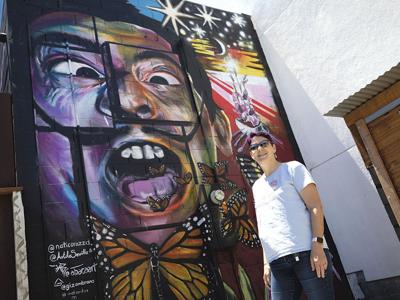

Kat Morgan moved to Seaside at the beginning of shelter-in-place, when the streets were unusually empty. During her walks, she started to find murals, and she gravitated to them. “One of the things I love about murals is that they are accessible to everyone,” she says. “You don’t have to go into a museum or gallery.”
She’s always loved public art. Morgan is a consultant for nonprofit organizations by day, and spends her free time mural hunting. “I love learning about a community through murals,” she says. She’s been on the move from King City to Castroville, taking photographs of murals large and small and adding them all to a map so others, locals and tourists alike, can locate and enjoy them as well.
She has documented over 500 murals and counting. She hopes her map encourages more businesses and cities to become street art-friendly. Morgan spoke with the Weekly about her mural-gathering journey.
Weekly: You say you’d always liked public art, what motivated you to start documenting murals as well?
Morgan: After I moved here, all the museums and galleries were closed; there wasn’t a way to go and see art displayed indoors. So I started just noticing all of the murals around me. In Seaside, I’m really lucky because up and down Broadway, there are at least a dozen murals that have been created over the last 30 years. There are some from the early 2000s and the late 1990s.
You have found a wide range of techniques, scenes and materials in murals of Monterey County. Do you have a favorite, or favorite artist?
I’m particularly a fan of José Ortiz, a Salinas native and Salinas-based artist who started a group called Hijos del Sol. His murals are just fantastic and huge and beautiful and have a very distinctive style. He’s always working with groups, particularly groups of young people, and he’s always mentoring and engaging the community in his art.
That’s one of the things I really love about it; even though the style is really distinctive, he’s usually depicting communities and groups of people working together and he’s also engaged in communities and with people, groups of people to create those works of art.
You’ve spent time looking at murals in different communities. What’s different or the same?
One of the things that’s similar, even though the content may be different, is that many cities have murals that reflect the history and cultural heritage of the place. For example, there’s a mural in Soledad about the Chinese immigrants who helped establish that city.
Another thing I see in many different places is murals that depict the natural world. The birds, the marshland that used to cover much more of the land here but still is present in the Elkhorn Slough area. There are murals that depict ocean life. There’s this tremendous mural in downtown Seaside, along The Reef, of a humpback whale (by artists Lisa Haas, Hanif Wondir and Maryia Hryharenka).
What is the value of street art in our communities?
There’s been a long-standing history of murals [in our state] that are about social change and social justice. Particularly in Southern California, that’s the case where there are organizations that have really dedicated themselves to expressing the history and culture of people who haven’t always been celebrated, particularly in the schools. The Chicano art mural movement is something that still exists. I just feel like there’s so much value.
Artwork is something that we all benefit from. We all need those skills to visualize our world. Kids who are engaged in the arts are more engaged with school. They do better. It really helps them tap into their creativity and I believe we all have creativity but not all of us recognize that.
Philadelphia has one of the largest nonprofits [Mural Arts Philadelphia] that focuses on and celebrates public art. They’re really dedicated to making sure that they add value to the city in terms of tourism, but also really support the arts so that the arts engage all of the artists, not just the ones who get picked to be in museums. They really are looking at democratizing art, which is really important because artwork is something we all benefit from. We all need those skills to visualize our world.


(0) comments
Welcome to the discussion.
Log In
Keep it Clean. Please avoid obscene, vulgar, lewd, racist or sexually-oriented language.
PLEASE TURN OFF YOUR CAPS LOCK.
Don't Threaten. Threats of harming another person will not be tolerated.
Be Truthful. Don't knowingly lie about anyone or anything.
Be Nice. No racism, sexism or any sort of -ism that is degrading to another person.
Be Proactive. Use the 'Report' link on each comment to let us know of abusive posts.
Share with Us. We'd love to hear eyewitness accounts, the history behind an article.