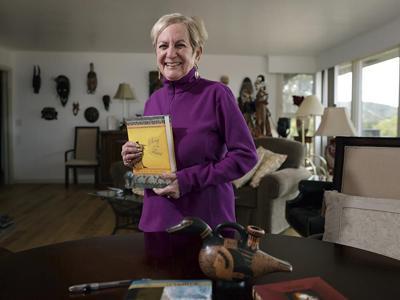

Rosalind Burgundy belongs to a family of art lovers. It’s obvious when you take a look inside her Monterey home, filled with pieces brought back from journeys to places both familiar and exotic. The living room, for instance, is guarded by figures from Papua New Guinea. But it’s not Oceania that captured her heart.
As a 21-year-old, this Californian visited Rome. Although not an excavator, she worked as technical illustrator and curator for a renowned archaeologist in the Roman Forum. While there, she encountered ancient Etruscan art from all over Northern Italy.
By the 18th century, people had discovered many Etruscan tombs filled with jewelry, paintings and utensils. They belonged to the Caucasian people who inhabited the western coastal Italian peninsula immediately before the foundation of Rome (between 3,000 BCE to 753 BCE). Since then, the ancient people have been largely overlooked – especially in the context of exploring the civilizations of ancient Greece and Rome. Yet the Etruscan civilization passed on a lot to Rome, including – it is suspected – togas. Etruscans were avid in medicine and astronomy (and were perhaps a bit slow to rise; they counted noon as the beginning of each day). Etruscan treasures are still buried under Italian cities.
While Burgundy spent the biggest chunk of her career teaching English as a second language, she has been thinking about how to foster knowledge about Etruscans all her life. She lectured on the civilization at Modesto Community College and other schools in the 1980s. In the 2000s, after many years as educator, lecturer, wife, mother, grandmother and world traveler, Burgundy came up with the idea of an “Etruscan historical novel,” proclaiming herself the “muse for the Etruscans.” Her first book was Song of the Flutist: Epic of the Ancient Etruscans (2003, republished 2010), a three-generation family saga that takes us back “2,000 years before Dante, Michelangelo and the Medicis of the Renaissance.” In ancient Etruria, we meet people surprisingly contemporary in their problems: a family patriarch, a healer, a noble child and a neglected wife.
The book was followed by Tuscan Intrigue (2005, republished 2010), a contemporary archaeological escapade that takes place in the present time.
Finally, in 2010 Burgundy published Odyssey of an Etruscan Noblewoman, a story of an ancient lady concealing herself as a man to exercise her gift of scribing in the sixth century BCE.
Weekly: How did your Etruscan odyssey start?
Burgundy: In Rome. But it wasn’t the Roman art that I liked best, but this long-neglected layer buried underneath. I saw Etruscan art [in Villa Guilia Museum in Rome] and it had a whole different vitality. Villa Guilia has the best collection in the world. Since then, I’ve been to Italy so many times and visited so many tombs.
What makes the Etruscans so special to you?
They show a different outlook on life – more modern than Roman. Men and women are shown sitting together. Women were treated equally; They worked with gold and silver. They were very artistic – very, very positive people. Etruscans really seem overlooked, disenfranchised. I wanted to bring them to the people of the U.S.
And you tried in a couple of ways.
Yes, I did a series of lectures in Modesto Community College in the ’80s. Then I moved to writing. Even though people don’t really read anymore [laughs].
You wrote three books and now, at age 78, you are working on the fourth one.
I’m using the character from the second book [Tuscan Intrigue], a cultural arts historian Amanda Oliver. I decided she was a fun character – an Etruscan specialist and a quasi-archaeologist. The first novel starts with her dad, a renowned American archaeologist, ending up in an Italian hospital because of an explosion in an Etruscan tomb. In my new book, it’s eight years later and she has a son. There’s a little bit of a romantic element in all of my books.
How is the writing going?
It will be my fourth historical fiction novel, about Etruscan museum curators. The title is Murder and the Missing Masterpiece and it will be coming out this year. It will be my last book. It’s a lot of work but I have a great editor – my husband. He used to teach English and is a good critic. I couldn’t do it without him.


(0) comments
Welcome to the discussion.
Log In
Keep it Clean. Please avoid obscene, vulgar, lewd, racist or sexually-oriented language.
PLEASE TURN OFF YOUR CAPS LOCK.
Don't Threaten. Threats of harming another person will not be tolerated.
Be Truthful. Don't knowingly lie about anyone or anything.
Be Nice. No racism, sexism or any sort of -ism that is degrading to another person.
Be Proactive. Use the 'Report' link on each comment to let us know of abusive posts.
Share with Us. We'd love to hear eyewitness accounts, the history behind an article.