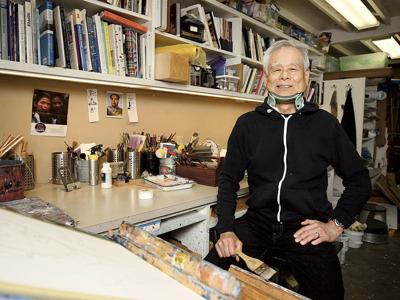

Asked to prepare a five-minute speech for the upcoming Hiroshima-Nagasaki Remembrance Day event, painter Joe Aki Ouye is aware he is doing it mostly for himself. But after years of silence, the anger needs to be expressed.
And it is being expressed in the art he has been producing – portraits of daily life of contemporary Asian Americans. He concentrates on faces and bodies in their daily environment, rarely more than a couple people per piece. Each is a careful study. They seem both naturalistic and abstract, because there’s so much attention to detail, yet so much is omitted at the same time.
But sometimes art is not enough. And Ouye’s cause is becoming more and more urgent because not many survivors are left. “Hundreds, maybe low thousands,” he speculates, while pouring green tea in the garden of his house in Pacific Grove.
It is patience that dominates Ouye’s approach to the matter of American bombing of Japan in the summer of 1945. That can be expected from someone who waited decades before becoming a full-time artist in 2012, fulfilling his parents’ wish to have a son-engineer, and then waited years before telling his children the truth about what happened.
That he and his mother were in Hiroshima that day in 1945, witnessing everything, going through hell and somehow surviving. And that it hurts him that the U.S. government, his government, has never formally apologized for dropping the atomic bombs on Hiroshima and Nagasaki, nor provided aid to the survivors.
However, anger is not all that is there. There’s also gratitude – for survival and the good life he has been living in the U.S., the country he immigrated to as a 4-year-old. His artwork helps reconcile those perspectives.
Weekly: Have you always thought about your art as political?
Ouye: That’s the best way for me to be political, the best way to have an impact. I went to Berkeley so I’ve always been sort of an activist. Because I worked as a professional, I didn’t do a lot. But now, when I do art full time, I’m getting more engaged politically.
My art is focused on the Asian American community. I’m talking about being invisible. That is a political statement. I’d like to see Asian American faces on the canvas, kind of like the explosion of Black art on big canvas within the last five years.
What’s the reception to your work in Monterey County?
It’s hard to get traction with that kind of art in this area. This area is, from the art point of view, quite conventional. No space for figurative, contemporary political art that I do. Even though it’s soft politics.
Do you consider yourself Japanese? American?
I love Japan, I love Japanese history. But I know I’m not Japanese. I’ve been to Japan many times. But do I consider myself American? Of course not. Because of all the discrimination we face. It got better over years, absolutely, but there’s a long way to go.
You spoke about similar issues at an art opening event last spring. You also have your pieces being shown at the Carl Cherry Center now. What is the response like?
We had a very good response. Over 50 people showed up. I sold three pieces. Asian Americans told me they were really happy to have their own history illustrated.
And what are your expectations when it comes to this event, where you are a keynote speaker?
I want to express my feelings. That’s all I can do. I want people there to understand basic facts about what happened. That hundreds of hundreds of people died. I want to express my sorrow and anger that it could have happened. As someone recently told me, this would be considered a crime against humanity today.
Would you like the U.S. government to apologize?
Yes, it would mean a lot. Obama was the first American president who went to Hiroshima. But he did not apologize. There are always justifications. This country has always been racist. Stereotypes and expectations are deeply ingrained in the American psyche.
Are you committed to a world without nuclear weapons?
I would like to make them all disappear.


(0) comments
Welcome to the discussion.
Log In
Keep it Clean. Please avoid obscene, vulgar, lewd, racist or sexually-oriented language.
PLEASE TURN OFF YOUR CAPS LOCK.
Don't Threaten. Threats of harming another person will not be tolerated.
Be Truthful. Don't knowingly lie about anyone or anything.
Be Nice. No racism, sexism or any sort of -ism that is degrading to another person.
Be Proactive. Use the 'Report' link on each comment to let us know of abusive posts.
Share with Us. We'd love to hear eyewitness accounts, the history behind an article.