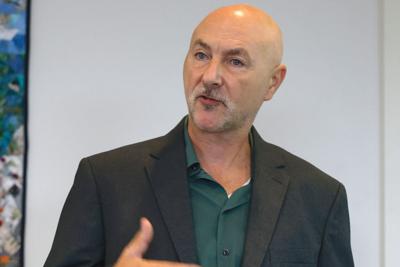

Within days of the 2025 Moss Landing fire, Ivano Aiello, a Prunedale resident and a marine geologist at Moss Landing Marine Labs, noticed something was off. Most obvious were the chunks of battery material, visible to the naked eye, scattered around Elkhorn Slough, pieces that had once been part of Vistra’s Battery Energy Storage System at Moss Landing.
Aiello, who had years of restoration data from before the fire, did what any curious scientist might: collected samples to look at what changed under a microscope, only to find metals concentrations 1,000 times higher than before.
The battery storage facility, the largest in the world, caught fire in the center of a global academic hub, so where state and local agencies failed to study the impacts tied to a growing industry, local researchers and community groups stepped in.
“That we had all of this before data was lucky,” says Kerstin Wasson, research coordinator of the Elkhorn Slough Reserve.
On Friday, Aug. 7, nine researchers presented their latest findings on the battery fire’s fallout at a symposium at Moss Landing Marine Labs. The researchers, working with full schedules and shoestring budgets, presented over the course of seven hours to roughly 70 people, with hundreds more registered to watch online. The Estuary Monitoring of Battery Emissions and Residues (EMBER) research group received additional financial support totaling $300,000 in grants over the past 18 months, according to Wasson, including donations from members of the Packard family, CDFW and the Monterey Bay Aquarium.
Each scientist examined something different, providing evidence as to whether or not battery cathode material – namely, nickel, cobalt and manganese – was found in sediments, plant material, invertebrates, human hair and more.
Two questions guided their research: Was there evidence of contamination from the battery fire? A resounding yes. Did that contamination have negative impacts on wildlife or people? That answer is more complicated.
“I would advise you not to believe anyone – or any report – that provides a simple ‘no,’ or a simple ‘yes’ answer to this question,” Wasson said at the symposium. “What you will hear today instead is the sausage-making of real science.”
For example, Don Smith, an environmental and neurotoxicologist at UC Santa Cruz, studied hair follicles from 85 volunteers – 160 hair segments – organized through the community group Never Again Moss Landing. While the metal levels varied substantially from person to person, Smith found “clear evidence of elevated exposure to battery-related materials.”
“When accidents like this happen, counties and local jurisdictions turn to the state,” County Supervisor Glenn Church said. “We do not have a toxicologist on hand employed by the county.”
Just a week before the symposium, the County’s Environmental Health Bureau released its 343-page Preliminary Environmental Assessment report which found that the battery fire did not pose long-term risks to people or the environment.
The report was prepared by Vistra’s environmental consultant Terraphase Engineering, in response to County of Monterey directives and reviewed sampling done by the Environmental Protection Agency, the Department of Toxic Substances, County of Monterey and others.
County and state scientists studying the fire were invited to participate in the symposium, but all declined.
“Environmental Health’s role has largely been that of an intermediary and information portal,” Karen Smith of the County’s Environmental Health Bureau said in a written statement explaining the decision. Vistra and the DTSC did not respond to the Weekly by press time.
“Money or no money we’re going to do [this research] because we know it’s the right thing to do,” Aiello said. “But our offer is to create a model… a framework applicable to future battery fires.”


(1) comment
This is at the top of my most important concerns. But to open with, it was lucky - lucky? Ouch. Edit miss for sure.
Welcome to the discussion.
Log In
Keep it Clean. Please avoid obscene, vulgar, lewd, racist or sexually-oriented language.
PLEASE TURN OFF YOUR CAPS LOCK.
Don't Threaten. Threats of harming another person will not be tolerated.
Be Truthful. Don't knowingly lie about anyone or anything.
Be Nice. No racism, sexism or any sort of -ism that is degrading to another person.
Be Proactive. Use the 'Report' link on each comment to let us know of abusive posts.
Share with Us. We'd love to hear eyewitness accounts, the history behind an article.