
All funerals begin with a death. Despite the varying practices of many religions and cultures surrounding death, many are social interactions. A priest may attend to a dying person in a hospital or convalescent home to give last rites. Relatives and friends of the deceased get busy in their kitchens making batches of food so the most severely bereaved – even when they have lost their appetites – have something to eat. There is music to be planned. Speeches to be heard. Shoulders that need to be gently touched by various mourners. Altars and candles to be displayed so that grief is visible to the closest of friends and the most distant of strangers. Funerals are reminders that the loneliest are not alone in their grief. Funerals are gatherings.
But in the pandemic, something changed: Large gatherings became unsafe.
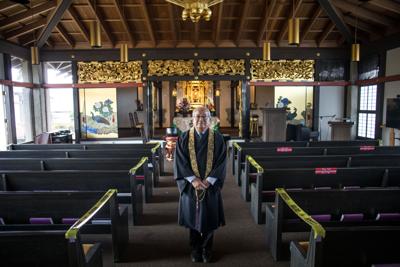
Before Covid-19, Pastor Jay Shinseki of the Monterey Peninsula Buddhist Temple would be allowed to enter hospitals and homes where he would attend to the body of the recently deceased and say the first prayers to welcome them into the “pure land.” “I would go to the home and do pillow services. It’s a way to honor the deceased and celebrate the next phase,” he says.
At first during the pandemic, it was deemed safe to enter homes and hospitals with masks. Pillow services, by nature of the situation, are intimate affairs, with only the immediate family or household present. But today, even this is not allowed.
These days, Shinseki is framed in one screen, and the family and the deceased are framed in another.
“When we’re talking about death, as a minister, I need to get a sense of how to handle these things emotionally. It’s hard to do that when you can’t be there,” Shinseki says.
After a death come the funerary preparations. Ellen Medina, an embalmer at Healey Mortuary and Crematory in Salinas, says that process also had to adapt during Covid-19. In a non-pandemic year, planning would begin in-person with a conversation. Medina would be able to show families the various caskets available and have a face-to-face conversation on what services they could offer at their two chapels attached to the funeral home. “There was no limit on how many people could attend,” Medina adds. But now, eight-hour viewings have been condensed to four. Back-to-back services until closing time at 9pm were rolled back to two services daily. And depending on when the funeral took place in 2020, on-site funerals were either limited to a parking lot or a single chapel.
Medina says more families are opting for in-home funerals rather than staging it at the chapel – a way to get around the attendance restriction. “It really depends when [during the pandemic] we’re talking about,” she says of the constantly changing rules on gatherings.
As for preparing the bodies, not much is different because embalmers have always prepared bodies with personal protective equipment: gloves and mask. In the case of very contagious diseases, they wear a full suit. Although Medina had experience preparing bodies before with contagious diseases that “don’t die with the host,” such as tuberculosis, she was initially hesitant when she worked on her first body of someone who died of Covid. “We just didn’t know how long it lives after someone dies,” says Medina. There was one instance, she says, of an already embalmed body having to be sent back to a coroner, where the virus was still present days later.
Whether or not someone has died from Covid, Medina and Shinseki both say the pandemic has changed funerals for everyone. “Funerals are easily attended by hundreds of people,” Medina says. “It’s not just the family, but everybody in that person’s life wants to say goodbye.”
It’s another layer of loss beyond losing a person. “I cannot begin to describe to you how important community is in mourning,” Shinseki says. “Grief and loss – it’s difficult for all of us. Sharing that experience with others is what we’ve lost during this time.”


(0) comments
Welcome to the discussion.
Log In
Keep it Clean. Please avoid obscene, vulgar, lewd, racist or sexually-oriented language.
PLEASE TURN OFF YOUR CAPS LOCK.
Don't Threaten. Threats of harming another person will not be tolerated.
Be Truthful. Don't knowingly lie about anyone or anything.
Be Nice. No racism, sexism or any sort of -ism that is degrading to another person.
Be Proactive. Use the 'Report' link on each comment to let us know of abusive posts.
Share with Us. We'd love to hear eyewitness accounts, the history behind an article.