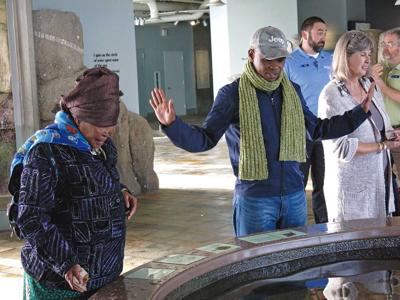
It’s a classic field trip day, with bellowing school children running around, chaperones chasing after them and tourists milling around the shops of Cannery Row.
It’s just another tourist day for most visitors here, except for a group of three who have journeyed from D’Kar, Botswana, one of whom is about to see the ocean for the first time.
Ndodonyane Ditsheko, Cgoma Simon and Jan John are members of the San population, an age-old lineage of indigenous hunter-gatherers who have turned to the arts as a secondary source of income, generating cash in addition to their continued hunter-gatherer tradition.
Peggy Flynn met the trio when she served as a Peace Corps volunteer and worked with the Kuru Art Project, an organization that helps the San people make money to buy things they could once harvest from the land for free.
Flynn helped coordinate an art auction at the Museum of Art and History in Santa Cruz on Nov. 10 to benefit the group back home – and used it as a way to bring Ditsheko, Simon and John to the Central Coast, including a tour of the Monterey Bay Aquarium and wide-open view of the Pacific Ocean. (Flynn raised $11,000 through GoFundMe to support the costs of the trip.)
Ditsheko serves as the group’s translator, translating between English and Nuru. Coming from the dry, landlocked Kalahari Desert, he says the group didn’t know what to expect in coming to the Monterey Bay, just that it would certainly be different than home: “You expect things to be quite different from where you are.”
It’s John’s first time ever seeing the ocean. “[I heard stories] from other people, and they say the ocean makes a huge noise,” John says through their translator. “I panicked a little bit not knowing.”
Their aquarium tour provides a first-hand look at the animals and plants below its surface – a novelty for all three. “[Simon] saw the ocean before,” Ditsheko says. “And what she can say is that she didn’t know what was inside the ocean.”
“They say the ocean makes a huge noise. I panicked a little bit not knowing.”
As they walk through the Open Sea exhibit and see a rush of silver sardines glittering against the blue backdrop, the group stops to gaze up in silence.
After roaming among species large and small, the group steps outside onto a deck where artwork – made of plastic – is formed into a leatherback turtle. Nearby, a collage made of plastic represents the hazardous material that endangers marine life. And even though these hazards aren’t immediately visible from Botswana, the group readily relates to the use of artwork to tell the story of the clash between urbanization, nature and the traditions affected at the center.
Their artwork includes oil canvases in vibrant colors like green and orange depict animals – zebras, lizards, birds – or everyday tasks, like harvesting nuts. There are kudu, a type of antelope, in brilliant yellows and greens, grazing alongside other creatures that are portrayed as bigger than the trees.
The San people have used stone art for generations to tell stories, and the Kuru Art project has given the people a literal canvas with which to continue this tradition.
The San people’s works are as complex as the landscape and ecosystem around them. One depicts horned animals flocking together on a blue field, surrounded by trees that have either branches stretching out like fingers or round, bushy heads. Three birds fly high with long wings resembling rabbit ears in a sky of deep purple.
Art is nothing new to the San people, but money is, and by forging their traditions through a familiar medium, they show their ability to be self-reliant and self-sustainable.
The 2,000 or so San people who live in the Kalahari Desert are thought to be the closest living relatives to the ancestors of the entire modern world. Hunters and gatherers on what’s now the Central Kalahari Game Reserve, the arrival of modern farmers and ranchers forced them to adapt economically.
“I want to share with you our culture,” John says through the translator. “That we relate to the natural environment and are able to live life in the bush, without any help from anywhere.”

Artists Cgoma Simon, left, and Jan John look into the bat ray touch pool at the Monterey Bay Aquarium.
Maude Brown, the Kuru Art Project coordinator in Botswana, explains that since the San live off the land, it is the animal and plant life more than the scenery that really capture their attention in Monterey Bay.
Getting their art up on the walls in the U.S., she adds, goes deeper than even the messages in the artwork itself: “The San people are still here,” she says. “They still hang onto their own identity. And they are a part of this world.”


(0) comments
Welcome to the discussion.
Log In
Keep it Clean. Please avoid obscene, vulgar, lewd, racist or sexually-oriented language.
PLEASE TURN OFF YOUR CAPS LOCK.
Don't Threaten. Threats of harming another person will not be tolerated.
Be Truthful. Don't knowingly lie about anyone or anything.
Be Nice. No racism, sexism or any sort of -ism that is degrading to another person.
Be Proactive. Use the 'Report' link on each comment to let us know of abusive posts.
Share with Us. We'd love to hear eyewitness accounts, the history behind an article.