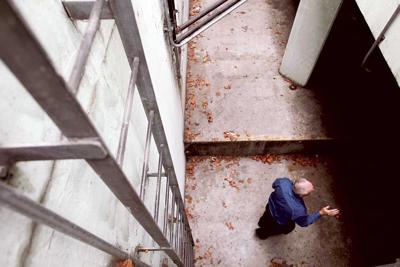

It’s the type of unobtrusive doorway you might pass by a thousand times without noticing it. It has the look of a utility closet, and opens into a white stucco structure next to the bocce ball court at Custom House Plaza in Monterey. The door reveals a platform barely bigger than a closet floor – and a metal ladder that descends about 15 feet to another platform, leading to another ladder, then down into an underground world built 50 years ago.
City Fleets & Streets Operations Manager Bret Johnson grabs the ladder and descends. He estimates he’s been into into the city’s underground labyrinth 100 times.
“The bocce court is right here,” he said, pointing directly upward.
Inside, cardboard boxes of tiles are gathering dust, and Johnson kicks one into place as a door stop. They’re spares for the hundreds of thousands of light yellow tiles lining the tunnel that connects New Monterey and downtown Monterey, partly for decorative purposes, partly to help minimize noise. Ironically, it might be thanks to the acoustics from those tiles that honking is so popular in the tunnel – a tradition that City Manager Mike McCarthy says dates back to the time the tunnel first opened to traffic. “It’s a fun tradition,” McCarthy says. “I do it myself.”
The cavern has the feeling of an untouched garage, with a musty smell and crunchy dead leaves blowing around on the floor. Graffiti on the wall is faded and gray. One message reads, “People DO get in here.”
Not many people walk through this network of below-ground passageways and large rooms, but electricians come down weekly for a maintenance check, mechanics monthly.
Fans with wide propellers, laden with thick dust and chunky cobwebs, line openings in the wall. Sensors measure carbon monoxide levels, and on high-traffic days, kick the fans into gear to keep air flowing. Even as traffic has gotten worse, emissions have gotten better: “It was a bigger problem 50 years ago when they designed this,” McCarthy says.
The tunnel is not technically a tunnel by engineering standards; it’s really just a cap on top of a cut-through chunk of road, not a route that was drilled underground. When it was first constructed in September of 1967 for a cost of $2.5 million, it was called “Minnie’s ditch,” named for then-mayor Minnie Coyle – the only woman mayor Monterey’s ever had, and who that same year made a brief appearance on stage at the Monterey Pop Festival, which also celebrated its 50th anniversary this year.
“It’s amazing that construction from 50 years ago is still working,” McCarthy says. “It’s a sign of incredible engineering and construction, modern technology that has stood the test of time.”
And it conveys more traffic, thousands of cars moving in either direction every day, than Coyle might’ve imagined. “The tunnel is absolutely critical to the Peninsula,” McCarthy says. “Having that pass-through is essential to our traffic plans.” Because of cost, he adds, it’s a project that probably could never get built today.
It remains a major piece of infrastructure for the small city, with a series of wells and pumps that kick in during rainy weather to drain the downtown neighborhood. It connects to the city’s stormwater system, where a crew uses a different access point in Custom House Plaza – an opening in the ground topped with a sewer cover – to remove debris and litter before letting stormwater drain into Monterey Harbor.
It’s the stormwater component that makes the tunnel rate high on Johnson’s list of maintenance duties: “If it were to flood, that’s a big artery people can’t drive,” he says. “It would really mess up traffic if that tunnel flooded.”
Currently, Pacific Street is closed to through traffic for construction, meaning more car traffic is being diverted through the tunnel, while “truckers are having a heckuva time,” Johnson says. They’re left to detour up the hill in New Monterey to Highway 1. That’s because some trucks exceed the maximum height limit – 14 feet and 3 inches – or are carrying flammable materials, which are prohibited in the tunnel.
“If there’s a wreck, it just goes off like a bomb and it torches everything,” Johnson explains.
Just days after groundbreak in 1967, a front-page story in the Monterey Peninsula Herald covered tunnel construction: “Traffic flow normal in downtown Monterey,” a headline proclaimed.
Johnson climbs up the ladder, and walks back out into the light next to the bocce courts and locks the door behind him. He picks bits of cobweb off his pants, and shows his darkened palms, grimy from the rungs of the ladders.
“I always think it’s cool to go down there,” he says. “You go through a door, and all of a sudden there’s all this infrastructure down there that people don’t know about.”


(0) comments
Welcome to the discussion.
Log In
Keep it Clean. Please avoid obscene, vulgar, lewd, racist or sexually-oriented language.
PLEASE TURN OFF YOUR CAPS LOCK.
Don't Threaten. Threats of harming another person will not be tolerated.
Be Truthful. Don't knowingly lie about anyone or anything.
Be Nice. No racism, sexism or any sort of -ism that is degrading to another person.
Be Proactive. Use the 'Report' link on each comment to let us know of abusive posts.
Share with Us. We'd love to hear eyewitness accounts, the history behind an article.