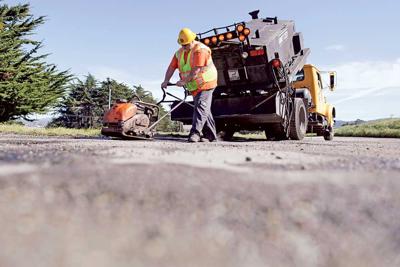
On a recent morning, two trucks pull up to the corner of Del Monte Avenue and Casa Verde Way in Monterey and park near a pothole. Roy Genegabus gets out of the truck and sets up a row of orange traffic control cones while Juan Garcia and Solomon Ortiz unload shovels and rakes, and Daniel Bonafant monitors oncoming traffic.
Genegabus is only two years away from retirement and has worked for the city of Monterey for 30 years. Despite the longevity, there’s a spelling error in his name on his helmet – but no matter, he goes by the nickname “Papa.”
Ortiz is newest to the crew, just one month into the job, but he’s catching on fast. Garcia has 16 years of experience, Bonafant 13. They work with the synchronized rhythm of people who know exactly what they’re doing and don’t have time to burn.
The guys all agree: Their job is reliant on teamwork. Also: Seniority rules. That means the new guy – Ortiz – does the sweeping while Genegabus uses the blowtorch. They operate like a family, keeping up a steady dialogue of bickering and joking throughout the day. They know Genegabus doesn’t eat much on shift and that Bonafant has four kids at home.
“When push comes to shove, we have each other’s backs,” Bonafant says.
These days, after storms have rocked the area, Monterey’s streets and utilities team of the maintenance division is busy. Post-storm, the crew is repairing anywhere from 20 to 50 potholes per day, compared to the occasional pothole repair job when it’s dry.
Crew members have lost eyebrows, mustaches and arm hair to torching.
Along with downed power lines and fallen trees, Monterey’s streets have been under assault this winter. As heavy rains pound the asphalt and water seeps underneath, the soil weakens. Add the weight of a few cars or trucks, and the asphalt breaks apart, opening up unevenness and potholes that can damage vehicles.
Their goal is to restore the level surface of the road as efficiently as possible – and then get out of the way of traffic.
To repair the pothole, the hole is first sprayed with SS-1 oil, using a small wand. Next, the hole is blowtorched to heat up the asphalt. Hot mix is then shoveled in from the back of the “Patch Truck,” a truck heaped with steaming material that looks like thick black sand.
The crew drives to Salinas or Aromas to pick up the mix in the morning, and depending on how much work they have ahead, they’ll go through 4 tons by noon.
The hot mix, kept at a steaming 300 degrees, is then raked across the hole until it’s level. Although crew members have lost eyebrows, mustaches and arm hair to torching, the blowtorch reappears without fanfare in cases when the mix has hardened too much. (All of the crew members concur, and say that kneeling for hours to mix concrete is far more tedious than torching work.) A compactor is then pushed slowly over the area to tamp down the materials. Finally, the now-smooth patch of new asphalt is covered with a thin layer of sand to help the filler cohere, as well as protect passing car tires from picking up oil.
The repairs are semi-permanent and done with the intention that they last until the road is repaved – or until the next storm rips the road open again.
Depending on the size of the pothole, the crew finishes the whole process in 10 minutes or less. Normally they’ll work as a two-man team, but in highly congested areas, it’s crucial that someone keeps an eye on traffic. This is one of the most grueling and dangerous aspects of the job – alongside being lowered into a sewer hole and worrying about spider bites – partly because of fielding angry comments from drivers.
When it comes to going down sewer holes, practicality trumps the seniority rule. The skinniest guy – in this case, Bonafant – goes down the hole.
The crew likes seeing the work they’ve done and watching the city change over the years with new construction.
“Anything you see here on this road, from the paint to the signs, we’ve done,” Bonafant says, gesturing down Del Monte Avenue.
As quickly as they’ve patched the hole on Del Monte, Genegabus, Ortiz, Garcia and Bonafant drive across the street to set up for another pothole repair by Dela Vina Avenue. They’ll continue at this fast-moving pace until they call it a day at 4:30pm, but as supervisor Chris Singh says with a laugh, “Our work is never done.”
Ortiz meticulously sweeps the area after the repair is finished, and it’s as if the road crew has never been here at all, leaving only a smooth and level surface in their wake.


(0) comments
Welcome to the discussion.
Log In
Keep it Clean. Please avoid obscene, vulgar, lewd, racist or sexually-oriented language.
PLEASE TURN OFF YOUR CAPS LOCK.
Don't Threaten. Threats of harming another person will not be tolerated.
Be Truthful. Don't knowingly lie about anyone or anything.
Be Nice. No racism, sexism or any sort of -ism that is degrading to another person.
Be Proactive. Use the 'Report' link on each comment to let us know of abusive posts.
Share with Us. We'd love to hear eyewitness accounts, the history behind an article.