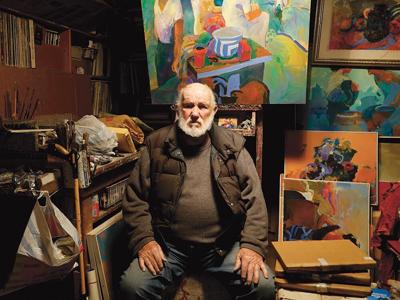

The Carmel Highlands house Keith Lindberg shares with his wife, ceramic artist Kathleen DeBord, is full of his paintings, often large pieces, but there are another 2,000 in the shed by the house. The location is idyllic, just off Highway 1, the vibe is country-like, with ocean views.
Not particularly interested in selling his stuff – pieces in the house are off-limits – if someone pursues him and insists, Lindberg pulls out something from the shed.
Lindberg’s works are unique, immediately recognizable after one sees a few, and made according to the method the artist created for himself and still follows. The subject matter is not important; Lindberg doesn’t consider himself a realist and thinks of realistic paintings as decorations. It’s all about the color and composition and the balance and dynamics between them. It’s a rare thing to see a detailed human face in his painting, even when he painted his children.
The scenes he ends up composing are capturing leisure – figures sitting, never facing the viewer, busy with their worlds. The painter likes to put color first – colorful, round-in-shape fruits are one of the favored sources of colors such as red and deep yellow – with even brighter backgrounds. That applies to pieces such as “Umbrella,” “Summer Retreat” or “Car with Blue Jars.”
Elements of still nature are also an important addition to Lindberg’s art. Occasionally, he reverses the technique, like in his painting “The Gathering,” where white-clad figures play at the backdrop of dark trees.
“They are not figures but symbols,” he says, pointing out to human figures, often trios, that inhabit his works.
A big believer in “the method,” Lindberg says that artists, e.g. impressionists, were very clear about their process, but people don’t seem to listen.
“There’s no secret,” he says about artistic methods. “Artists often tell you exactly what they do, step by step.”
Lindberg, 87, still paints, but not at the speed of previous years. Otherwise, he has all the time in the world to read Hemingway (his favorite), contemplate his satisfying artistic life and reminisce on times past.
“It was a community for the locals,” he says about Carmel of the 1960s and ’70s. It was a time of artistic independence and “starving” artists, except poverty was a choice, part of the lifestyle and not the housing “famine” that chases out so many young, talented people from the area. One could get by.
“No weekenders and no empty houses,” Lindberg says. “There were more grocery stores and hardware stores. A new gallery would open each week, selling inexpensive paintings. We had exhibits in gift shops and bars, and people would come to Carmel looking for art. Now all the professionals are gone. The town [Carmel] doesn’t support painters anymore and we have only amateurs left.”
Born in Kansas City, Missouri, Lindberg grew up in San Diego. Before he chose the Kansas City Art Institute, he was considering a military career. Later, Lindberg studied at the Art Institute of Chicago and even though he was told that only 1 in 100 students becomes a successful painter, he never looked back.
“I was a terrible painter,” he says about his beginnings. He has been painting since 1960 and his career took off circa 1965 when he joined the Carmel Art Association that “opened it all” for him (he remains the association’s oldest member). He praises the times when he was able, as a young painter, to find and afford a cottage on Mission Street, with two other young artists. They paid $45 for a room and shared their meals.
“Select a group of limitations for yourself,” he recommends to young artists. “And stick to them. Find your niche.”


(0) comments
Welcome to the discussion.
Log In
Keep it Clean. Please avoid obscene, vulgar, lewd, racist or sexually-oriented language.
PLEASE TURN OFF YOUR CAPS LOCK.
Don't Threaten. Threats of harming another person will not be tolerated.
Be Truthful. Don't knowingly lie about anyone or anything.
Be Nice. No racism, sexism or any sort of -ism that is degrading to another person.
Be Proactive. Use the 'Report' link on each comment to let us know of abusive posts.
Share with Us. We'd love to hear eyewitness accounts, the history behind an article.