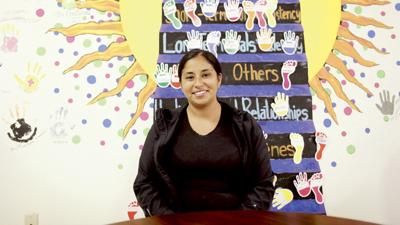
Sabrina Martinez remembers the time she first tried pot at age 12, when a group of friends were passing around a bowl. Her story unfolds like a cautionary tale from an anti-drug workshop for middle-school kids: She immediately got a “good, relaxed feeling, like everything was fine.”
She started smoking regularly, and got expelled from seventh grade. She’d already starting relying on marijuana as a social crutch: “It’d get me out of my comfort zone, which felt good,” she says. “Growing up, I had been a shy kid.”
It wasn’t substance abuse that first landed Martinez in trouble with the law. When an investigator from the Monterey County District Attorney’s Office called her in 2015, Martinez had been illegally filing for welfare for four years, not reporting income from her job at a market on Fisherman’s Wharf. “I didn’t think it was going to catch up with me,” Martinez says.
By then she was drinking heavily too. She got a DUI, got sober, then started smoking and drinking again. After she and her then-boyfriend split and he took custody of the couple’s three children, her downward spiral continued: Martinez fell into a depression and started drinking and smoking more. She was 23.
Now, five years later, it’s hard to imagine that version of Martinez. She’s had a full-time job for the past month at a Salinas sushi restaurant, and plans to enroll in Monterey Peninsula College next spring, with hopes to transfer to CSU Monterey Bay with a goal of becoming a substance abuse counselor.
But first, in December, she’s set to graduate from the Monterey County Day Reporting Center, an alternative to traditional probation or parole.
The center, operated by GEO Reentry Services on a three-year, $508,000 contract with Monterey County, offers rehabilitation to probationers and parolees.
“We help you develop the skills to live a more productive lifestyle,” Program Manager Luke Lynch says. “Our goal is to reduce their risk of reoffending.”
They do that by constant contact with clients, starting with daily check-ins, then winnowing down to five days a week, three days, then once a week – far more than a standard monthly check-in with a probation officer. Individualized treatment plans might include parenting and anger management classes, employment training and substance-abuse therapy.
There’s a rewards system to keep people on track, earning a stamp every time they pass a drug screening, for example. They can use stamps to get raffle tickets (just last week, the center raffled off a charcoal grill) or snacks or candy.
GEO also launched a new program Aug. 14 in the Monterey County Jail, where more than 30 inmates are now enrolled in similar programming intended to guide them to readjust to society upon their release. The three-year, $930,000 contract runs through 2020.
Caseworkers focus on getting participants to hang out with “prosocial” rather than “antisocial associates” – people who are using drugs, don’t have a job or are involved with gangs.
There are more invested relationships with caseworkers, too. Lynch says the caseload for a probation or parole officer averages 50; at the Day Reporting Center, caseloads are just 15-20 clients.
“We also have different responsibilities,” Lynch adds. “We don’t arrest individuals or go to court. We don’t have to worry about that, so we can focus on the treatment aspect.”
It’s not all touchy-feely; Lynch and his staff also apply metrics to show clients have a lower probability of reoffending. They use the Ohio Risk Assessment System, which scores clients (one question: On a scale of 1-4, how easy is it to acquire drugs in your neighborhood?). If someone’s score goes up, the team at the reporting center changes their approach. “We might realize there’s a bigger problem such as their attitudes or belief system,” Lynch says. “If we don’t target that, they’re not buying in.”
Martinez didn’t buy in right away. “I didn’t think I was going to learn so much from it,” she says. “It really helped me. I’m getting my life back together.”
At a recent celebration with balloons and banners at the Elks Lodge in Salinas, Martinez sits at the back of a ballroom handing out programs as about 100 proud family members file in to celebrate a graduation ceremony for 18 members in the class ahead of Martinez.
“A lot of these individuals have never graduated from anything in their life,” Lynch says. “It’s a really big deal.”
Now, Martinez is five months sober and on track to graduate in December, at a similar balloon-filled celebration. She just received her high school diploma, and looks forward to this next milestone: “It will be the second thing I’m finally accomplishing in my life.”


(0) comments
Welcome to the discussion.
Log In
Keep it Clean. Please avoid obscene, vulgar, lewd, racist or sexually-oriented language.
PLEASE TURN OFF YOUR CAPS LOCK.
Don't Threaten. Threats of harming another person will not be tolerated.
Be Truthful. Don't knowingly lie about anyone or anything.
Be Nice. No racism, sexism or any sort of -ism that is degrading to another person.
Be Proactive. Use the 'Report' link on each comment to let us know of abusive posts.
Share with Us. We'd love to hear eyewitness accounts, the history behind an article.