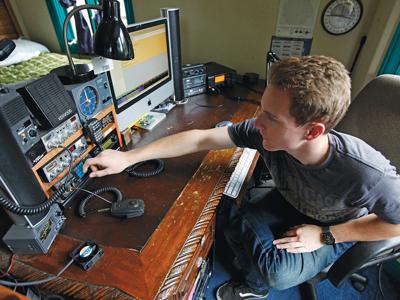

In his Pacific Grove bedroom, with an American flag proudly hanging and symbols of a future military career adorning the walls, Nick Carswell shows off his amateur radio equipment. His mentor, retired U.S. Army major Rick Lagerstrom, looks on approvingly until Carswell powers up his system and electronics throughout the house start buzzing with interference.
“We gotta fix that Nick,” Lagerstrom says, eyebrows raised, to the 17-year-old.
The teenager, looking bemused, starts recounting a story he heard of an amateur radio operator who inadvertently drove his elderly neighbor insane.
“The lady started hearing voices and that pushed her over the edge,” Carswell says with a grin. “It turned out that her hearing aids were just picking up interference from her neighbor’s ham radio.”
Lagerstrom interjects to keep his young friend on message. Hams – the century-old nickname given to amateur radio operators – are people who keep the world connected in absence of telephone lines, Wi-Fi and cell service, he says.
“Hams run event communications at the California International Airshow Salinas, hams are at the Soberanes Fires keeping various agencies and communities connected,” Lagerstrom says. “There’s so much you can do with amateur radio. Its applications are limitless.”
Amateur operators are an eclectic bunch who range from students and professionals to doctors and truck drivers. Various theories are kicked around about the true source of the term “ham,” which can be applied to both the radio and its operator.
One theory is early amateur radio operators were called hams because they like to talk a lot and ham it up. An hour with Lagerstrom lends evidence to that hypothesis. Another theory is that “ham” and “am,” as in amateur, sound alike and the geeky bunch took the self-deprecating moniker as a badge of honor.
Not just anyone can buy a transmitter, a microphone and other radio equipment and then start communicating with the world. The Federal Communications Commission requires every ham to pass a written test on the technical and regulatory protocols of self-broadcasting.
Locally, the Naval Postgraduate School Amateur Radio Club was created in 1969 and has been open to the public for more than 25 years. They hold an annual Radio Fest where enthusiasts from the region talk shop, exchange ideas and see new technology in use.
In 1995, Lagerstrom helped start the nonprofit Emergency Communications Through Amateur Radio, Inc., to better leverage ham radio in emergency situations. The group has created an infrastructure for emergency response if and when cell signals and landlines go out.
In Big Sur, where cell service is spotty, there’s added incentive to become a ham operator. Rayner Marx, a member of the Big Sur Volunteer Fire Brigade, became a ham a few years ago.
“I hike a lot, and if I were to get into trouble it’s good to have a way to call for help,” Marx says.
“I have a picture in my mind of guys sitting in La-Z-Boys.”
But Marx also has an idea of what ham radio looks and sounds like in non-emergency situations: “I have a picture in my mind of guys sitting in La-Z-Boys in a room stuffed with radio equipment.”
He’s not far from the truth.
Sitting at a his desk, Carswell has now tuned his radio to a frequency that doesn’t make the TV in the living room chirp with feedback. He then attempts to reach someone an ocean away.
“I’ve spoken with people in Japan, Lithuania, the Czech Republic and Puerto Rico,” he says. “Sometimes I ask, ‘How’s life?’ Sometimes I ask, ‘How’s the weather?’”
When asked for the substance of the conversations, Carswell demurs. The same question is posed to Lagerstrom, who then hems and haws. A more specific question is posed: Do hams mostly talk to other hams about ham radio?
The two grin and nod in agreement.
“Yeah, pretty much,” Lagerstrom adds.
For many like Carswell and Lagerstrom, amateur radio is more than just a hobby; it’s a community.
Amateur radio is a lot like music, Lagerstrom says, adding that kids and adolescents who get involved in understanding radio signals tend to be better at math and science.
After high school, Carswell wants to join the Army Corps of Engineers. With Lagerstrom’s help customizing his amateur radio setup, along with hours and hours of self-driven tinkering, he says he’s learned a lot more than he has in high school science classes.
Carswell walks out to the deck to show off the antennas he constructed by hand, the tallest of which reaches 20 feet high. Wires and cables run in different directions. He looks up at his creation and says, “My parents say it looks like a spider took over this place.”


(0) comments
Welcome to the discussion.
Log In
Keep it Clean. Please avoid obscene, vulgar, lewd, racist or sexually-oriented language.
PLEASE TURN OFF YOUR CAPS LOCK.
Don't Threaten. Threats of harming another person will not be tolerated.
Be Truthful. Don't knowingly lie about anyone or anything.
Be Nice. No racism, sexism or any sort of -ism that is degrading to another person.
Be Proactive. Use the 'Report' link on each comment to let us know of abusive posts.
Share with Us. We'd love to hear eyewitness accounts, the history behind an article.