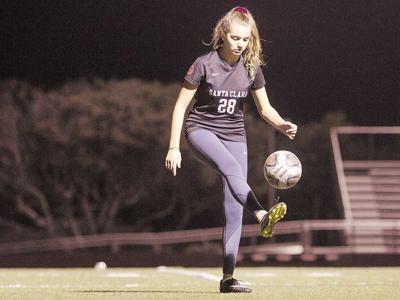

Just a little after 6pm on a Monday night, Niamh Burke removes her shin guards and slugs her cleats over her shoulder. It’s barely 45 degrees outside – cold enough to see a person’s breath in the dark winter night – but there a still a few drops of sweat glistening on her face from soccer practice. “I have a lot of homework to do,” she says.
The 15-year-old is a typically busy high schooler, and now she has another thing to add to her plate. Burke, along with six other players in Breakers Monterey County Futbol Club, have made it onto the Olympic Development Program. The program plucks the best of the best soccer players from age groups (ranging from ages 11-16) from all across the country to compete in national tournaments and to be potentially picked for Junior Olympic and National Soccer teams.
“When I heard I was picked, I was surprised,” Burke says. She is the only girl from the Breakers MCFC who made it onto the highly selective team. She’s also the oldest, playing with the Girls ’02 team – a team made up of girls who were mostly born in 2002.
“There were so many good players – I just didn’t think I could do it,” she says.
Then again, she has been cultivating an instinct for the game since she was 4 years old. And she has a competitive streak: When the whistle blows, she says, “it’s on.”
But competitiveness isn’t the only thing that Burke is learning by playing with her club. Cooperation and positivity are key, and it’s evident at the Breakers MCFC practice. As Burke leaves early to do her homework, behind her are four mixed-age scrimmages and one group of girls running fitness drills. The scrimmages don’t have goalies – or coaches yelling down the line. The self-directed players move fluidly, passing the ball with quick accuracy.
Another eye-catching sight in these scrimmages: The players come up short – physically, that is. A majority appear to be around 4-foot-7 or shorter. “Soccer is probably the only sport where you don’t have to be big to be good,” says Olympic Development qualifier Rogelio Jacinto of Salinas. Jacinto is 11 years old.
Well under 5 feet, he remembers facing off against a taller midfielder during the Olympic Development tryouts. “Other teams are more technical, but this guy was probably like 6-foot-something, and he’s only 12!” Jacinto says. “I think I slide tackled him.”
“You can be small, and you can be good.”
Their coaches agree that they have to get creative in games. “Yeah, if you look at us, we’re not an immediately athletic-looking team,” Coach Artie Cairel says.
If it’s not the brawn that’s qualifying players to the Olympic Development Team, it has to be something else.
“What makes us different from other teams is our focus on development,” Cairel offers. “Development” is a vague term to describe the Breakers MCFC’s philosophy of emphasizing teamwork over the individual, and personal growth over ultra-competitive goals. The result is a team that works smarter, not harder.
“There was one season where we were losing every game, and I was like, ‘I don’t know about this coach,’” says Rob Bernardino, president of the Breakers MCFC board and parent of one of the Olympic Development qualifiers, Trevor Bernardino.
But patience has paid off. Since 2015, the Breakers have been qualifying players to the Olympic Development team.
It’s not all touchy-feely teamwork building, there are technical skills too. “Don’t get us wrong. They’re learning how to play soccer,” Cairel says. “We’re not running drills all day long, but at the same time we’re teaching them that there are winners and losers.” (Cairel is referring to some youth soccer clubs that don’t keep score in order emphasize sportsmanship.) What Cairel cares about is developing quick-thinking players.
“We’re the underdogs,” he says, noting their regional competitors are San Francisco Bay Area clubs that tend to have bigger budgets and more players. “We’re lucky if we can fill four teams in a season.”
Bernardino notes that they are taking steps to get more kids, including by providing financial aid; he says over half of the current players receive financial assistance for registration fees that can run $350-$475 per season.
That support helps the club draw talent from all over Monterey County. “We get all kinds of players,” Bernardino says. “They’re from the military, Salinas, Soledad.” The six players selected for the Olympic Development Program live Monterey, Marina, Salinas and Seaside, reflective of the club’s far reach.
But as qualifier Sekou Mathews says, where you’re from – or how big you are – doesn’t matter on the field: “We push ourselves no matter how much bigger or stronger the other team is.”


(0) comments
Welcome to the discussion.
Log In
Keep it Clean. Please avoid obscene, vulgar, lewd, racist or sexually-oriented language.
PLEASE TURN OFF YOUR CAPS LOCK.
Don't Threaten. Threats of harming another person will not be tolerated.
Be Truthful. Don't knowingly lie about anyone or anything.
Be Nice. No racism, sexism or any sort of -ism that is degrading to another person.
Be Proactive. Use the 'Report' link on each comment to let us know of abusive posts.
Share with Us. We'd love to hear eyewitness accounts, the history behind an article.