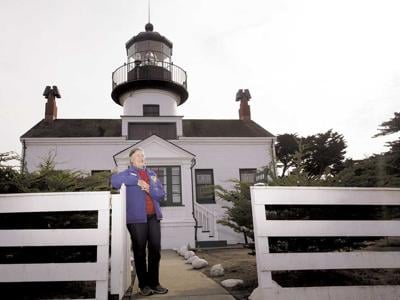

It was 1855, five years after California became a state and the gold rush was in full swing. But away from the gold towns of the mountains, the U.S. Treasury Department – then responsible for overseeing the nation’s lighthouses – had identified seven crucial points along the jagged California coast for lighthouses. One of those was Point Pinos, the rocky northern tip of the Monterey Peninsula and entryway to Monterey Bay.
It’s where Charles Layton was appointed as the first lighthouse keeper, responsible for keeping the light clean and functioning, starting on Feb. 1, 1855. Later that year, he joined a posse of 10 men, including the sheriff, in pursuit of outlaw Anastasio Garcia. As they closed in around Garcia at a house in Salinas, gunfire came from inside and hit four members of the posse. Lawton was hit once in the hand, losing the tips of two fingers, and a second bullet hit his pistol, then ricocheted into his stomach.
According to a Nov. 19, 1855 story in Daily Alta California, Layton crawled, bleeding, for six miles to a hotel. “After several days of intense suffering, death has finally closed the scene,” the newspaper reported.
It was an eventful first few months for the Point Pinos Lighthouse, but the light had to go on. Layton’s wife, Charlotte Layton, took over, becoming the first woman lighthouse keeper on the West Coast. Her task was to keep the lighthouse going, and she did. (Until she married her assistant lighthouse keeper five years later; then he became lighthouse keeper and she became his assistant.)
Point Pinos remains the oldest continuously operating lighthouse on the West Coast, still flashing nightly in a unique sequence – Oc 4s 89ft 17M – meaning it’s illuminated for three seconds, then off for one.
It remains a functioning navigational tool today. “People come in and say, ‘I guess lighthouses are obsolete, because everybody has GPS,’” says Nancy McDowell, the modern-day lighthouse keeper. “I say, does your GPS always work?” (The last boat that crashed at Point Pinos, a 24-footer, had a GPS system that wasn’t working.)
McDowell works here about 10 hours a week for the city of Pacific Grove, and sticks to her official title, docent coordinator, rather than lighthouse keeper. It’s now the U.S. Coast Guard – not the Treasury Department – that sends personnel to check on the lightbulbs every few months. And besides, McDowell’s tasks tend toward the more mundane.
She sweeps the floors and sidewalks, and winds four wind-up clocks, including a majestic grandfather clock, weekly.
In 2001, McDowell retired from a career as a special education teacher and started coming by the lighthouse. She began filling in for the first modern-day lighthouse keeper, Bruce Handy, when he was busy.
Before its modern era, lighthouse keepers continued to live on the premises, keeping the light functioning, and making sure the government building was open to the public. An 1899 notice, still hanging on the wall today, reads: “Visitors will be courteously and politely received, and admitted into the Tower and Lantern.”
Robert Louis Stevenson visited lighthouse keeper Alan Luce during his tenure (1871-93), before Emily Fish, a famous socialite who made the lighthouse into a hub of activity, took over from 1893-1914. A 1985 article in The Keepers Log, a publication of the United States Lighthouse Society, talked about Fish’s arrival to relieve Luce from his 20-plus years of service: “She was 50, tall, slender, and fashionably dressed, and not deterred by her first sight of the light station near the ocean… There were no trees, only bushes and wild flowers common to beaches and sand dunes.” Fish left her mark in part by planting the cypress trees that still form a windbreak today.
The interior today is decorated in an approximation of what Fish’s Victorian-era style might have looked like, with ornate lamps, heavy wood furniture and colorful teacups set out. A local chapter of the Questers, an international nonprofit, took an interest in the lighthouse in 1993 when Handy spoke to their group about Fish, a woman in a traditionally male career who carved out a space and made the lighthouse into her own palace; the group undertook restoration throughout the ’90s. (Projects are continuous; Pacific Grove’s mayor-elect, Bill Peake, is part of the volunteer restoration team now working to landscape what’s now a dirt patch out front.)
McDowell’s only fear now is that they’ve been too successful in making the lighthouse a spot worth visiting. “I worry about summers – if what happens at Bixby Bridge happens here, I don’t know,” McDowell says. Last year, attendance was about 30,000.
Anyway, there’s something solitary about life as a lighthouse keeper: “I always wanted to live in a lighthouse, my mother told me,” McDowell says. “I just have always loved lighthouses.”


(0) comments
Welcome to the discussion.
Log In
Keep it Clean. Please avoid obscene, vulgar, lewd, racist or sexually-oriented language.
PLEASE TURN OFF YOUR CAPS LOCK.
Don't Threaten. Threats of harming another person will not be tolerated.
Be Truthful. Don't knowingly lie about anyone or anything.
Be Nice. No racism, sexism or any sort of -ism that is degrading to another person.
Be Proactive. Use the 'Report' link on each comment to let us know of abusive posts.
Share with Us. We'd love to hear eyewitness accounts, the history behind an article.