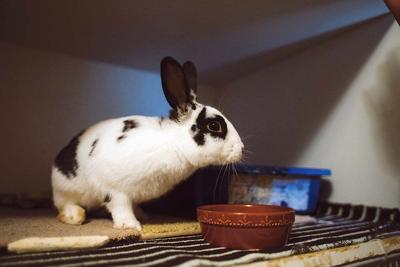
Everything in Lisa Redmond’s Marina home is in order, including the shelves, the throw pillows and the rabbits. Thirteen bunnies live with her in total, four of her own and nine currently in foster care.
Sturdy cages are stacked two or three high in her rabbit room, a one-time home office. Somewhere else in the house another bunny is hopping around. Two are in the backyard basking in the sun, and two are resting in their cages in the entry room. It’s all orderly and clean, with no trace of animal smells.
As a co-founder of Animal Friends Rescue Project’s Rescue Rabbits Rock, Redmond fosters bunnies that have been abandoned, hurt or are about to be euthanized. Along with Kelly Lehrian, executive director of Animal Friends Rescue Project, she’s been taking in bunnies since the early 2000s. Both Redmond and Lehrian play a significant role in the care for these fuzzy creatures. Redmond provides 24/7 support while Lehrian provides services and donations via AFRP.
“I will sometimes get phone calls in the middle of the night with frantic bunny owners asking where to bring their sick bunny,” Redmond says. “I have too big of a heart to not answer the phone, even at 3am.”
She says all bunnies have very different personalities, which is quite evident when visiting her home. Chloe Girl, whose tall ears make her look more like a jackrabbit, wears an expression of laziness and does not budge from her spot in her cage, even as new visitors approach. Just a few feet away, Lil’ Pumpkin hops around her cage energetically and looks up at Redford, her way of asking to be cuddled.
Rescue Rabbits Rock tries to fit each bunny’s unique personality with the right owner. “If a little girl comes to one of our shows looking for a fluffy, small and cute bunny, we have to stress to the parents that the those bunnies need someone more mature,” Redmond says.
“The white rabbits with the red eyes are the hardest to adopt out because of how they look,” she continues, “but their gentle nature makes them the best pets to cuddle with you on the couch.”
The white rabbits look docile in their cages as they calmly sit and observe, while other bunnies draw attention for their quirks and general appearance. Ginny, the “rebellious teenager,” leaves droppings anywhere but her litter box, while the pair of Stormy and Snowy, who were found abandoned on the side of the road, spend their days snuggling each other like young lovers.
Rabbits are the third-most surrendered animal in United States animal shelters, according to the nonprofits Humane Society and House Rabbit Society. “People typically are not taught how to take care of rabbits or understand that they will fight each other if not bonded properly,” Redmond says. As she strolls through her backyard garden, two bunnies hop peacefully around one of her cats.
It takes effort to create this idyllic bunny environment. Redmond says there’s an involved process when it comes to bonding rabbits that can take years. It starts with a meeting in new territory, where neither one is likely to claim dominance.
“I have found that the best and quickest way to bond rabbits is to put them into a carrier together, first making sure that they don’t seem aggressive toward each other, and then take them on a car ride,” Redmond says.
The aftermath of a bonding experience gone wrong is on display on a recent Saturday at Petsmart in Sand City, where Rescue Rabbits Rock is set up in the puppy training area with a half-dozen adoptable rabbits in cages. A couple pushes over their recently adopted rabbit, wrapped in a blanket in a Petsmart shopping cart, to show Redmond the damage of a bite wound and get her advice.
There are positive notes at the Petsmart bunny station, too. One man says he and his wife started out fostering one bunny, which turned into two, then four. “You think one bunny will be enough but then you want to get them a friend,” he says.
Rescue Rabbits Rock used to have about a dozen families offering to foster bunnies, and now just has around five regular foster homes, and is looking to expand its number of regular volunteers – whether they’re foster families, adopters or donors.
“We hate to turn bunnies away, and usually we find a way to house them, but with new bunnies almost every week and a declining amount of foster homes it is difficult to save them all,” Redmond says.
“It can sometimes be hard to take care of 13 bunnies by myself,” she says, “but I love them too much to stop.”


(0) comments
Welcome to the discussion.
Log In
Keep it Clean. Please avoid obscene, vulgar, lewd, racist or sexually-oriented language.
PLEASE TURN OFF YOUR CAPS LOCK.
Don't Threaten. Threats of harming another person will not be tolerated.
Be Truthful. Don't knowingly lie about anyone or anything.
Be Nice. No racism, sexism or any sort of -ism that is degrading to another person.
Be Proactive. Use the 'Report' link on each comment to let us know of abusive posts.
Share with Us. We'd love to hear eyewitness accounts, the history behind an article.