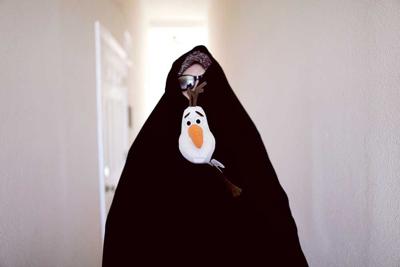

On a freezing winter’s night in Baghdad, Iraq, when the air was just cold enough to see a person’s breath, Zainab (her name has been changed for her protection) had a vivid dream. She saw men dressed in fatigues and helmets, marching in unison. A few more rode in armored tanks and humvees.
Though she had at that point in her life never seen an American soldier, there they were in her own neighborhood. She had a sense they were doing something good. She woke up suddenly, before she knew what exactly that was.
That dream was in the middle of January 2003. When she recounted the dream to her friend the next day, she was met with a hush. Talk like that wasn’t considered favorable toward the government, and Iraq was led by Saddam Hussein at the time.
But just a couple months later, in March, her dream became reality. The U.S., along with the U.K., Australia, Poland and the Iraqi National Congress (a government-opposition group), collectively deployed troops to overthrow Hussein’s regime. The U.S. government called it Operation Iraqi-Freedom.
To many Iraqis, especially those loyal to the existing government, it was just another name for U.S. occupation.
To Zainab – whose family had been targeted by Hussein’s government because they were Kurdish, and whose father was once arrested and beaten by the regime in front of her when she was 4 years old – it was a much-needed intervention and a step toward a modern democracy.
But that future would come with a violent price. Government loyalists exchanged bullets with American forces for days in Zainab’s neighborhood.
“At some point, you didn’t know who was shooting at who,” Zainab recalls. The chaos kept her Kurdish-Sunni family reluctant to support any side.
Yet Zainab had already made up her mind. She wanted to help the Americans and she refused to watch the war unfold from her bedroom window.
She decided to leave her job in the Ministry of Finance to become a translator for the U.S. Embassy, for three years escorting wounded soldiers and locals in and out of the green zone. Then she became a translator for the U.S. military, working alongside American soldiers, crammed together in the same humvees, eating the same food and experiencing the same day-to-day fighting.
But choosing allegiance to a country not her own proved to be a tightrope walk.
Zainab would frequently see graffiti voicing anti-American sentiment with messages like “death to the translator” or “the translator is a traitor.” She was also regularly followed by mysterious black cars, which Zainab believes were sent by the government to kidnap her, which wasn’t uncommon.
“Insurgents considered translators as the worst kind of traitor,” Zainab says.
The work was hard, but she persisted for nine years, until the formal end of U.S. operations in Iraq in 2011.
Soon Zainab was out of a job, and it was too dangerous for her to stay. She says she begged her American boss, “Can I not crawl into your suitcase and go the USA to make a better life for me and my family?” Zainab did make it to the U.S., on a special refugee visa later in 2011.
Zainab has now settled into her American dream. She got a driver’s license, a job teaching Arabic at the Defense Language Institute in Monterey, and citizenship. As everything lined up, it looked like she could eventually realize her goal of bringing her family over.
But in November 2016, that changed. Her annual contract with DLI wasn’t renewed; the word around campus was that as the U.S. drew back from involvement in the Middle East, many Arabic teachers would soon be out of a job.
Two months later, President Donald Trump signed an executive order limiting travel from seven predominantly Muslim countries, and Iraq was on the list. Zainab panicked. For two nights after the travel ban was announced, she could barely sleep or eat. All the work she had put into bringing her family over seemed to have been for nothing.
Although Trump de-listed Iraq on a revised travel order – and both have been temporarily stopped by judges – the message seems clear to Zainab.
“I can’t go back to Iraq, there is nothing for me there,” she says. “But what can I do when the U.S. doesn’t have a place for me either?”
She says she now barely makes rent for her small Monterey Peninsula studio with her unemployment check, which runs out in two months – also her deadline to leave the U.S. and return to Iraq if she can’t find a new job.
Again, she finds herself at odds with a government, and says she feels betrayed. “I feel used,” she says.
Scott Beggs, who befriended Zainab while volunteering locally for Hillary Clinton’s 2016 campaign, agrees. “It’s abominable to utilize her in her home country in a war that [the U.S.] is fighting,” he says, “and not recognize the sacrifices she made to serve our country.”


(0) comments
Welcome to the discussion.
Log In
Keep it Clean. Please avoid obscene, vulgar, lewd, racist or sexually-oriented language.
PLEASE TURN OFF YOUR CAPS LOCK.
Don't Threaten. Threats of harming another person will not be tolerated.
Be Truthful. Don't knowingly lie about anyone or anything.
Be Nice. No racism, sexism or any sort of -ism that is degrading to another person.
Be Proactive. Use the 'Report' link on each comment to let us know of abusive posts.
Share with Us. We'd love to hear eyewitness accounts, the history behind an article.