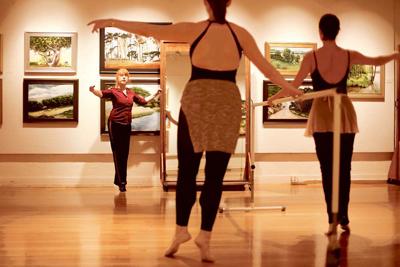

Clumsy but almost synchronized tip-toeing gently rattles the wooden floorboards on the second level of the Pacific Grove Art Center. Children, boys and girls, no taller than 4 feet and donning tights and dancer’s slip-ons, are pretending to gallop on ponies.
One boy exaggerates a leap and misses his next gallop, while a smaller girl looks down at an older girl’s feet, looking for the next step. Suddenly, their teacher, Milou Ivanovsky, stops the music. She wants the dance from the top.
“You need to lead with your right foot,” she reminds them, then begins to count “and five, six, seven, eight… ” The next time around is less confused and a little more focused, as the next generation of Ballet Fantasque dancers have finally heeded their teacher’s advice.
Ballet Fantasque students typically come to dance two to four times on weekdays, but Sunday morning practices are something of a tradition leading up to the annual production of The Nutcracker.
Their annual production is treated like an extravagant, extended family reunion involving current students, alumni and their families.
The leadership is also all in the family. Kira Ivanovsky, who founded Ballet Fantasque in 1974, died at age 104 on Feb. 6 and her daughter, Milou, is carrying on the tradition. The young kids scampering on and off the stage are still practicing Kira’s choreography today.
The dancers play major roles, minor roles and even the grandfather clock striking midnight – it’s a community effort. And if there’s any play that needs enthusiasm and effort to produce, it’s The Nutcracker, which has 13 major dances – in just the first act.
The famous holiday ballet, scored by Peter Ilyich Tchaikovsky and originally choreographed by Marius Petipa and Lev Ivanov, gained popularity in part for its balletic interpretations of various cultural dances from Spain and China to the Arabian Peninsula. Less beloved for its cultural “authenticity,” and more for its display of exoticism, TheNutcracker was a half-painted canvas ready for Kira Ivanovsky to transpose her experiences as a well-traveled dancer.
Kira was born in Russia during turbulent times. Her family was forced to flee during the Russian Revolution, and after a brief time in Turkey, Kira’s family relocated to Nice, France, where she began her formal ballet training with an ex-Bolshoi dancer Maria Nevelska.
Kira excelled in her career. She trained with Imperial Ballet dancer Lubov Egorova, danced with companies like Colonel Wassily de Basil’s Ballet Russes de Monte Carlo, traveled extensively across Europe but also to the Java Islands, China, Sri Lanka and lived in India for 10 years until World War II, when she decided to head for the U.S., making a stop in Connecticut before moving to Monterey in 1957.
Kira settled into the slower-paced lifestyle, but not without establishing a place that rooted her inner dancer’s soul. “My mother was a deeply philosophical person,” says Milou, Kira’s daughter – and until this year, her co-teacher. “Dancing was her meditation.”
From Kira’s formal years in learning the strict classical foundations of Russian and French ballet, to her deep appreciation of ethnic and traditional dances learned from her travels, Kira taught with her personal touch – literally.
“If she didn’t like something, she’d poke you with her nail,” says Caroline Hayworth, a 30-year-old student of Ballet Fantasque who began training with Kira in 2000. “She was expressive with her hands, pointing at us all the time.”
Hayworth says Kira’s calm and collected demeanor in class was something to be respected. When Kira spoke in her low Russian-inflected voice, students would listen closely.
“She was never mean about it,” Hayworth says, “but she always believed her students were capable of more.”
Ballet Fantasque’s Nutcracker is the best exemple of Kira’s choreographic style. For example, when doing the “Spanish,” or “Chocolate” dance, her choreography demands strong, posed arms and clenched fists; it feels like the dancers are more than just ballerinas in flamenco costumes. For the “Arabian,” or “Coffee” dance, Kira wanted her dancers to loosen up their hands to be more like belly dancers than ballerinas.
Even into old age, she required dancers to properly stretch after practice – including full splits, which she would do with ease alongside her students.
Milou watches today’s students, stops the music, then corrects them. It’s a little different from how her mom would’ve done it – “but that’s OK,” she says. “She’s always encouraged me to develop my own creative gifts.”


(0) comments
Welcome to the discussion.
Log In
Keep it Clean. Please avoid obscene, vulgar, lewd, racist or sexually-oriented language.
PLEASE TURN OFF YOUR CAPS LOCK.
Don't Threaten. Threats of harming another person will not be tolerated.
Be Truthful. Don't knowingly lie about anyone or anything.
Be Nice. No racism, sexism or any sort of -ism that is degrading to another person.
Be Proactive. Use the 'Report' link on each comment to let us know of abusive posts.
Share with Us. We'd love to hear eyewitness accounts, the history behind an article.