
As the sun sets over the agricultural fields of Salinas, the East Alisal campus of Hartnell College grows quiet. A single student walks away from the enrollment office as a staff member closes down and locks the door behind them. One classroom light is still on in the C building.
Inside are about five adults, an instructor, the executive director of El Pajaro Community Development Center and one child clinging to his mother. As the five students settle into class, instructor Vincio Vides begins a lesson on cash flow, projecting an Excel worksheet on a screen.
This isn’t an ordinary night class. There are no credits or grades earned. There are no after-class tutors. There are no midterms or finals. But the stakes for the students are still high. That’s because this 10-week course is all about introducing prospective business owners to the ins and outs of how to start, maintain and manage their own business.
The course was developed by the nonprofit El Pajaro CDC, located in Watsonville. Their various workshops and courses are meant to attract people from within the tri-county area.
El Pajaro CDC launched 38 years ago in 1979, to help migrant women improve their own livelihoods by supporting them through business ventures. As the program grew, staff members began expanding the opportunities toward migrant families.
About 85 percent of their students are Latino immigrants, many of who come from working-class backgrounds, and are often employees of the agriculture, service and hospitality industries, according to Executive Director Carmen Herrera. “We’re more than just classes,” Herrera says. “Students see this as a way out of poverty, for a better standard of living.”
Vides, says there’s a reason there’s no prerequisites to take the course – to welcome students as they are.
“They come from different backgrounds,” he says. Some come with second-grade literacy in their native language, or don’t know how to use a computer – which isn’t a problem, Vides adds: “This isn’t business school. It’s surviving business 101.”
Students still have to complete their homework, despite varying levels of literacy in language or technology. Vides expects his students to work with what they have.
“I tell them to turn in accounting worksheets however you can,” he says. “Do your work and write it down on a piece of paper – I don’t care as long as you do the work.”
And the work is hard. The courses are broken down into three segments: management, marketing and finances. “When they come to us,” Vides says, “what they have is just an idea.” It’s his job to bring those dreams into focus in the real world.
Some lessons are simple, like carrying a checkbook and recording all transactions or making daily cash drops. Some lessons are much bigger, like hiring employees under a specific job description or taking care of your credit score – or making sure you have enough money to open up in the first place.
Vides uses the restaurant and food industry as an example: “To open and be completely operating, you have to have $80,000 to $90,000 in cash up front.”
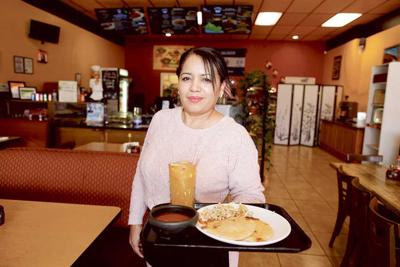
Marleny Rivas, owner of Pupuseria Marlney, is a testament to the courses’ lessons. When she began, she was surprised how fundamental the basics were: tracking cash flow and making sure to make more than just a monthly rental payment. The courses also got her on track to save, opening up shop in Salinas with just $6,000 in cash. El Pajaro CDC helped her find a loan.
In opening up her second shop in Watsonville she knew business like the back of her hand. “It was less stressful, Rivas says in Spanish. “I knew what I was doing this time.”
It’s that kind of outside support – access to financial resources and commercial kitchen and business incubators with coaching and one-on-one consulting – that students can expect to have upon completion of the course.
“Our mission isn’t just to provide these classes,” Herrera says. “We’re here to provide support and help people realize their own agency.”
In the middle of the class, 27-year-old Gonzales resident Yanel Rached puts her 2-year old son down and walks up to Herrera. From a tote bag she pulls out colorful hand-stitched baby jumpers, bibs and headbands. “This is my business,” Rached says in Spanish.
One by one, the students – who come from all over the Salinas Valley – begin to describe their businesses: an organic jam-making company, a diesel mechanic shop, a food truck. One woman says she doesn’t have an idea just yet.
“But it will come,” she promises.


(0) comments
Welcome to the discussion.
Log In
Keep it Clean. Please avoid obscene, vulgar, lewd, racist or sexually-oriented language.
PLEASE TURN OFF YOUR CAPS LOCK.
Don't Threaten. Threats of harming another person will not be tolerated.
Be Truthful. Don't knowingly lie about anyone or anything.
Be Nice. No racism, sexism or any sort of -ism that is degrading to another person.
Be Proactive. Use the 'Report' link on each comment to let us know of abusive posts.
Share with Us. We'd love to hear eyewitness accounts, the history behind an article.