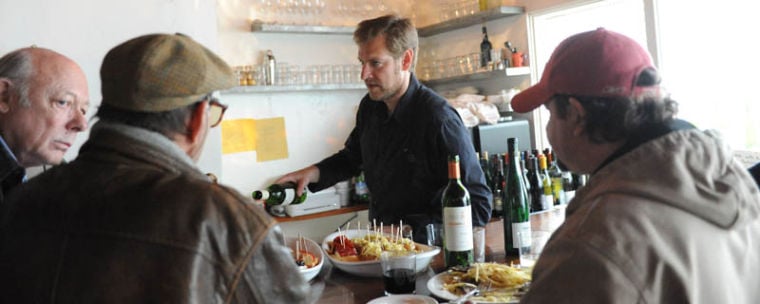
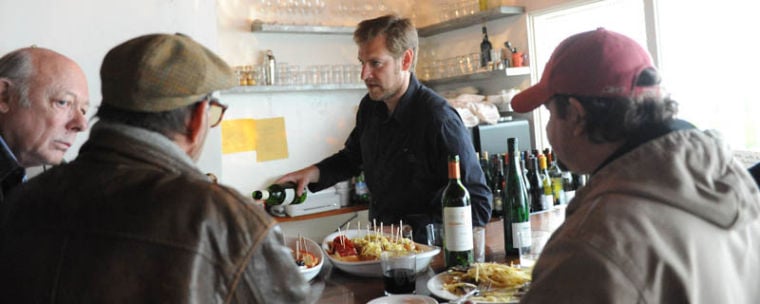
As I sat down to a meal with three friends at Carmel’s new restuarant Mundaka, I was driven to distraction by the interior design. Formerly Gem Restaurant, Mundaka has gone beyond the merely sustainable to using a treasure trove of reclaimed materials in its remodel.
Old pipe-fittings are adapted to form an irregular assortment of lighting fixtures, old doors are repurposed as wall paneling, rusty corrugated metal fashions the siding on the bar. A palette of muted colors washes over two connected rooms of well-used furnishings. A wall and floor are splashed with patterns by gobo lighting.
Somehow, the effect looks modern. Decorating comes naturally to owner Gabe Georis, a scion of the Georis restaurant dynasty, known for its interiors.
The name Mundaka, meanwhile, comes from a hilly surf town in the Basque region of northern Spain where Georis studied and surfed. More than a decade ago, when Spain assumed the mantle of Europe’s most innovative gastronomic culture, it became the destination for food professionals and hobbyists. While the elite food community adored the now-old new wave for pitching flavored foam, fruit caviar and other culinary curve balls, more of us also became familiar with Spain’s traditional dishes. The most widespread are tapas, from Andalusia.
Tapas are simply small plates, which are not inherently such a big deal. Sure, they’re cool, since all food lovers like to sample dishes, but the flavors and food combinations are the main attraction and Mundaka is a premier showcase for food anchored in the conventional recipes of Spain.
Mundaka’s menu offers a survey of Spain’s distinguishing ingredients: saffron, figs, sheep’s milk cheese, white anchovies, octopus, fava beans, membrillo (sweet quince paste), Marcona almonds (milky, fatty), Serrano ham (dry-cured, sliced thin), piquillo peppers (many chefs make an exception to their fresh-only rule for this bottled delicacy). The lowly chicken egg is often cooked and chopped, or used whole.
About two dozen tapas and only two or three fuertes (large plates) appear on the ever-changing menu. Platters of tapas are always available on the bar, where patrons help themselves, as they would at a party. The cost is tallied by the used cocktail picks left on your plate ($2 apiece). Everyone on staff seems to be a friend of Georis and in fact, our server, Adam, said, “It’s like we’re having a dinner party every night!” I don’t mind inviting myself.
A playfulness pervades the décor and the menu. The wine list is headlined “How to become a matador.” I won’t spoil it for you, but will divulge that wine is presented by price, beginning with a shockingly low $15 section. In Carmel? Yes.
Wines are mostly from Spain and elsewhere in Europe. With a $35 price point and a few parameters, Adam recommended a 2004 “Crianza” from Bodega Mitarte. This brawny, complex Tempranillo from 60-year-old vines in Rioja, Spain was quite elegant, with notes of spice, earth and dark fruit. A rebel among us also ordered a glass of Kalimotxo (red wine and Coca Cola, $5). It’s a Spanish thing, as is Clara (beer and lemonade, $5).
We asked Chef Brandon Miller, formerly of Stokes Restaurant and a longtime devotee of Spanish cuisine, to name his three favorite items, and we tried them all. First was ravioli with housemade ricotta and an organic egg, topped with morel mushrooms and pancetta ($7). We were directed to pop the egg so the yolk would ooze and meld with the sauce.
Puerco, a pork belly confit (house-immersed in duck fat) was served over polenta with a drizzle of cactus pear reduction ($6). Dátiles amounts to two dates stuffed with goat cheese and almonds, then wrapped in bacon and splashed with fig and balsamic reduction ($6). We ordered 12 different tapas and all cannot be described, but I do recommend these three.
Three of my other favorites were the tartare, a cold salad of raw halibut, fava beans, fennel slices and saffron riso tossed in olive oil and lemon; queso, two sheep’s milk cheeses, fig bread, quince paste, glazed walnuts, almonds and raisins ($7); and hamburguesa, a small lamb burger and fries ($6).
I only spotted two green dishes: a mixed greens salad and spring green gazpacho. The fresh peas in the latter was dominated by crème fraiche, but the former was sparingly dressed, teeming with parsley and minced egg. I’d like to see a seasonal vegetable plate on the menu.
We ordered the most unusual dessert, pan chocolate. It’s a scoop of fudge-like chocolate dusted with sea salt atop toast on olive oil. The Spaniards have enjoyed this combination for years and it has traveled around the globe. The point isn’t to enjoy salt, but to relish how it makes chocolate flavors pop. It won’t be for everyone, in which case the flan or rice pudding will be more persuasive.
Mundaka can be quite affordable. Four of us ate like fiends, including two desserts and wine, for $150 before tip. You could easily aim for less. Georis said he wanted to serve comfort food, and “it becomes uncomfortable when it’s too expensive.” I’m glad he noticed.
On most Mondays and Wednesdays, live music happens on an old upright piano. I’ll be going back for that and more of the vital, self-assured Mundaka.
Mundaka San Carlos between Ocean and Seventh, Carmel • Open daily from 5pm. • 624-7400.


(0) comments
Welcome to the discussion.
Log In
Keep it Clean. Please avoid obscene, vulgar, lewd, racist or sexually-oriented language.
PLEASE TURN OFF YOUR CAPS LOCK.
Don't Threaten. Threats of harming another person will not be tolerated.
Be Truthful. Don't knowingly lie about anyone or anything.
Be Nice. No racism, sexism or any sort of -ism that is degrading to another person.
Be Proactive. Use the 'Report' link on each comment to let us know of abusive posts.
Share with Us. We'd love to hear eyewitness accounts, the history behind an article.