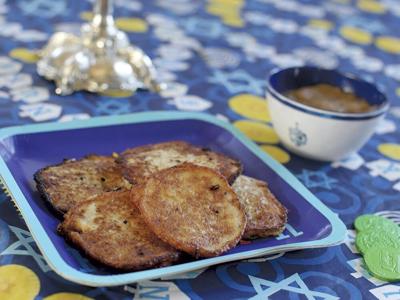


Latkes can be fancy - made with zucchini or sweet potato, served with smoked salmon, capers or creme fraiche. But the classic is potato-based and served with applesauce.
Many traditions among many faiths feature food prominently as part of a celebration. In Judaism, food is often incorporated as a symbol. On Hanukkah, which this year began on the evening of Nov. 28 and ends Monday, Dec. 6, the featured foods are jelly donuts and potato latkes. The common thread is that both are fried – the miracle at the center of this 2,300-year-old story is about oil.
The Hanukkah story goes roughly like this: Starting in 168 BCE, Greek King Antiochus IV Epiphanes embarked on a mission to Hellenize the Jews living in his empire. This effort evolved to an all-out ban on practicing Judaism, the killing of Jews, and an order to display Zeus in the Jewish Temple in Jerusalem. (That temple, then in its second iteration, is today famously known for its Western Wall that still stands as a sacred site.) This prompted the Maccabees to revolt – successfully – against Hellenistic powers. But the real miracle follows later when the temple is rededicated. A Jewish holy lamp there was supposed to be kept burning always, but the oil supply had been ransacked. Only pure oil – composed of just the first drop extracted from each olive – could be used, and there was just one tiny jug of this extra-extra-extra-virgin oil left, enough to burn for one day. Replenishing the oil supply would require a long journey, four days in each direction. But the tiny bit of oil lasted all eight days until a resupply arrived.
“That is the whole miracle of Hanukkah,” says Binie Holtzberg, who is married to Rabbi David Holtzberg at Chabad of Monterey, and who runs a kosher food program there. “That is why we eat oily food.”
Potato latkes likely didn’t come around until the 15th century but today, along with jelly donuts called sufganiyot, they are emblematic of the holiday.
Susan Greenbaum, the wife of Rabbi Bruce Greenbaum of Congregation Beth Israel, regularly hosts Hanukkah parties. “You’ve got to have latkes,” she says. “It doesn’t feel like Hanukkah without latkes.”
There’s an art to good latkes – the challenge is to get a crispy outside and chewy, satisfying interior. Greenbaum uses latke mix (made of dehydrated potato or potato flour, available in most kosher grocery aisles) instead of flour. “I like a latke that’s got some body to it,” she says. “The mix gives a little more body, otherwise things fall apart.”
Besides the direct symbolism, latkes present an invitation to eat and celebrate together, even for secular people. Alongside lighting candles in a menorah for eight nights – in the windowsill, visible to passersby – latkes are part of the Jewish Festival of Lights. “The message is to spread light and illuminate darkness,” Holtzberg says. “Unfortunately there’s a lot of darkness in the world right now. The whole idea of Hanukkah is to spread light, and not just inside in my kitchen, where nobody sees it.”


(0) comments
Welcome to the discussion.
Log In
Keep it Clean. Please avoid obscene, vulgar, lewd, racist or sexually-oriented language.
PLEASE TURN OFF YOUR CAPS LOCK.
Don't Threaten. Threats of harming another person will not be tolerated.
Be Truthful. Don't knowingly lie about anyone or anything.
Be Nice. No racism, sexism or any sort of -ism that is degrading to another person.
Be Proactive. Use the 'Report' link on each comment to let us know of abusive posts.
Share with Us. We'd love to hear eyewitness accounts, the history behind an article.