
It might be hard to tell on the basis of Japanese restaurant menus locally, but there is a lot more to Japanese cuisine than sushi and ramen.
Growing up, my only exposure to Japanese food was Cup Noodles – ramen in a styrofoam cup. So when I moved to Japan in 2002 and spent two years teaching English in public schools, what surprised me most – in a country full of surprises – was the wide variety of the food.
What I found in Japan was a vast array of dishes and vegetables, like lotus root and bitter melon, I didn’t even know existed. And while Japan consumes more seafood per capita than any other nation (by far), I discovered sushi is merely a sometimes food, just like most Americans don’t eat burgers every day.
For the most part, a typical Japanese meal – or at least a traditional one – consists of rice (of the homegrown Japonica variety), maybe seasoned but often eaten plain, some form of protein, a few vegetable sides and perhaps also miso soup.
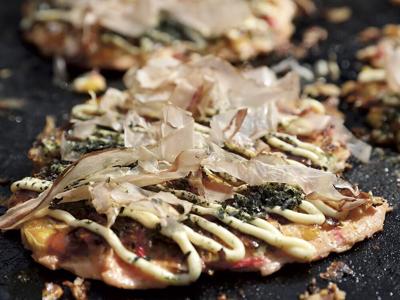
The most popular restaurants often specialized in something different, like Japanese curry, or takoyaki – savory, ball-shaped pancakes with octopus and vegetables inside. And then there are those dedicated to making okonomiyaki, a savory vegetable pancake that often includes pork or shrimp, but that sings without either.
For me, it was love at first bite. When I returned to California, I struggled to find restaurants that made it. To eat it again, I was going to have to learn to make it myself.
While this dish is highly adaptable, there are key ingredients that can’t be found in Western supermarkets, the most obscure being a tuber that, in Japanese, is called nagaimo (long potato), which is grated down into a slimy goop – it may not sound or look appetizing, but it has a neutral flavor and is critical for achieving the right texture. (Some people get a mild irritation touching it after it’s peeled, so handling it with latex gloves is recommended if that’s a concern.)
Also key is okonomi sauce – which is sweet and savory and is spread atop the pancake once it’s finished cooking – and Kewpie Japanese mayonnaise, which is lighter than American mayo and is squeezed out in fine lines on top once the okonomi sauce is applied.
Other important ingredients are red pickled ginger (unlike the kind served with sushi, it’s savory, not sweet), powdered nori and shaved bonito flakes, sprinkled on top, which provide a blast of umami in every bite. And if you can find it, tenkasu – cooked bits of tempura batter – add great texture.
Those wanting to make it more traditional, consider adding dried shrimp into the mix and thin-sliced pork belly (laid on top with a lid over it to steam, which then ends up on bottom when the pancake flips).
I was able to cobble together the essentials at two Korean markets – Asian Market in Marina and Han Kook in Seaside. But the place that has it all is Tokyo Oriental Foods & Gifts in Salinas, including tenkasu, which I was forced to omit from my recent batch.
Preparation is relatively simple, but it helps to check out an online explainer of the steps and ingredients.
As the Japanese tell others when something is delicious, “Oishii yo.”


(0) comments
Welcome to the discussion.
Log In
Keep it Clean. Please avoid obscene, vulgar, lewd, racist or sexually-oriented language.
PLEASE TURN OFF YOUR CAPS LOCK.
Don't Threaten. Threats of harming another person will not be tolerated.
Be Truthful. Don't knowingly lie about anyone or anything.
Be Nice. No racism, sexism or any sort of -ism that is degrading to another person.
Be Proactive. Use the 'Report' link on each comment to let us know of abusive posts.
Share with Us. We'd love to hear eyewitness accounts, the history behind an article.