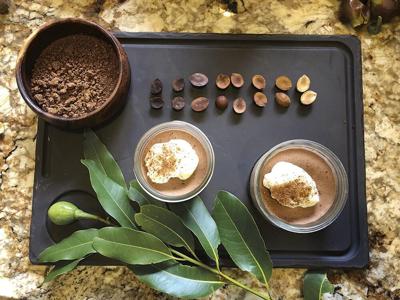

At this time of the year, if you have careful eyes or have been trained to look for them, you’ll notice that Monterey County’s bay nuts are getting ripe. The nuts of the California bay laurel tree look a little bit like tiny avocados as they hang from the tree’s verdant branches – they then turn a colorful mixture of red and yellow and drop to the ground once ripe. This can happen any time between October and January, depending on your exact location.
Bay nuts, unlike the aromatic leaves of the tree, are not exactly a common ingredient in modern cooking. But they were an important food source for the Indigenous people of Northern California, including the Esselen Tribe here in Monterey County.
Like any nut, the meat of a bay nut takes a bit of work to access. But it rewards this effort with a fatty, slightly bitter, cacao or chocolate-like flavor, and a stimulant effect similar to that of caffeine. For this reason, Jana Nason, tribal administrator of the Esselen Tribe of Monterey County, says her ancestors may have carried roasted bay nuts with them as efficient – and delicious – fuel for long journeys.
These days, Nason herself harvests bay nuts and roasts them to eat either plain or to use as an ingredient in a modern treat – like the bay nut and coconut cream mousse we enjoyed on a recent fall afternoon, for example.
Either way, it is a process that connects her to her history.
“We’re harvesting in the same ways that our ancestors did, in some of the same places,” Nason says. “It’s a good way for us to connect to our ancestral foodways.”
Harvesting and processing bay nuts is a multi-step process.
First, you’ll need to seek out ripe bay nuts. This might take a little searching, which is part of the fun of foraging – nuts in certain areas of the county will ripen earlier and others later. Bay trees, like many other fruit and nut trees, also go through annual cycles of heavier and lighter production.
Once you have collected the bay nuts, remove the outer skin and flesh to reveal a hard, light brown shell. Wash the nuts and dry them thoroughly – in the sunshine on a sunny day or in a warm room. This might take a few hours, or up to two weeks indoors.
Next, on an oven sheet, roast the bay nuts (still in their shells) in a 350-degree oven for somewhere between 45 minutes and an hour-and-a-half. Stir occasionally. Once the roasted nuts have cooled, use a nutcracker to remove the shells.
Nason looks for a fairly dark roast – somewhere between the color of caramel and dark chocolate. You’re looking for well-roasted nuts because the oils in bay nuts can be irritating if not thoroughly roasted; that said, an over-roasted bay nut isn’t great either – Nason says that as the color starts to approach black the nuts begin to lose their chocolate flavor and taste like popcorn. If your bay nuts are not yet roasted enough, pop them back into the oven. Finding the right roast for your oven and your taste may take a bit of experimentation.
Once they are fully roasted, bay nuts can be stored for months in airtight containers or in the freezer.
“It’s quite a process – it’s pretty time-consuming,” Nason says, of processing bay nuts. But if you’re a cacao and chocolate lover, you’ll almost certainly enjoy the results.
In addition to eating the nut by itself as an energy-boosting snack, you can grind bay nuts into a powder and use it in a similar way to how you might use cocoa powder, ground coffee or even rough flour – in brownies, a nutty crust for a pie or tart, mole sauce or even bay nut coffee. (If you are sensitive to caffeine, start with a small amount.)
If you do decide to go forage for bay nuts locally, remember to harvest responsibly. Also, keep in mind that foraging is not allowed in many areas, including most state parks – check the rules before you gather.
Harvesting, processing and eating bay nuts is also a good reminder that we live on vibrant, bountiful land – and not just in the agricultural fields of the Salinas Valley.
“Reconnecting with those [original] foodways is so rewarding,” Nason says. “We forget that everything we need is already here.”


(0) comments
Welcome to the discussion.
Log In
Keep it Clean. Please avoid obscene, vulgar, lewd, racist or sexually-oriented language.
PLEASE TURN OFF YOUR CAPS LOCK.
Don't Threaten. Threats of harming another person will not be tolerated.
Be Truthful. Don't knowingly lie about anyone or anything.
Be Nice. No racism, sexism or any sort of -ism that is degrading to another person.
Be Proactive. Use the 'Report' link on each comment to let us know of abusive posts.
Share with Us. We'd love to hear eyewitness accounts, the history behind an article.