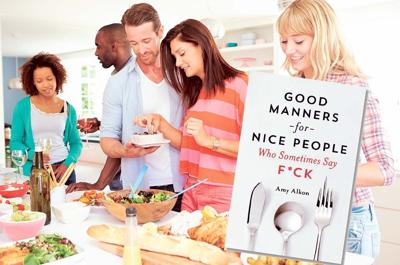
Amy Alkon (aka The Advice Goddess) writes a nationally syndicated advice column and is the author of the new book Good Manners for Nice People Who Sometimes say F*ck (St. Martin’s Griffin). The book has a chapter called “Eating, Drinking, Socializing,” with some interesting advice on food-related manners. I spoke with Alkon about the dynamics of three important food-related relationships: Those between restaurant server and customer, host and guest at a dinner party, and two people on a date.
Let’s talk about tipping.
People believe that they tip solely based on the quality of the server or the service. The truth is that some people do, but a whole lot just believe they do. We like to believe that we’re rational and do things for good reasons. But because our brains like to conserve energy where they can, we have a lot of cognitive biases that lead us to act automatically, in ways that aren’t wholly rational.
For example: If you’re male, you’re likely to tip bigger if your waitress is blond, if she’s wearing red lipstick, a red dress, or has a flower in her hair, according to behavioral scientist Nicolas Gueguen.
Other customers will leave bigger tips if the server does things to create the feeling of a familiar relationship, like if the server squats down at the table, making conversation seem more intimate. This, in research by Cornell University’s Michael Lynn and colleagues, increased the tip amount by 20 percent for a waiter and 25 for a waitress. Giving chocolates or mints with the check also ups the tip.
What if the service is truly terrible?
If you don’t tip at all it makes you look bad if you’re with dining companions, and the server can pretend that it’s on you, that you were the terrible one. So if the service is egregiously bad, use an idea I borrowed from Steve Dublanica, author of Keep The Change, and give your tip to the busboy.
But before you take drastic measures, make sure you’re positive that the waiter is intentionally slacking off.
Approaching the situation with compassion is counterintuitive but very helpful. Look for clues as to why you’re getting bad service. Is this person having a bad day? Are they covering three sections? Or are they just a person who thinks ‘Ha-ha, you’re going to wait for your lunch.’ You’ll feel better if you call up compassion and say, ‘OK, maybe this person isn’t trying to screw me over. Maybe there’s something wrong.’ And by the way, don’t blame the waiter if the kitchen doesn’t make food you like. Don’t find ways to be cheap.
What do you do if a friend serves you something that’s disgusting or conflicts with your dietary regimen?
This is America, we’re all getting regular meals. So if you have one meal that’s a bummer, you’ll survive. It’s better not to make the host feel bad. Just push the food around on your plate, and hit the drive-thru on the way home.
There’s gonna be something on your plate that you can eat. And I say this as someone who eats a low-carb, high-fat diet. And if you have any major food issues, like things you’re deathly allergic to, you should tactfully let them know upon RSVPing, but also let them know that you don’t expect them to create a whole different meal for you.
So no honest communication?
No. No, no, no. People have this mistaken idea that honesty is the best policy. And it is, except when lying your ass off is a better policy. For example, it does not help the host in that moment to learn that you think they are a terrible cook. It’s also not your job to tell them. As somebody who gives advice for a living, I have to say, it is really rude to give unsolicited advice. Besides, criticizing people does not make them want to change. It makes them hate you, or want to clobber you.
What if you’re on a date and he or she cooks you something inedible?
Make something up that preserves their feelings: “Forgive me, I’m not that hungry” or “I had a late lunch.” The point is making them feel good in the moment and then, if you continue seeing them, covertly try to find a way to improve their cooking, like taking cooking classes together.
What if your date is doing something weird at the table?
I had a question from a reader, a woman whose date was licking his fingers repeatedly – all of his fingers – at a sushi restaurant. I base the advice I give in my book about what behaviors are and aren’t acceptable on research [about] disgust by evolutionary psychologists Joshua Tybur and Debra Lieberman. Disgust seems to have evolved to help us avoid disease-causing micro-organisms. It’s basically a psychological keep-out sign that pops up when we encounter a substance that can infect us, like poo, bodily fluids, spoiled food. So, my rule goes like so: If something you’re doing at the table could cause some speck of something to be airborne, it’s bathroom behavior. Nose blowing, finger licking, ear digging, eyebrow plucking, removing your fake eye, all are no-gos. Get thee to the restroom.


(0) comments
Welcome to the discussion.
Log In
Keep it Clean. Please avoid obscene, vulgar, lewd, racist or sexually-oriented language.
PLEASE TURN OFF YOUR CAPS LOCK.
Don't Threaten. Threats of harming another person will not be tolerated.
Be Truthful. Don't knowingly lie about anyone or anything.
Be Nice. No racism, sexism or any sort of -ism that is degrading to another person.
Be Proactive. Use the 'Report' link on each comment to let us know of abusive posts.
Share with Us. We'd love to hear eyewitness accounts, the history behind an article.