
Sara Rubin here, trying to invoke the power of my imagination. What would it really look and feel like if nobody in our communities was unhoused? It would be more dignified for all, and safer. There are also some admittedly gross issues in public spaces that might just cease to exist—the smell of urine, for example.
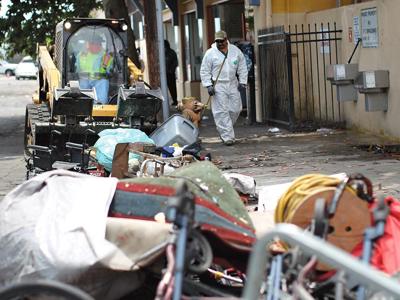
This is, of course, a distant dream at the moment. But it was part of the discussion when Salinas City Council met last night, Feb. 3, and deliberated about making updates to an ordinance and city procedures related to clearing homeless encampments.
Or more accurately, the unattainability of that dream was part of the discussion. “These ordinances will not end homelessness and they will not end encampments, they just won’t,” Assistant City Manager Lisa Murphy told City Council. “It’s a tool to help us manage and help us meet the balancing act the community needs.”
Broadly speaking, that balancing act is to uphold the dignity of all residents. That includes those living outdoors, unhoused. It also includes everyone else, and their right to access safe sidewalks and streets. Councilmember Tony Barrera described hearing from a constituent who found the public bathroom at Closter Park had become unusable for her and her child after it was commandeered by unhoused people, even though it was built to serve everyone.
“The city has a responsibility to protect the public health and safety of the entire community,” Murphy said. “It has a responsibility to protect access to public facilities. But it’s a balancing act with compassion and kindness for residents who are experiencing homelessness.”
City Council members did not agree entirely on how to adjust existing regulations and ordinances, although they ultimately voted 6-1 (with Andrew Sandoval dissenting) to accept Murphy’s recommendations.
Those changes include a shorter notification window—shifting from 72 to 48 hours—before clearing an encampment, which Murphy said would allow city officials to respond more quickly and ideally prevent new encampments from becoming entrenched. They updated the city’s prohibition on camping, specifically within 25 feet of “critical infrastructure,” which includes government buildings, train tracks, bridges and roads.
At Barrera’s request, council also voted for Salinas to host an intergovernmental meeting focused on homelessness, including people with lived experience. The lived experiences shared during council’s Feb. 3 meeting felt like calls of desperation.
“I come forward before you today with deep concern with a moral question,” said Tim Heavin, who has experienced homelessness and holds a number of leadership roles, including on the board of Coalition of Homeless Service Providers, among others. “Who is helped by this and who is harmed? The people most affected by this ordinance are not abstractions…they are human beings. Yet nowhere in these documents is there a plan for where these people are supposed to go.”
That is not in dispute, although reality is a bit more complicated. Murphy and Kayshla Lopez, the city’s homeless services manager, described recent contact with people in an encampment of roughly 50. Only three people accepted shelter. The other 47—well, nobody knows. They might have moved onto the next encampment.


(0) comments
Welcome to the discussion.
Log In
Keep it Clean. Please avoid obscene, vulgar, lewd, racist or sexually-oriented language.
PLEASE TURN OFF YOUR CAPS LOCK.
Don't Threaten. Threats of harming another person will not be tolerated.
Be Truthful. Don't knowingly lie about anyone or anything.
Be Nice. No racism, sexism or any sort of -ism that is degrading to another person.
Be Proactive. Use the 'Report' link on each comment to let us know of abusive posts.
Share with Us. We'd love to hear eyewitness accounts, the history behind an article.