
Sara Rubin here, thinking about the uphill battle that Cesar Chavez and other farmworker rights advocates faced a couple of generations ago. The progress achieved in Chavez’s lifetime was remarkable. Today, the basic premise of farmworker protections is baked into the agriculture industry and regulatory agencies, even if there is a continued push and pull between regulators and activists about exactly how to honor those protections—lawsuits over paid lunch breaks, for example, remain a feature of the modern landscape.
But structurally, times are different than they were when Chavez cofounded the United Farm Workers in 1962; for example, California’s Agricultural Labor Relations Board was formed in 1975, giving growers and workers a formal venue in which to resolve labor disputes.
Even with the structural changes he observed in his lifetime, I think Chavez would never have guessed that we would see the degree of cooperation we see today between anti-pesticide activists and the California Department of Pesticide Regulation. I don’t think even the activists who helped lead the charge would have expected it just a few years ago.
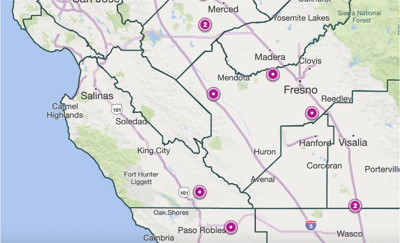
A week ago today, the state agency launched SprayDays, a digital notification system that provides updates about impending pesticide applications before they happen. It’s an unprecedented tool at a statewide scale, the result of digitization of data submitted by growers, and posted in an easily accessible format for all of us to review. You can also sign up to receive notifications by text or email.
The new app is a win for transparency, and for public health. The site provides tips on reducing exposure, including steps to take if you learn a pesticide application may be happening near you. Tips include: Keep windows and doors closed; bring children’s toys indoors; bring in laundry from the clothesline.
These might seem straightforward, but it’s a big deal for a public acknowledgment that steps like these can help keep farm-adjacent communities safer—and to also empower those residents with information that they can act on.
I searched upcoming applications in Monterey County today, and I can quickly find 420 acres east of Bradley in South County that are set to be treated with the weedkiller 2,4-D tomorrow morning at 7am. (For insight on how to use the site, check out this video produced by the Department of Pesticide Regulation.)
This kind of real-time, interactive portal is of course the result of technology that didn’t yet exist when the UFW started. But it’s also the result of collaboration between industry leaders, workers’ rights representatives, environmental health advocates and regulators—a unique coalition that serves as a reminder of how far we’ve come on this Cesar Chavez Day. And that’s something to celebrate.
Editor's note: This story has been updated to correct the name of the California Department of Pesticide Regulation, previously incorrectly referred to as the Department of Pesticide Control.


(0) comments
Welcome to the discussion.
Log In
Keep it Clean. Please avoid obscene, vulgar, lewd, racist or sexually-oriented language.
PLEASE TURN OFF YOUR CAPS LOCK.
Don't Threaten. Threats of harming another person will not be tolerated.
Be Truthful. Don't knowingly lie about anyone or anything.
Be Nice. No racism, sexism or any sort of -ism that is degrading to another person.
Be Proactive. Use the 'Report' link on each comment to let us know of abusive posts.
Share with Us. We'd love to hear eyewitness accounts, the history behind an article.