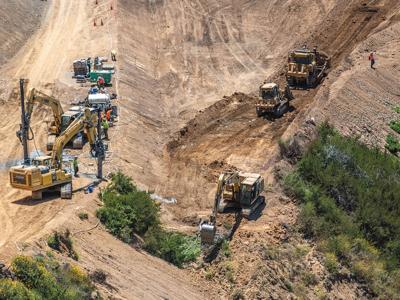

Katie Rodriguez here, thinking about slip-n-slides. Not the fun ones, though—the ones that plague Big Sur’s coastline.
At last week’s Big Sur Multi-Agency Association Council meeting, Caltrans representative Aaron Henkel, deputy director of traffic and maintenance, announced that Highway 1 at Rocky Creek will likely go down to one lane only starting in January 2026. Another kicker (the sighs from the crowd mounting as he spoke) was the fact that this lane would be closed for two years, with little flexibility in terms of length.
The sighs are, perhaps, obvious. Highway 1 has been closed for nearly three years; the Garrapata Creek Bridge had only one lane open for two years beginning in 2021; and the slides continue with no regard for the humans of Big Sur.
Looking back in reverse chronological order: Regent’s Slide occurred in 2024, overlapping with Paul’s Slide in 2023; Rat Creek Slide in 2021; and Mud Creek Slide in 2017, which overlapped with the Pfeiffer Canyon Bridge Slide. Nevermind the slips—like the one near Rocky Creek Bridge in March 2024.
Assemblymember Dawn Addis, D-Morro Bay, hoping to alleviate some of the accumulated frustration, probed Henkel with: “I think you should really reconsider this timing and its overlap with Regent's Slide." To which he responded with a “no-can-do:” the RFP was out, and once a contract has been awarded, there is only so long to execute on a contract until it expires. And two years is necessary to do this kind of bridge treatment.
So, what are they doing? Something called electrochemical chloride extraction. It’s the same treatment that closed one lane at Garrapata Creek Bridge from August 2021 to November 2023, costing $6.7 million. The process fortifies bridges by removing chloride ions from chloride-contaminated reinforced concrete, by applying an electrical current to the steel rebar.
In other words, the treatment addresses the corrosion damage on bridges caused by the salty fog. Caltrans says it’s been used all over the state, and in Big Sur, at Garrapata Creek Bridge, Big Creek Bridge and MalPaso Creek Bridge.
That means, more bridges to fortify, and many more years of lane closures to be had at bridges along the Big Sur coastline that have yet to be treated.
The treatment at Rocky Creek Bridge is estimated to cost $16.33 million, part of a $5 billion statewide funding effort (from a mix of state and federal funds) for local projects, bridge repairs, alternative transportation options and freight movement.
The good news: hopefully, better (safer) bridges ahead.
The bad news: congestion—slower drives into Monterey for doctors’ appointments, fears of a Car Week–style backup. These are things Big Sur residents are all too familiar with.


(0) comments
Welcome to the discussion.
Log In
Keep it Clean. Please avoid obscene, vulgar, lewd, racist or sexually-oriented language.
PLEASE TURN OFF YOUR CAPS LOCK.
Don't Threaten. Threats of harming another person will not be tolerated.
Be Truthful. Don't knowingly lie about anyone or anything.
Be Nice. No racism, sexism or any sort of -ism that is degrading to another person.
Be Proactive. Use the 'Report' link on each comment to let us know of abusive posts.
Share with Us. We'd love to hear eyewitness accounts, the history behind an article.