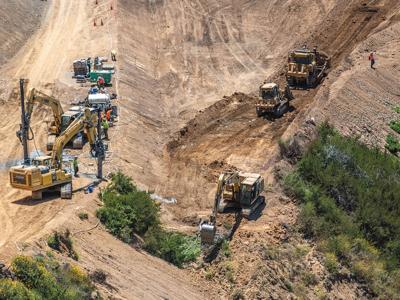

As of press time, Highway 1 in Big Sur has been closed to through-traffic for 971 days – over two-and-a-half years – the longest in history. Its closure has squeezed businesses, physically split the Big Sur community, and left some residents confused and frustrated, in search of details about what’s been going on.
“We know there are going to be problems on this road in the future, at all times,” said Planning Commission Chair Martha Diehl at a Big Sur Byways Organization meeting on June 18, where Caltrans gave a detailed presentation of what was happening at Regent’s Slide, dispelling some of the confusion. “Nobody’s trying to keep anything from anybody. We just don’t know.”
Regent’s Slide has kept the highway closed roughly 5 miles south of the Esalen Institute since Feb. 9, 2024. The Regent’s Slide cleanup is estimated to cost approximately $81 million, $51 million over the current approved cost. The nagging question: Why is it taking so long to fix?
“As we excavated what would happen was we would start pushing material over the side, it would start to drop, and it would start to accelerate. So we would stop,” Tim Campbell, deputy director of construction with Caltrans, said at the Byways Organization meeting. “We were in this on-off pattern. That’s when we decided to research the remote equipment.”
After deploying remote-controlled equipment and identifying a strategy that was showing signs of progress, Caltrans announced plans for a tentative reopening timeline in mid-September. (That timeline remains to be announced.) The strategy, detailed on June 18, involves installing thousands of shear dowels – 40 to 60-foot-long steel rods – drilled deep into the side of the cliff to keep the unstable material from sliding.
Regent’s Slide is different from other slides, Caltrans personnel say. Campbell shared that he has been with Caltrans since the ’90s and worked on several slides, including at Mud Creek and Paul’s Slide. Regent’s Slide is taller, and the ground has continued to move in unexpected ways, pushing crews higher up the cliff to reach stable ground and keep workers safe. Caltrans likens the slide to a pile of apples at a grocery store: pulling out the bottom apples would cause the whole pile to crumble.
A total of 3,500 dowels have been installed to stabilize the cliff, with more expected. By comparison, work at the Rocky Creek slipout used 40 dowels.
The business impacts as a result of the closure have been significant, says John Handy, co-founder and owner of Treebones Resort, located south of the closure. He adds that business is down by 40 percent, and they’ve relied on disaster relief loans to stay afloat.
South Coasters are requesting progress updates (with photos) every two weeks that are more detailed than the “Highlights” that Caltrans sends out weekly.
“If you’re making decisions that affect somebody else, they’ll accept it, as long as they understand why, and as long as you tell them what you’re doing,” Handy says. “If you don’t [tell people what you’re doing] people get really upset. They get suspicious, they make up their own stories. And that’s what has happened with some of this.”


(0) comments
Welcome to the discussion.
Log In
Keep it Clean. Please avoid obscene, vulgar, lewd, racist or sexually-oriented language.
PLEASE TURN OFF YOUR CAPS LOCK.
Don't Threaten. Threats of harming another person will not be tolerated.
Be Truthful. Don't knowingly lie about anyone or anything.
Be Nice. No racism, sexism or any sort of -ism that is degrading to another person.
Be Proactive. Use the 'Report' link on each comment to let us know of abusive posts.
Share with Us. We'd love to hear eyewitness accounts, the history behind an article.