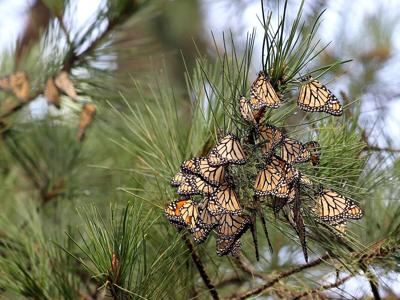

Pam Marino here, with some new/old news about monarch butterflies and direct action all of us can take to help the species that hopefully is not on its last wings.
Last week a social media post began circulating saying that “hundreds” of monarch butterflies were dying near the Pacific Grove Monarch Butterfly Sanctuary.
Hundreds? I had just finished reporting how this year’s official Western monarch count was dangerously low, just 9,119 for all overwintering sites, 228 at the P.G. sanctuary. More recent counts at the sanctuary were closer to zero. I reported another story about how the monarchs are up for consideration as an endangered species by the U.S. Fish and Wildlife Service.
Dubious about the post, I reached out to Emma Pelton, my source at the Xerces Society, the nonprofit that conducts the annual count and conducts extensive research into monarchs and other invertebrates. She confirms there was a significant die-off of monarchs in P.G. over a year ago in January 2024, when the count was much higher. It wasn’t reported to the public until Jan. 23 of this year.
According to the report, sanctuary volunteers stumbled upon approximately 200 dead and dying monarchs on a private lawn across the street from the city’s property. The butterflies that were still alive were spasming, a symptom of pesticide poisoning.
Officials at the Pacific Grove Museum of Natural History, a partner with Xerces in counting the monarchs, reported the event to Xerces. The California Department of Fish and Wildlife was called in, as were the U.S. Geological Service and Pacific Grove city staff. They collected a sample of the dead butterflies for testing.
The results showed that the butterflies had been exposed to a variety of pesticides, including multiple insecticides, fungicides and herbicides, according to a Xerces press release. On average, each butterfly contained residues of seven different pesticides. Three pyrethroid insecticides, described as “extremely toxic” by Xerces, were each found in near lethal levels.
Xerces and its founders filed reports with the Environmental Protection Agency, as well as CDFW, the city and the Monterey County agricultural commissioner. The ag commissioner’s office launched an investigation into the source but could not identify any reported pesticide applications that could have caused the deaths.
The conclusion by Xerces scientists was that it was likely an unreported and untraceable application by a resident or business.
My takeaway from this story is that all of us need to rethink using chemical pesticides at our homes and businesses. Even so-called organic pesticides like Bacillus thuringiensis, or BT, are highly toxic to monarchs and other butterflies.
“Accept that some ‘pest’ activity is a normal part of a healthy ecosystem,” the Xerces press release states. Use nonchemical prevention methods whenever possible. If using pesticides, do not apply them on open flowers, always choose the least toxic chemical and use targeted application methods like traps instead of sprays.
We face the reality of this majestic species being lost forever and the fact that each and every one of us has a role in the monarchs’ protection. Hopefully it’s not too late.


(0) comments
Welcome to the discussion.
Log In
Keep it Clean. Please avoid obscene, vulgar, lewd, racist or sexually-oriented language.
PLEASE TURN OFF YOUR CAPS LOCK.
Don't Threaten. Threats of harming another person will not be tolerated.
Be Truthful. Don't knowingly lie about anyone or anything.
Be Nice. No racism, sexism or any sort of -ism that is degrading to another person.
Be Proactive. Use the 'Report' link on each comment to let us know of abusive posts.
Share with Us. We'd love to hear eyewitness accounts, the history behind an article.