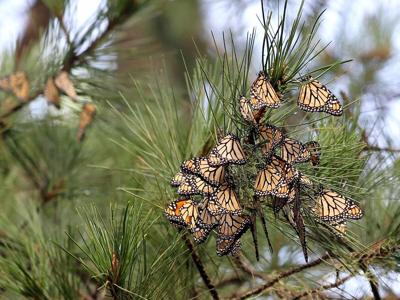

For years advocates for monarch butterflies have argued that the insects need to be protected under the Endangered Species Act. Despite their numbers precipitously dropping in recent years, their protection was put on the back burner by federal authorities, until now.
On Tuesday, Dec. 10, the U.S. Fish and Wildlife Service announced that it was making a formal recommendation to designate the monarch butterfly, Danaus plexippus, as a threatened species by the end of next year. If finalized, it would allow the government to designate critical habitat for protection, including land in Monterey County.
In total, nearly 4,400 acres of land in Monterey, Santa Cruz, Alameda, Marin, San Luis Obispo, Santa Barbara and Ventura counties would be protected.
That includes the Pacific Grove Monarch Butterfly Sanctuary, where the insects have been overwintering for decades. Once in abundance, their numbers have declined from 45,000 in 1997, to just 228 monarchs tallied the week of Dec. 2.
"Overwintering habitat is crucial for monarchs to survive, and over the years that habitat has been significantly decreasing, leaving monarchs vulnerable," said Liese Murphree, the Pacific Grove Museum's director of education and outreach, in a press release.
The museum has been participating in the Western Monarch Count with the Xerces Society since its inception in 1997 and has been involved in tracking monarch numbers in the sanctuary since 2012.
In December 2020, when the Thanksgiving count for all overwintering sites in California was approximately 1,800, monarch advocates anxiously awaited a decision by the USFW to put the butterflies on the threatened list.
They were disappointed when officials announced that there were a backlog of 161 other species ahead of monarchs. Listing monarchs as threatened was "warranted but precluded at this time by higher-priority actions," the announcement said. Officials also blamed a lack or resources in being able to research threatened and endangered species.
At some point in the last four years it was the monarchs' turn. The USFW has released a 184-page report detailing why the monarchs need protection.
"We have determined that the monarch butterfly meets the [Endangered Species] Act's definition of a threatened species," the report states. Researchers determined that the Western monarch population has declined by 95 percent, the Eastern population by 80 percent.
They put the chance of the Western monarchs becoming extinct by 2080 at 99 percent.
"The iconic monarch butterfly is cherished across North America, captivating children and adults throughout its fascinating lifecycle," said USFW Director Martha Williams. "Despite its fragility, it is remarkably resilient, like many things in nature when we just give them a chance."
The threats to monarchs include: loss and degradation of breeding, migratory and overwintering habitat; exposure to insecticides; the effects of climate change.
A 90-day public comment period begins on Thursday, Dec. 12, closing on March 12, 2025. Comments can be submitted through regulations.gov.


(1) comment
It's about time. The federal agency also needs to coordinate with Mexico, which is the winter breeding ground under serious threat. Locals can plant Milkweed that is native to our area. Don't plant the other milkweeds, as they cause the butterfly to linger longer in our area, where they can succumb to the weather when they should have been migrating to Mexico.
Welcome to the discussion.
Log In
Keep it Clean. Please avoid obscene, vulgar, lewd, racist or sexually-oriented language.
PLEASE TURN OFF YOUR CAPS LOCK.
Don't Threaten. Threats of harming another person will not be tolerated.
Be Truthful. Don't knowingly lie about anyone or anything.
Be Nice. No racism, sexism or any sort of -ism that is degrading to another person.
Be Proactive. Use the 'Report' link on each comment to let us know of abusive posts.
Share with Us. We'd love to hear eyewitness accounts, the history behind an article.