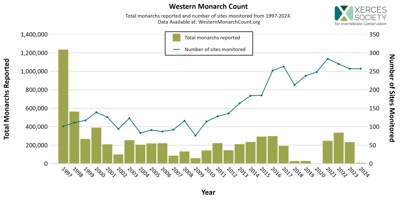

In more distressing news for monarch butterflies, the annual Western Monarch Count tallied just 9,119 overwintering monarchs, the second lowest count since the tracking began in 1997, the Xerces Society announced on Jan. 30. It’s a steep decline from the previous year, which recorded nearly 233,400 monarchs.
The Pacific Grove Monarch Butterfly Sanctuary saw just 228 butterflies counted, down from 6,508 the previous year. In 2020, which was the lowest number of monarchs counted up and down the West Coast at just 2,000, P.G.’s sanctuary recorded zero.
The largest number of monarchs recorded at the sanctuary was 45,000, the first year the butterflies were tracked in 1997.
“The population’s size is extremely concerning,” said Emma Pelton, an endangered species conservation biologist with the Xerces Society for Invertebrate Conservation, in a press release. “We know small populations are especially vulnerable to environmental fluctuations, and we think that’s what happened this year.”
Pelton said the record high temperatures in the drought in the West was the likely cause of the significant drop-off. Monarchs are challenged by a variety of threats across their migratory range, including pesticides, habitat loss and increasingly severe weather made worse by climate change.
The Xerces Society announcement comes two months after the U.S. Fish and Wildlife Service announced it was formally recommending monarchs be declared a threatened species under the U.S. Endangered Species Act. If finalized, it would allow the federal government to designate habitat for protection, including in Monterey County at locations like the P.G. sanctuary. A public comment period on the listing is open until March 12.
Whether the new administration will follow through is a question, including when it comes to federal pesticide regulations.
Research by the Xerces Society and the University of Nevada-Reno in California’s Central Valley found that a key food source for monarch caterpillars were contaminated with 64 different pesticides.
One of the pesticides, methoxyfenozide, is likely to be highly toxic to the caterpillars. It was found in 96 percent of milkweed samples. It is currently classified as “practically non-toxic” to adult honey bees, the only insect species that is included in testing by the Environmental Protection Agency before a new pesticide is approved for market.
The Xerces Society and Earthjustice formally petitioned the EPA in December to close the gaps in how it assesses pesticide risk to additional pollinators.


(0) comments
Welcome to the discussion.
Log In
Keep it Clean. Please avoid obscene, vulgar, lewd, racist or sexually-oriented language.
PLEASE TURN OFF YOUR CAPS LOCK.
Don't Threaten. Threats of harming another person will not be tolerated.
Be Truthful. Don't knowingly lie about anyone or anything.
Be Nice. No racism, sexism or any sort of -ism that is degrading to another person.
Be Proactive. Use the 'Report' link on each comment to let us know of abusive posts.
Share with Us. We'd love to hear eyewitness accounts, the history behind an article.