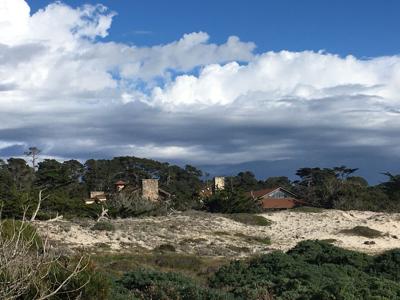

On Wednesday, July 15, California State Parks and Aramark Destinations will cut the ribbon on the new Historic Preservation Center at Asilomar Conference Grounds, marking a formal commitment to a landscape that has already spent more than a century proving it is worth preserving.
Asilomar's story begins in 1913, when the YWCA established the site as its first permanent conference grounds in the West—a retreat meant to nurture the "intellectual, moral, spiritual, social and physical health" of young women. Phoebe Hearst, a driving force behind the project, sponsored a contest to name the place; a Stanford student named Helen Salisbury won with "Asilomar," a portmanteau of the Spanish asilo and mar, meaning "refuge by the sea." That idea of refuge has outlasted every organization that has managed the grounds since.
What makes Asilomar irreplaceable, though, is Julia Morgan. Between 1913 and 1928, California's first licensed female architect designed roughly two dozen structures here, from the Social Hall and Long houses that opened camp in its first summer to Merrill Hall, her final and most ambitious building on the site.
Working in the Arts and Crafts idiom known as the First Bay Tradition, Morgan built from the inside out: exposed wood trusses, redwood walls, river-stone fireplaces and windows placed to frame the dunes and Monterey pines rather than compete with them. Eleven of her original buildings still stand and, remarkably, many still do exactly what they were built for—housing conferences, hosting gatherings, sheltering guests.
That continuity of use is rare for buildings this old, and it's a large part of why the National Park Service designated Asilomar a National Historic Landmark in 1987, citing its role in women's history, the YWCA's development and the region's resort heritage.
The site changed hands in 1956, when the State of California bought the grounds and brought in architect John Carl Warnecke to add seven more buildings—an expansion that had to answer to Morgan's original vision without imitating it outright. That balancing act is the same one the new Historic Preservation Center now inherits: how to keep a working, revenue-generating conference destination alive while ensuring its irreplaceable fabric—hand-hewn beams, original glazing, the specific relationship between building and dune—isn't quietly lost to deferred maintenance or well-meaning renovation.
That is worth safeguarding for reasons beyond nostalgia. Morgan's buildings are a rare physical record of a woman architect working at the height of her powers at a moment when few women were allowed to practice at all. The dune forest and coastal scrub surrounding them are themselves a fragile, actively restored ecosystem. And the culture of gathering that Asilomar was built to foster—education, reflection, community, away from ordinary distraction—is arguably as scarce now as pristine coastal wilderness itself.
The Historic Preservation Center formalizes what Asilomar has quietly practiced for over 100 years: treating a place as something held in trust, not just owned.
A ribbon-cutting for the Historic Preservation Center at Asilomar Conference Grounds takes place at 1pm Wednesday, July 15. Asilomar Conference Grounds, 800 Asilomar Ave., Pacific Grove. Free; RSVP required. (888) 635-5310.
Consider attending a documentary screening about Julia Morgan hosted by the Carmel Heritage Society at 2:30pm on Sunday, July 19, capping 32nd Annual Carmel House Tour. $15. carmelheritage.org/tickets.


(1) comment
Aramark is the same corporation that operates Yosemite National Park's shuttle busses, guest facilities, and High Sierra Camps. How's that going?
Welcome to the discussion.
Log In
Keep it Clean. Please avoid obscene, vulgar, lewd, racist or sexually-oriented language.
PLEASE TURN OFF YOUR CAPS LOCK.
Don't Threaten. Threats of harming another person will not be tolerated.
Be Truthful. Don't knowingly lie about anyone or anything.
Be Nice. No racism, sexism or any sort of -ism that is degrading to another person.
Be Proactive. Use the 'Report' link on each comment to let us know of abusive posts.
Share with Us. We'd love to hear eyewitness accounts, the history behind an article.