
AS THE SO-CALLED TEA PARTY MOVEMENT GATHERED STEAM IN THE LATE 2000s, the Daily Show sent then correspondent John Oliver to a rally, where he encountered a man shouting the revolutionary slogan, “No taxation without representation.” Oliver calmly responded to the effect of, “You do realize you have representation, don’t you?”
The man caught on camera is no different than many Americans in his understanding of the cause of the American Revolution. We have ingrained “no taxation” and overlooked what to colonists of the 1770s was the much more important demand: “without representation.”

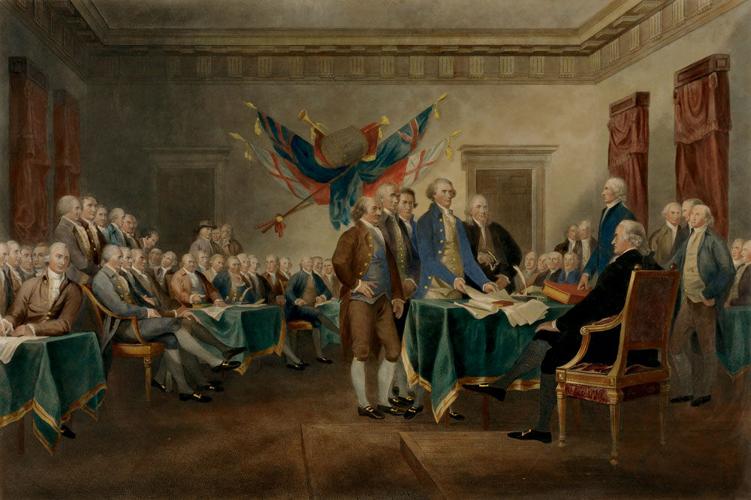
Signing of the Declaration of Independence. Vintage artwork, art illustration. People in vintage artwork, painting of people.
Many Americans are not particularly well-versed in details of the nation’s history. It’s likely that most can tick off the key events leading up to the Declaration of Independence 250 years ago – The Boston Massacre, The Stamp Act, The Boston Tea Party, The Midnight Ride of Paul Revere. And we can name key figures, such as George Washington, Thomas Jefferson and Benjamin Franklin.
Our shorthand, however, makes the progression toward revolution appear orderly. Moreover, it invites misuse of the past. Among the Tea Partiers’ demands were lower taxes and a smaller federal government. But it was men like Franklin and Washington who recognized the need for a strong central government to replace the loosely-stitched authority of the Articles of Confederation, hammering out the Constitution just a few years after the end of the Revolutionary War.
In our understanding of the nation’s history, Americans tend to fall back on a form of patriotic mythology that obscure or even dismisses nuances, shortcomings and contradictions. Now, 250 years after the Declaration of Independence, Donald Trump has stepped in to make matters worse.
JOHN ADAMS TURNED TO THE JURY WITH HIS FINAL THOUGHTS. Seven months earlier – in March of 1770 – British soldiers under the command of an officer had fired into a crowd gathered around their post, killing five, an incident known to posterity as the Boston Massacre.
In the outrage that followed, Captain Thomas Preston and the eight men were arrested for murder. But Adams defended the soldiers, bringing forth evidence that they had acted in self defense. “Facts are stubborn things,” he told the jury. “And whatever may be our wishes, our inclinations, or the dictates of our passions, they cannot alter the state of facts and evidence.”
The jury of Bostonians had felt and fielded anger toward the soldiers. Yet they found Preston not guilty and likewise acquitted six of the men. Two were declared guilty on the lesser charge of manslaughter and were branded as punishment.
In his 2025 executive order – number 14253, with the ironic title of “Restoring Truth and Sanity to American History” – Trump lashes out against fact. The retelling should “focus on the greatness of the achievements and progress of the American people.” The order goes on to demand that monuments, markers or other memorials “do not contain descriptions, depictions, or other content that inappropriately disparage Americans past or living (including persons living in colonial times).”
The order has been appropriately mocked. Writing for the International Bar Association, Tim Ryback, executive director of the Institute for Historical Justice and Reconciliation in The Hague, noted that Trump failed to clarify what appropriate disparagement of American heroes might look like.
Race is a central theme through American history, and the one most often met with cultural somnolence or false narratives. In Executive Order 14253, Trump insists that National Park Service guides presented “a divisive, race-centered ideology” when it comes to slavery. The order instructs historic sites that are federal property – both parks and museums – to teach an ideal of “consistent progress” of “advancing liberty, prosperity and human flourishing,” blaming previous administrations for reconstructing our past as “inherently racist, sexist, oppressive or otherwise irredeemably flawed.”

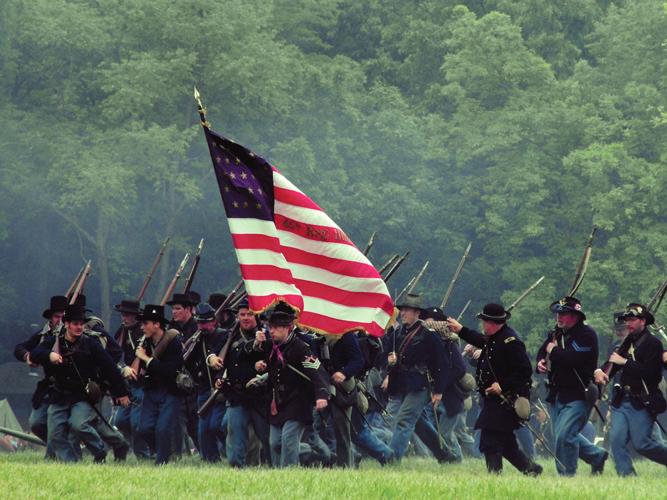
Civil War reenactment Lakewood Forest Preserve Wauconda Illinois. Picture taken on 07/09/16.
Humans, of course, are naturally flawed. How do we cope with baseball hall of fame manager John McGraw, who in 1901 signed Negro League infielder Charlie Grant, hoping to pass him off as a Cherokee to bypass the color barrier, and who hoped to bring dozens of other Black players to the New York Giants, but also reportedly accepted a piece of rope from a lynching as a good luck charm?
One of the most persistent national myths is related to a massive racist blight that Trump shrugs off: slavery. Some people insist that the Confederate States seceded in defense of states’ rights. But was there a right, in particular, that slave-owning states wished to preserve?
The answer can be found in Mississippi’s Declaration of Secession, which states clearly that “Our position is thoroughly identified with the institution of slavery – the greatest material interest of the world. Its labor supplies the product which constitutes by far the largest and most important portions of the commerce of the Earth… These products have become necessities of the world, and a blow at slavery is a blow at commerce and civilization.”
How noble. Granted, there were mill owners in England and merchant shipping operators in Northern ports that also profited off the labor of enslaved people. Yet the message is clear. Mississippi’s delegates complained that slavery was not allowed on federal land, that abolitionists schemed to emancipate their property or – apparently worse – advocated for Black equality.
That fighting against the United States was merely an action in support of states rights is further contradicted in a song popular in the South following the war. “I’m A Good Old Rebel” includes lyrics such as “I hate the Constitution” and “I hate the Freedmen’s Bureau,” the latter a reference to the agency responsible for aiding refugees and emancipated slaves.
It would, of course, be a mistake to suggest that U.S. volunteers were inspired by abolitionist zeal. Most joined the army in order to restore the Union. As the war dragged on, however, many came to see freeing Blacks as a way to undermine the authority of Southern planters and bring the war to a quicker conclusion. One of the common questions in letters and diaries as Sherman’s men moved through the deep South was why whites in the region joined plantation owners in opposition to the U.S. To Americans encountering Southern culture for the first time, it was evident that the white underclass was fighting to keep themselves subordinate to the wealthy. They did not instantly grasp that, in general, white Southerners rich and poor shared the same cultural perspective toward Blacks.
Racism strains another mythologized era, that of the “greatest generation.” NBC News anchor Tom Brokaw coined the term in his 1998 book by the same name, recognizing the American men and women who came through the Great Depression and found World War II – both significant achievements.
Recall, however, that this was also a time when much of America was segregated. In 1942, the same President Franklin D. Roosevelt who cherished the “four freedoms” in radio fireside chats (and who was called a “traitor to his class” by patrician neighbors for the New Deal), signed an executive order rounding up Japanese on the West Coast – the majority of them American citizens, many from Monterey County – and herding them into camps of mass incarceration.
While factories were hiring frantically to keep pace with wartime production demands, adding around 6.6 million women to the workforce, one company stated that Blacks were only suitable for janitorial positions. A political cartoon at the time portrayed a white Southerner saying, “Let Hitler win, he hates Negroes too.”
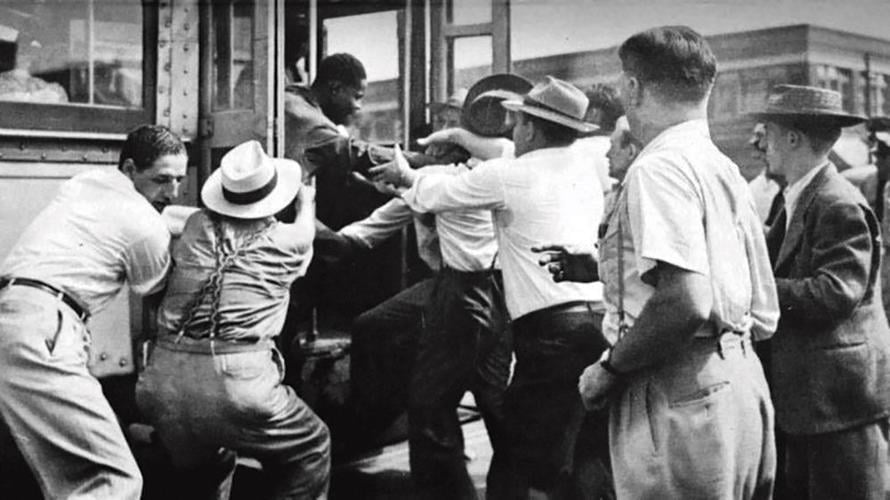
Of course, the problem was not limited to the Southern states. Nine whites and 23 Blacks died during a Detroit race riot in 1943 (17 of the Black Americans died as a result of police violence). Roosevelt had to send troops to Philadelphia in 1944 when white transit company employees went on strike after the city hired eight Black trolley operators.

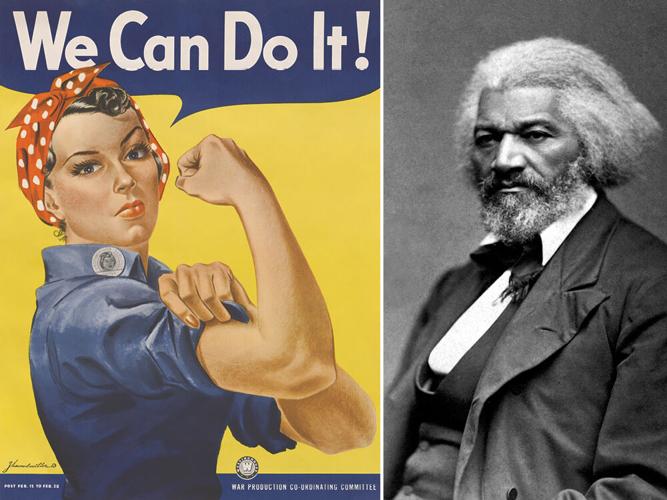
(left) Rosie the Riveter became an iconic figure during World War II, when some 6.6 million women entered the workforce. After the war, however, the stay-at-home sitcom mom replaced the factory worker as the ideal image. Although women won the right to vote in 1920, a campaign for an equal rights amendment failed six decades later. (right) Frederick Douglass was an escaped slave who became a leader in the abolitionist movement. In speeches he would remind people that Independence Day did not apply to all.
These are facts Trump wishes to obscure. In response to Trump’s Executive Order 14253, the American Historical Association issued a statement advising that the purpose of historical study “is neither criticism nor celebration.” Instead, it is to understand the past, to understand change and to provide a foundation to shape the future – flaws and all.
That Washington, Jefferson and many other signees of a document of self-evident statements such as “All men are created equal” owned enslaved Black people is well known. And some people do view this fact through a present lens, arguing that we remove such figures from the nation’s pantheon.
Asked to speak in 1852 on Independence Day, escaped former slave Frederick Douglass told those gathered in Rochester, New York, “What have I, or those I represent, to do with your national independence? Are the great principles of political freedom and of natural justice embodied in that Declaration of Independence extended to us?” Douglass lashed out at the hypocrisy of the nation, dismissing the celebration of independence as incomplete, the imagined greatness of America as mere vanity and its appeal to liberty as empty rhetoric. Yet he praised those who led the Revolution.

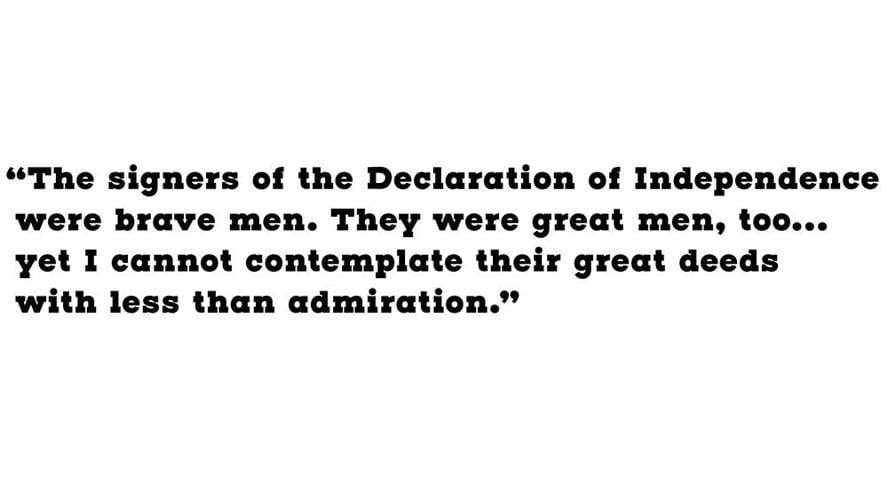
“I am not wanting in respect for the fathers of this republic,” he said. “The signers of the Declaration of Independence were brave men. They were great men, too, great enough to give frame to a great age… The point from which I am compelled to view them is not, certainly, the most favorable; and yet I cannot contemplate their great deeds with less than admiration.”
AMERICA’S PREFERENCE for a mythologized version of its past is not a recent development.
A minister with a flair for writing, Mason Weems, invented the story of a young George Washington chopping down his father’s cherry tree. But his biography – The Life of Washington, published in 1800 – proved so popular that the tall tale made it to the American vernacular.
The notion of a contrite pre-teen Father of Our Country, ax in hand, saying “I cannot tell a lie,” is a harmless lark. But false narratives can have a detrimental effect not only on our grasp of history, but also on beliefs that guide decision-making on state and national levels. For example, statements in support of a small central government are most often attributed to Jefferson, although “That government is best which governs least” is actually cited in Henry David Thoreau’s 1849 essay Civil Disobedience, in which he asserts that an individual’s assumptions of right and wrong should guide behavior, rather than legislation. Thoreau objected to slavery and was jailed briefly for refusing to pay taxes that might help fund the war with Mexico, which he saw as imperialistic in nature.
There are many who follow this thread, believing that reducing government’s reach and spending is beneficial for both individual liberty and the economy, and there are points to be made toward that idea. The conservative-leaning Hoover Institution credits deregulation and lower taxes for the boom that started in 1982 and lasted, by its count, about 15 years. The author of that analysis, Martin Anderson, calls it “the greatest economic boom in history.”
A bit of hyperbole there. Recall that American prosperity soared from 1940 to 1970, a much longer span. Economic expansion was sparked by government spending – war production, to begin with, followed by the construction of interstate highways and the aerospace program – and fueled by consumer clout. And keep in mind that during this rising tide, labor unions were strong and the gap between executive pay and worker salaries was quite narrow. According to the Economic Policy Institute, CEOs received 281 times more than a typical employee in 2024. In 1965, the difference was 21 percent.
Of course, there are dips, even in periods of growth, and many factors influence economies. There were also notable disparities. For one, wealth tended to flow more readily to the white male workforce. That was changing during the 1980s “long boom.” And the punishing 70-percent top tax rate remained in place until the early ’80s.
LIKE THE ECONOMY, HISTORY IS COMPLICATED – AND BUMPY. Over time, we have come to terms with some aspects of the nation’s past. The racist impulse that led to the burning of a Chinese fishing village in Pacific Grove in 1906 has perhaps slackened. We acknowledge the displacement or massacre of native peoples. Indeed, an effort to return land ownership to Indigenous people is well-funded in Monterey County.

White men try to pull a Black man from a bus during the 1943 Detroit race riot. Almost 35 people died and 675 were injured. More than 3,000 troops were sent to the city to quell the violence.
This is what progress looks like, but it requires effort. Kelseyville, California is a Lake County town named in honor of an early settler who so brutalized the Pomo residents that a group of Pomo men determined to settle the matter, killing Andrew Kelsey and another abusive rancher. In response, U.S. Army troops swept in and slaughtered much of the area’s Pomo population. Until 2006, Kelseyville’s high school athletics mascot was the Indians.
Lake County resident Clayton Duncan, a Pomo elder, successfully campaigned for the school to drop the mascot (now the Knights). He continues in efforts to address the town’s name. Given the attitude of Catholic missions in the 18th and 19th centuries toward native peoples of Monterey County, a similar effort was made in 2021 to drop Carmel High School’s mascot, the Padres. It failed.
America’s historic landscape is sometimes one of pendulum swings – progressive activists seeking reform, resistant activists pushing back, eventually resulting in change.
The labor reform movement that began in the late 1800s and continued through the 1930s was met with violent crackdowns against unions. The alliance of big business and big labor forged during World War II was a launchpad to prosperity.
We elevate Rosie the Riveter to a patriotic icon. But women in this country had limited rights to labor and property, fought for 72 years following the 1848 Seneca Falls Convention to earn the right to vote. In the aftermath of World War II, television sitcoms once again glamorized the domestic ideal. On the verge of an Equal Rights Amendment in the 1970s, conservative activist Phyllis Schlafly became a successful voice against ratification.
The “woke” concept, which raises awareness of racial discrimination and social justice, would seem unlikely to meet opposition. But the conservative Independent Institute cites it as “a cruel and dangerous cult.”
From the beginning, Americans have held diverse ideas about the nation and its course. The Declaration of Independence was the result of compromise, with dozens of edits and the elimination of chunks of text. In a postwar letter, Adams estimated that no more than two-thirds of the people had been committed to the Revolution. Loyalist militia units joined the Redcoats in the fight against independence.
It was the same with the Constitution just over a decade later. In his closing statement, Franklin urged delegates to approve the document, with commentary that sums up we, the people, asserting a reality Trump and others would wish to avoid: “When you assemble a number of men to have the advantage of their joint wisdom, you inevitably assemble with those men all their prejudices, their passions, their errors of opinion, their local interests and their selfish views. From such an assembly, can a perfect production be expected?”
Franklin gave his assent to the Constitution because, he said, “I expect no better, and because I am not sure that it is not the best.” He then asked delegates to join him and, “On this occasion doubt a little of [your] own infallibility.”
True achievement and greatness come from this. One only needs to read American history to find imperfect people taking a stand and, through division, making the nation a better place. It’s not hard to list flawed heroes, their innovations or to chart the jagged, crooked course from July 4, 1776 to July 4, 2026.
As a people, Americans have overcome much. But as we all should understand, there is more to accomplish. Whitewashing past evils and human shortcomings makes the leaders and activists of our time look poor by comparison. No wonder so many people believe greatness was in America’s past.
SHORTLY AFTER TRUMP ISSUED EXECUTIVE ORDER 14253, an employee removed the profile of abolitionist hero Harriet Tubman, who escaped slavery, from the National Park Service website. People took notice and were outraged, causing the park service officials to restore Tubman to her rightful place.
Two-hundred and fifty years on, the pendulum continues to swing. But facts are still stubborn things. 🗽
(1) comment
Dave Faries's article "Divided We Stand" was interesting and for the most part factual, but was ceertainly interjected with personal opinions. One fact that was completely omitted in the article is the fact that this nation was formed under Judeo/Christian principles. In such a lengthy discussion that included our value system how could that fact be ignored? The other obvious take is that Mr.Faries suffers from TDS. His interpretation of President Trump's remarks are very debatable. Those remarks were purely opinion, not fact.
Welcome to the discussion.
Log In
Keep it Clean. Please avoid obscene, vulgar, lewd, racist or sexually-oriented language.
PLEASE TURN OFF YOUR CAPS LOCK.
Don't Threaten. Threats of harming another person will not be tolerated.
Be Truthful. Don't knowingly lie about anyone or anything.
Be Nice. No racism, sexism or any sort of -ism that is degrading to another person.
Be Proactive. Use the 'Report' link on each comment to let us know of abusive posts.
Share with Us. We'd love to hear eyewitness accounts, the history behind an article.