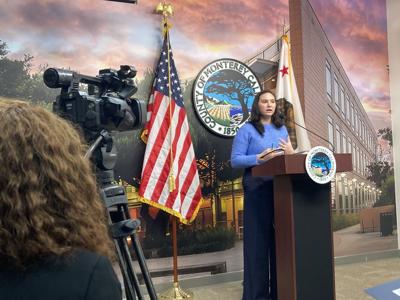

Sara Rubin here, thinking about the relativity of time. For example: Is recovery in Pajaro moving fast, or slow? The answers vary widely depending on your perspective.
I joined my colleagues Celia Jiménez and Katie Rodriguez today, along with other members of the Monterey County press corps, to attend a press conference hosted by the County of Monterey for an annual progress report on Pajaro flood relief projects. The state gave an unprecedented $20 million to the County of Monterey to spend for Pajaro’s post-flood recovery. The County undertook an unprecedented process of holding community meetings, engaging one-on-one with residents and gathering feedback on how to spend the money. That process culminated with a proposal one year ago to the County Board of Supervisors, which approved a plan for allocating the $20 million to support the goal of helping the community recover for the long term, instead of going back to feeling forgotten, only to wait for the next disaster.
Jiménez reviewed the progress report in advance, for a news story that appears in tomorrow’s print edition of the Weekly. New information announced today included a list of the 22 nonprofit recipients of nearly $2 million in grant funds, distributed via the Community Foundation for Monterey County.
The legislation requires that funds be expended by Dec. 31, 2025 which means there is one year to go. That might mean you’d expect about half of the funds to be spent already. But only $2.6 million so far in direct aid has been distributed out of $10 million. (The County divvied up the $20 million for various purposes. Roughly speaking, half goes toward direct aid—payments to residents and business owners to cover losses—and half toward county projects, like park and library improvements, and new gear such as a high-water rescue vehicle, for the North County Fire Protection District.)
Some of what Jiménez heard in her reporting is that distribution of money feels slow. She spoke to Maria Colin Paniagua, owner of the restaurant Mi Rancho, who says she’s had a variety of conversations regarding eligibility, but no money as of yet. “Two years have passed,” she said, “and nothing.”
That’s one perspective. From the perspective of County and nonprofit officials managing the relief program, progress is moving at a steady clip, even faster than predicted.
“It is important to acknowledge that relief cannot come fast enough for a disaster victim,” Kelsey Scanlon, director of Monterey County’s Department of Emergency Management, said today. “I fully feel and empathize with that. The money was absolutely needed yesterday, and the year before that and five years before that—I don’t want to diminish that experience.”
But—and there are some buts—there are requirements to fulfill. For one thing, the County and nonprofit agencies that are distributing direct relief money (Catholic Charities and Community Bridges) must verify losses. In a largely cash-based community, that can be a challenge; if your truck flooded with the title in it, and you have no receipt…the list of scenarios is long and each is unique. That uniqueness is part of the design of this program. Ray Cancino, CEO of Community Bridges, says residents of second-floor apartments may qualify for less cash aid than first-floor apartments due to the nature of flooding; it’s more complicated than just giving each household a standard check, but hopefully more fair.
Direct aid, of course, is also only one way to measure progress, and the $20 million will be out the door within a year because it must. The longer timeline is perhaps the more crucial timeline: When will residents feel like they have what they need?
“People in Pajaro have historically felt that they have been neglected,” said County Supervisor Glenn Church, who represents North County. “We can look at this and say, ‘This is not really so now.’ What is happening now is not just a recovery from the floods of March 2023. Pajaro will be coming back in a stronger position than it was.”
There is no legislated deadline for that, but progress, finally, has begun.


(1) comment
It appears that the levee reconstruction project, to prevent future flooding, will also take a while to complete: https://www.ktvu.com/news/massive-levee-project-protect-pajaro-watsonville-gets-underway I'm not certain that preventing foods every 100 years is even adequate, as we can easily get such flooding in the next few years, and we'll be starting over again.
Welcome to the discussion.
Log In
Keep it Clean. Please avoid obscene, vulgar, lewd, racist or sexually-oriented language.
PLEASE TURN OFF YOUR CAPS LOCK.
Don't Threaten. Threats of harming another person will not be tolerated.
Be Truthful. Don't knowingly lie about anyone or anything.
Be Nice. No racism, sexism or any sort of -ism that is degrading to another person.
Be Proactive. Use the 'Report' link on each comment to let us know of abusive posts.
Share with Us. We'd love to hear eyewitness accounts, the history behind an article.