
Katie Rodriguez here. If you’ve visited a beach in the last 24 hours or so, you may have noticed that there is a lot more, or a lot less, beach to walk on.
Yesterday morning at Carmel State Beach, the coastline had almost entirely disappeared. A walk on the beach meant wading through shallow pools of water, foamy from ocean waves and backsplash from the cliff sides.
‘Tis the season, I thought.
King Tides are here—the most extreme tides of the year, when our sandy beaches are either swallowed or exposed in extraordinary amounts. They are happening right now through the weekend, and again Dec. 13-15. Watch for low tides, as it’ll be an excellent time for beach walks by the tide pools. (See tide chart below.)
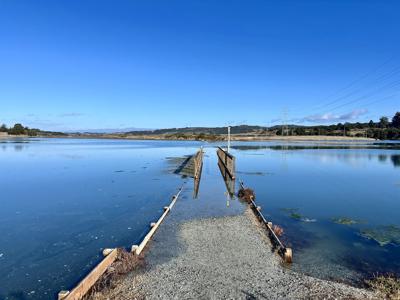
Tides happen every day; there are two high tides and two low tides. High tides hover around 5 feet or so. But this morning at 9:35am, I went to see the King Tide at peak high tide during a tour at Elkhorn Slough, where the high tide was at a whopping 6.4 feet. At around 4:15pm today, the tide will have dropped to a -1.1-foot low tide.
“On an average day, Monterey Bay sees an average tidal range of 5.34 feet between the higher of the two high tides and the lower of the two low tides,” says Beth Scrutton, Elkhorn Slough’s Volunteer Program and Community Engagement Coordinator. “Today in the slough we experienced a range of about 7.3 feet.”
Within an hour and a half of watching Elkhorn Slough, we watched a bridge emerge from beneath the water, marsh flats become exposed, and a car drive along a railroad track so shallow it appeared to float on water, checking whether it was safe for the train to cross.
King Tides occur when the Earth, moon and sun align, and the moon is at its closest point to Earth in its orbit. The gravitational pull from both the moon and sun causes the oceans to bulge, creating our most dramatic tides of the year.
For us here in Monterey County, these typically happen in the winter, though less extreme but still dramatic tides can also happen in the late spring. These tides happen all over the world at varying times during the year, depending on when the moon is closest to where they are on Earth.
Many of you might be aware of the California King Tides Project—a pretty amazing initiative that invites anyone witnessing the ebb and flow of King Tides along the coast to share their photos. These images contribute to a project that helps researchers visualize sea level rise by documenting the highest tides of the year.
You can find out how to participate and upload your photos from this weekend here.
“What King Tides do is give us a preview of what the average tides will look like with sea level rise,” Scrutton says.
This weekend, you can experience this preview at Elkhorn Slough, where naturalists are leading hikes for anyone interested in learning more about King Tides. Reserve your spot here.


(0) comments
Welcome to the discussion.
Log In
Keep it Clean. Please avoid obscene, vulgar, lewd, racist or sexually-oriented language.
PLEASE TURN OFF YOUR CAPS LOCK.
Don't Threaten. Threats of harming another person will not be tolerated.
Be Truthful. Don't knowingly lie about anyone or anything.
Be Nice. No racism, sexism or any sort of -ism that is degrading to another person.
Be Proactive. Use the 'Report' link on each comment to let us know of abusive posts.
Share with Us. We'd love to hear eyewitness accounts, the history behind an article.