
Katie Rodriguez here, thinking about how cool it is when you can save money and do good by the environment. Sometimes, that’s incorporating natural systems back into the environments we’ve changed through the use of chemical shortcuts.
Many of you have probably read about or seen images of the mangy bobcats roaming around Carmel Valley. Or perhaps you’ve heard about the blue flesh discovered in wild pigs roaming Monterey County’s agricultural lands.
Rodenticides are the common thread here, a common way for people to keep their rat problems at bay. While effective in the short run, the use of these poisons externalizes costs on our natural environments by inadvertently poisoning the animals that prey on rodents.
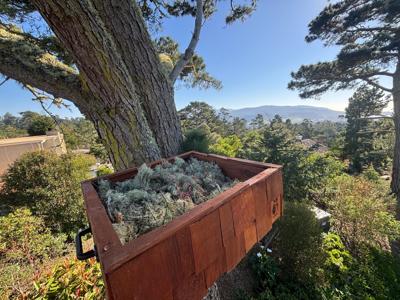
The other day, an email from a group called Carmel Owls popped up in my inbox underscoring these threats, sharing a way in which they’re utilizing boxes to help attract great horned owls to neighborhoods so they can feed on rats. The hope, of course, is to encourage people to drop their use of rodenticides.
I spoke with Paul Falworth, the founder of the organization, which is only a few months old. He explained that, with the help of seven volunteers, they’ve installed six great horned owl boxes across Carmel, with plans to install more throughout Carmel Valley and the Monterey Peninsula.
“Everyone has rats, a lot of people don’t talk about it though, until we bring it up,” Falworth says. “By putting up these platforms spaced out territorially, it allows them to nest and predate, especially if they're mating with fledglings, they’ll eat up to seven rodents a night.”
The group installs the boxes for free, fielding applications from homeowners and analyzing them for one important factor they see as most critical: whether or not there is a tall tree on the property.
Great horned owls are different from barn owls—the latter often prefer to nest in meadows, fields and vineyards, in places lower to the ground than great horned owls, who prefer to be higher up, often in forests.
Carmel Owls and volunteers worked to install platforms, renting a cherry picker to get high up in the tree—at least 35 feet, or “taller than a telephone pole,” Falworth says. The hope is that in the next year, they’ll see the owls show up and take root, using these designated platform boxes as their new nesting areas.
What will happen to owls that set up shop there who may likely feed on poisoned rats? Falworth replied that this is a real possibility. This will be something of a real-world test case that will hopefully influence community behavior and encourage people to steer clear of rodenticides, the outcome of which we’ll see in the following year.
“[There] is a healthy forest, and people are spending $125 a week for exterminators, or we hear certainly on Nextdoor, putting poisons out that aren’t very good, because you get the accidental killings of cats and raptors and bobcats,” he says.


(0) comments
Welcome to the discussion.
Log In
Keep it Clean. Please avoid obscene, vulgar, lewd, racist or sexually-oriented language.
PLEASE TURN OFF YOUR CAPS LOCK.
Don't Threaten. Threats of harming another person will not be tolerated.
Be Truthful. Don't knowingly lie about anyone or anything.
Be Nice. No racism, sexism or any sort of -ism that is degrading to another person.
Be Proactive. Use the 'Report' link on each comment to let us know of abusive posts.
Share with Us. We'd love to hear eyewitness accounts, the history behind an article.